[생산관리] 컨베이어 벨트 방식과 셀 라인 방식[Production Management] Conveyor Line vs. Cell Line
FREEWAYFREEWAY·2026년 7월 29일July 29, 2026·5분 읽기5 min read
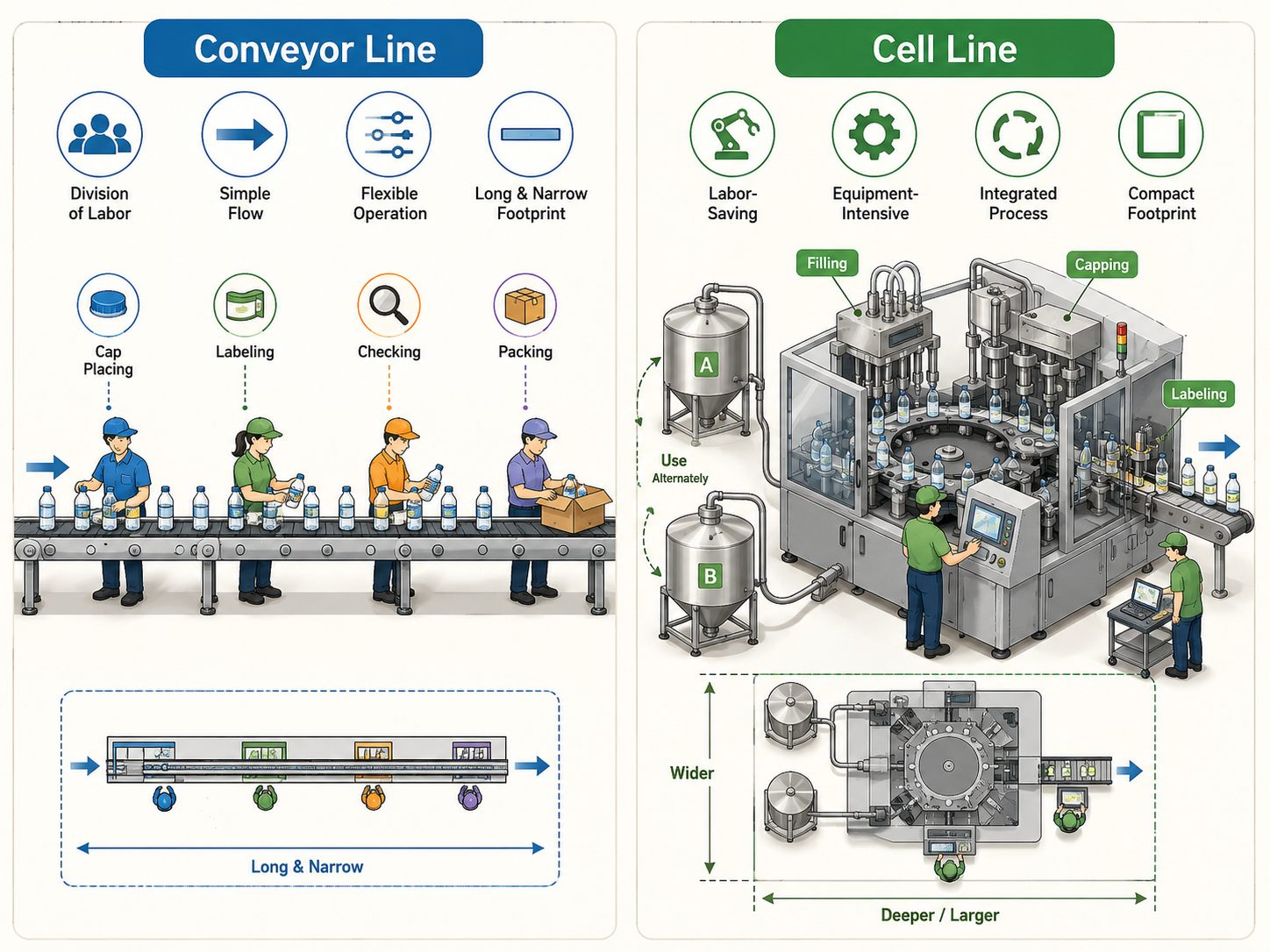
제조 현장의 대표적인 두 가지 생산 방식이 있다.
컨베이어 벨트 방식 (Conveyor Line)
벨트가 계속 돌며 제품을 다음 작업자에게 전달한다. 한 작업자가 정해진 짧은 공정만 반복 수행하는 전통적인 분업 생산 방식이다. 찰리 채플린의 공장 영화나 영국 산업혁명 다큐멘터리에서 많이 봤을 그 방식이다.
구조가 단순하고 유연성이 좋아 현장에서 가장 널리 쓰인다. 가로로 긴 면적을 차지하지만 세로 면적은 크지 않다.
셀 라인 방식 (Cell Line)
자동화 기기 장치의 비중이 컨베이어 방식보다 훨씬 높으며, 1~2명의 작업자가 한 자리에서 전 공정을 소화하는 방식이다. 장비 가격이 높은 대신 공정에 투입되는 인원을 줄일 수 있다. 소량보다는 대량 생산에 유리하고, 가로세로 모두 큰 면적을 차지한다. 일반 모터 대신 서보모터 등이 사용된다.
셀 라인에서 시간이 가장 많이 소요되는 것은 장비 셋팅 시간과 세척 시간이다. 세척 시간을 줄이려면 내용물(벌크)이 담기는 통의 스페어를 준비해 번갈아 쓰는 방법을 쓴다. 한 통을 쓰는 동안 다른 통을 세척하면 라인 정지 시간을 크게 줄일 수 있다.
화장품 생산에서의 실제 경험
셀 라인이 다품종 소량 생산에 유리하다는 말이 있다. 그런데 화장품 생산 현장에서 직접 경험해본 결론은 전혀 그렇지 않다.
화장품은 제품마다 용기 규격, 충전량, 캡 방식이 다르다. 셀 라인의 각 자동화 구간은 제품 규격에 맞게 셋팅해야 하는데, 이 셋팅 시간이 컨베이어 방식보다 훨씬 오래 걸린다. 품목이 바뀔 때마다 반복된다.
화장품 쪽에서는 컨베이어 벨트 방식이 다품종 소량 생산에 절대적으로 유리하다.
벨트 속도를 몰래 올렸던 이야기
예전에 포장실에서 컨베이어 벨트 속도를 아주 조금씩, 작업자들이 인지하지 못할 만큼 점진적으로 올린 적이 있다. 뜨거운 물에 개구리를 천천히 넣는 것처럼.
결과는 효과가 있었다. 생각보다 빠르게 셋트 포장 작업을 마쳤다. 벨트가 빨라지면 생산 속도도 어느 정도까지는 따라 올라간다.
하지만 이건 정말 특별히 시간이 없을 때만 쓸 수 있는 방법이다. 평소에는 절대 써서는 안 된다.
왜냐하면 품질에서 좋은 것도 나쁜 것도 아닌 일정한 것이 최선이기 때문이다. 속도가 올라가면 작업자의 동작이 빨라지고, 빨라진 동작은 미세한 오차를 만든다. 오차가 쌓이면 품질이 들쭉날쭉해진다. 생산 현장에서 변동(variation)을 줄이는 것이 품질의 핵심이다.
There are two main production line methods you'll find on a manufacturing floor.
Conveyor Line
A belt moves continuously, carrying the product from one operator to the next. Each operator performs only their assigned step — short, repetitive, specialized. It's the classic division-of-labor model that anyone who has seen Charlie Chaplin's Modern Times or a documentary about the Industrial Revolution will recognize.
The structure is simple and highly flexible, which is why it remains the most common setup on production floors. It takes up a long horizontal footprint but doesn't require much depth.
Cell Line
A cell line relies far more heavily on automated equipment. One or two operators handle the entire process from a single station. The equipment cost is significantly higher than a conveyor setup, but fewer people are needed per production run. It favors large-volume production over small batches and occupies a large footprint in both directions. Servo motors and precision actuators replace standard motors.
The biggest time consumers on a cell line are equipment setup and cleaning. One way to reduce cleaning downtime: prepare spare tanks for the bulk content. While one tank is in use, the other is being cleaned. Swapping them back and forth keeps the line moving.
Real experience in cosmetics production
It's often said that cell lines are better suited for high-mix, low-volume production. Based on direct experience in cosmetics manufacturing, the opposite is true.
In cosmetics, every product has different container dimensions, fill weights, and cap types. Each automated station on a cell line has to be reconfigured to match the product spec — and that reconfiguration takes significantly longer than the equivalent changeover on a conveyor line. It repeats every time the product changes.
In cosmetics production, the conveyor line is overwhelmingly better for high-mix, low-volume work.
The time I quietly sped up the belt
I once gradually increased the conveyor speed in the packaging room — so slowly that the operators didn't notice. Like the old story of a frog that doesn't react to water heating up degree by degree.
It worked. The set packaging run finished faster than expected. Up to a point, belt speed and production speed move together.
But this is something you can only justify when you're truly out of time. Under normal circumstances, never do it.
The reason: in quality, consistent is better than good or bad. When the belt speeds up, operators move faster, and faster movement introduces small errors. Those errors accumulate, and the result is inconsistent output. Reducing variation is the foundation of quality in manufacturing — and deliberately introducing it is never the right answer in ordinary conditions.
댓글Comments