단위 변환 Unit converter
길이, 무게, 부피, 온도 같은 자주 쓰는 단위를 바로 변환합니다. 더 많은 항목과 드물게 쓰는 단위는 「전체」 모드에서 볼 수 있습니다. 비중(SG) 탭에서는 부피(㎖, ℓ)를 무게(g, ㎏)로 환산할 수 있습니다. Convert everyday units for length, mass, volume, and temperature. Switch to "Full" for more categories and rare units. The specific gravity (SG) tab converts volume (㎖, ℓ) to mass (g, ㎏).
—
질량 ≈ 부피×비중 (물 20 °C 기준 근사). 1 ㎖ × SG ≈ g, 1 ℓ × SG ≈ ㎏. Mass ≈ volume × SG (approx. water at 20 °C). 1 ㎖ × SG ≈ g, 1 ℓ × SG ≈ ㎏.
단위 변환, 미터법이 걸어온 길 Unit conversion and the story of the metric system
이 페이지는 길이·무게·부피·온도·면적 같은 일상 단위를 서로 바꿔 주는 변환기입니다. 비중(SG) 탭에서는 액체의 부피를 무게로 환산할 수도 있습니다. 값을 입력하면 즉시 계산되고, 계정이나 설치는 필요 없습니다.
사용법
- 변환할 항목(길이, 무게, 온도 등)을 고르고 값을 입력하면 나머지 단위로 바로 계산됩니다.
- 비중 탭에서는 액체의 mL·L에 비중을 곱해 g·kg으로 바꿔 줍니다. 요리나 실험에서 저울 없이 무게를 어림할 때 편리합니다.
미터법의 유래
미터법은 프랑스 혁명 직후인 1790년대에 "모든 시대, 모든 사람을 위하여"라는 구호와 함께 태어났습니다. 당시 유럽은 마을마다 자·되의 크기가 달라 상거래 분쟁이 끊이지 않았고, 프랑스는 누구의 것도 아닌 기준 — 지구 그 자체 — 를 택했습니다. 1미터는 원래 북극에서 적도까지 거리의 1,000만분의 1로 정의됐습니다. 1875년 17개국이 미터협약을 맺으며 국제 표준이 됐고, 2019년부터는 킬로그램까지 포함한 모든 단위가 금고 속 원기(原器)가 아니라 빛의 속도 같은 변하지 않는 물리 상수로 다시 정의됐습니다.
왜 아직 인치와 파운드가 남아 있을까
미터법을 공식 채택하지 않은 나라는 이제 미국·라이베리아·미얀마 정도지만, 항공(피트)·모니터(인치)처럼 관습으로 남은 분야도 많습니다. 단위 혼동은 웃어넘길 일이 아닙니다. 1999년 NASA의 화성 기후 궤도선은 한 팀은 미터법, 다른 팀은 야드파운드법으로 계산한 탓에 1억 달러가 넘는 탐사선이 화성 대기에서 소실됐습니다. 단위 변환기가 필요한 이유를 이보다 잘 보여 주는 사건은 없습니다.
비중(SG)의 유래 — 유레카
과학·공학에서 비중은 어떤 물질의 밀도를 기준 물질의 밀도로 나눈 비율입니다. 고체·액체는 4 °C의 순수한 물(1.0 g/cm³)을, 기체는 0 °C·1기압의 공기를 기준으로 삼습니다. 밀도를 밀도로 나눈 값이라 단위가 사라진 무차원수죠 — 그래서 어느 단위계에서나 같은 숫자로 통합니다.
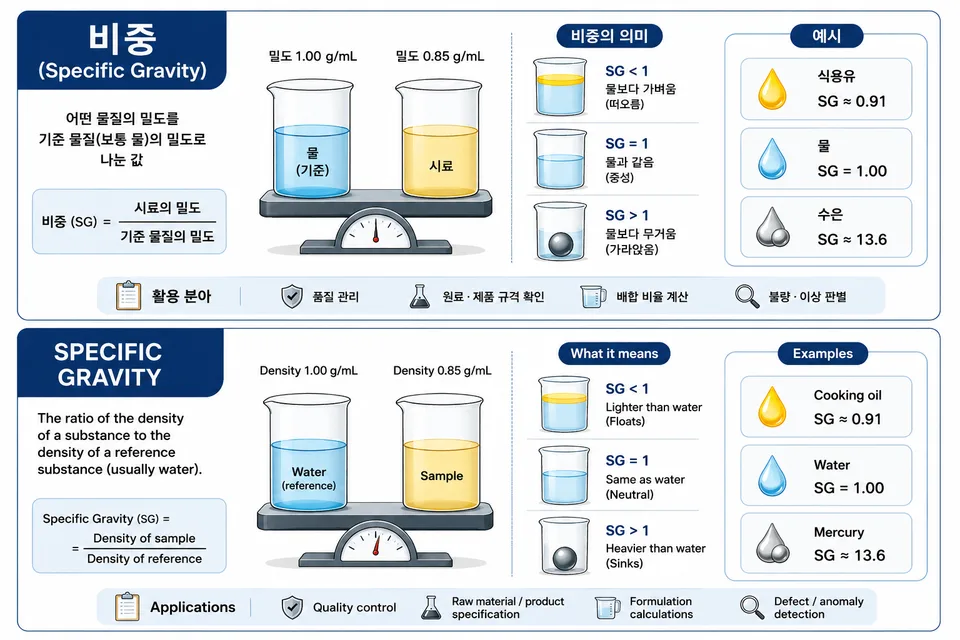
기원은 기원전 3세기로 거슬러 갑니다. 시라쿠사의 왕이 아르키메데스에게 새 왕관이 순금인지 알아내라고 명했고, 목욕탕에서 넘치는 물을 본 그가 "유레카!"를 외친 순간이 바로 이 방법의 발견이었습니다 — 물체를 물에 담가 무게와 밀어낸 부피의 비율, 곧 비중을 재는 것. 은을 섞은 왕관은 같은 무게의 순금보다 부피가 커서 물을 더 많이 밀어냈고, 세공사의 속임수는 들통났습니다.
판단 기준도 간단합니다. 비중이 1보다 크면 물에 가라앉고, 1보다 작으면 뜹니다. 철(7.85)은 가라앉고 식용유(약 0.91)는 물 위에 뜨는 이유죠. 양조장은 발효 전후의 비중 변화로 알코올 도수를 계산하고, 정비소는 배터리 전해액의 비중으로 충전 상태를 확인합니다. 이 페이지의 비중 탭이 부피×비중으로 무게를 어림하는 것도 같은 원리입니다 — 물 1 ℓ가 1 ㎏이니, 비중 0.79인 에탄올 1 ℓ는 약 0.79 ㎏입니다.
이런 때 쓰기 좋습니다
- 해외 직구: 인치·파운드·온스로 적힌 옷·신발·식품 규격을 cm·kg·g으로 확인합니다.
- 요리: 해외 레시피의 온스·파운드를 g으로, 화씨 오븐 온도를 섭씨로 바꿉니다.
- 운동·여행: 마일을 km로, 해외 일기예보의 화씨를 섭씨로 읽습니다.
- 업무·실험: 비중 환산으로 용액·원료의 부피를 무게로 빠르게 어림합니다.
입력한 값은 브라우저 안에서만 계산되며 서버로 전송되지 않습니다. 비중 환산은 물 20 °C 기준 근사값이므로 정밀한 작업에는 실측값을 사용하세요.
This converter handles everyday units—length, mass, volume, temperature, area—and a specific-gravity tab that turns liquid volume into weight. Type a value and the result appears instantly; no account needed.
How to use
- Pick a category, enter a value, and read the converted results.
- The SG tab multiplies mL or L by specific gravity to estimate grams or kilograms—handy in the kitchen or the lab when a scale isn't around.
Where the metric system comes from
The metric system was born in 1790s revolutionary France under the motto "for all times, for all peoples." With every town using different rules and measures, France chose a standard that belonged to no one: the Earth itself. One meter was defined as one ten-millionth of the distance from the North Pole to the equator. Seventeen nations signed the Metre Convention in 1875, and since 2019 every unit—including the kilogram—has been defined by unchanging physical constants rather than artifacts in a vault.
Why inches and pounds survive
Only the US, Liberia, and Myanmar never officially adopted metric, though feet in aviation and inches for screens live on by custom. Mixing systems is no joke: in 1999, NASA's Mars Climate Orbiter—a mission worth over $100 million—was lost because one team calculated in metric and another in imperial. There is no better argument for a unit converter.
Specific gravity — the Eureka number
In science and engineering, specific gravity is the ratio of a substance's density to that of a reference substance: pure water at 4 °C (1.0 g/cm³) for solids and liquids, air at 0 °C and 1 atm for gases. Dividing density by density cancels the units, leaving a dimensionless number — the same figure in any measurement system.
The idea dates to the 3rd century BC, when the king of Syracuse asked Archimedes to prove whether his new crown was pure gold. The bathtub moment that made him shout "Eureka!" was precisely this discovery: submerge an object and compare its weight to the water it displaces. A silver-alloyed crown is bulkier than pure gold of the same weight, so it displaced more water — and the goldsmith's fraud was exposed.
The rule of thumb is simple: above 1 sinks, below 1 floats. Iron (7.85) goes down; cooking oil (≈0.91) sits on top of water. Brewers read alcohol content from the SG drop during fermentation, and mechanics judge battery charge by electrolyte SG. The SG tab here works on the same principle: 1 ℓ of water weighs 1 ㎏, so 1 ℓ of ethanol at SG 0.79 weighs about 0.79 ㎏.
Good uses
- Overseas shopping: turn inches, pounds, and ounces into cm, kg, and g.
- Cooking: convert recipe ounces to grams and Fahrenheit oven settings to Celsius.
- Fitness and travel: miles to kilometers, forecast °F to °C.
- Work and labs: estimate solution weight from volume with specific gravity.
Values are computed entirely in your browser and never uploaded. SG conversion approximates water at 20 °C—use measured values for precision work.