[생산관리] 생산계획의 큰 그림: MRP부터 JIT, TPM, ERP까지[Production Management] The Big Picture of Production Planning: From MRP to JIT, TPM, and ERP
FREEWAYFREEWAY·2026년 8월 5일August 5, 2026·14분 읽기14 min read
지금까지는 라인 안에서의 생산성·낭비·표준시간처럼 "현장 레벨"의 이야기를 다뤘다면, 이번엔 한 단계 위로 올라가서 생산 시스템 전체를 어떻게 계획하고 통제하는가를 정리해봤습니다. MRP, OPT, JIT 같은 생산방식 비교부터 TPM, CIM, ERP까지 훑어보는 내용입니다.
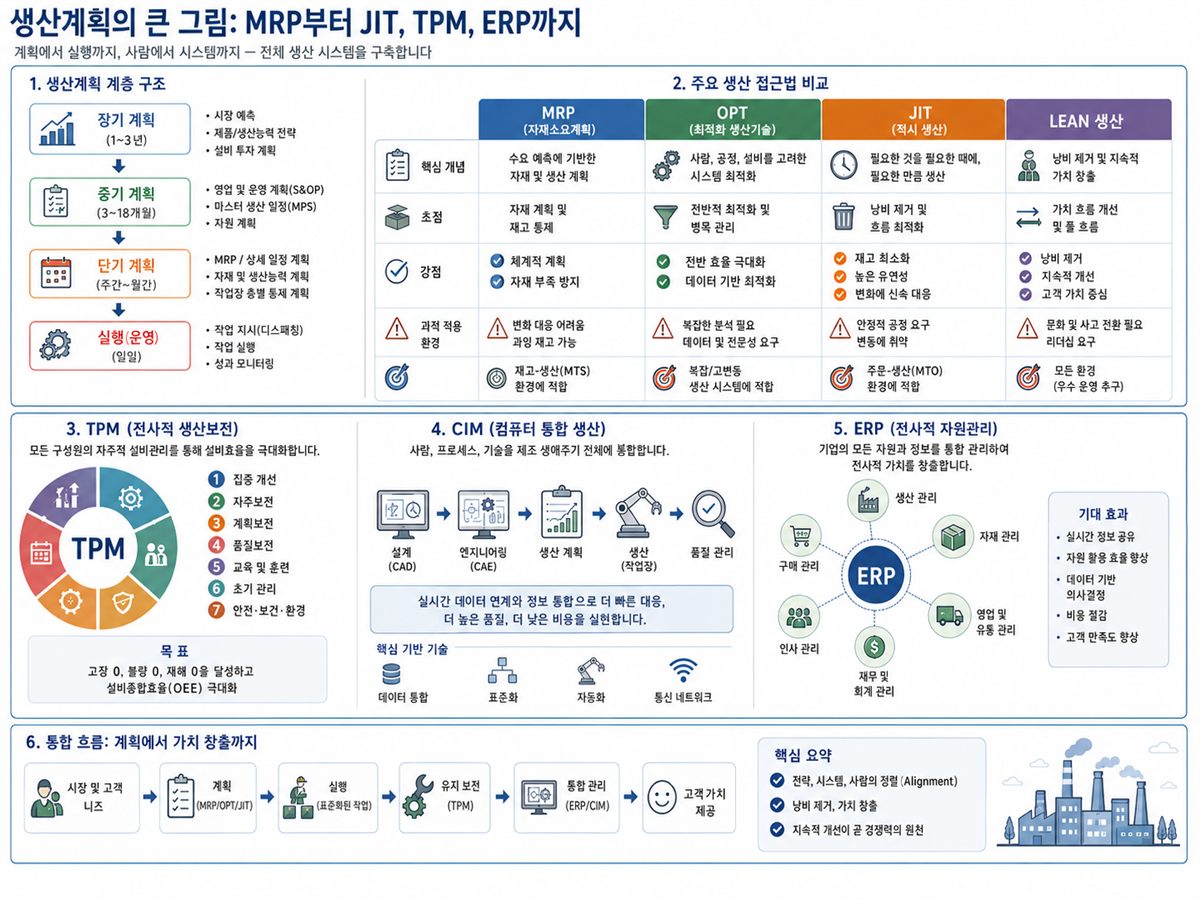
생산계획은 계층 구조로 되어 있다
생산계획은 시간 관점에서 보면 위에서 아래로 이렇게 내려갑니다.
총괄생산계획 (장기) — LP/IP 기법
    ↓
기본생산계획 (중기) — 각종 OR 기법과 휴리스틱
    ↓
자재소요계획/용량계획 (단기) — 순방향/역방향 스케줄링
    ↓
작업일정계획 (세부 스케줄링) — OR 기법, AI, 디스패칭
제품 관점에서 봐도 비슷한 계층이 있습니다. 총괄생산계획에서는 "중형차, 소형차" 정도의 타입으로 뭉뚱그려 전체 시스템을 고려하고, 그 아래로 내려가면서 "소나타, 엑셀" 같은 제품군 단위로, 최종적으로는 "소나타 1.8, 2.0, 2.5" 같은 개별 제품(아이템) 단위로 점점 상세해지는 구조입니다. 위쪽 계획은 큰 그림을, 아래쪽 계획은 실제 라인·장비 수준의 디테일을 담당한다고 보면 됩니다.
계획생산 vs 주문생산
생산 방식을 결정하는 기본 갈림길입니다.
계획생산방식: 고객 주문을 비교적 정확히 예측할 수 있을 때 씁니다. 최종제품 재고량으로 생산을 통제하고, 생산량을 평준화하며, 운용비를 줄이기 위해 적절한 로트 크기를 정하는 게 핵심입니다.
주문생산방식: 주문 예측이 어렵고 일회성이 강한 경우에 씁니다. 고객 서비스 만족도가 중요해지고, 생산 조달기간과 재공재고(작업 중인 재고)를 최대한 줄이는 게 관건입니다.
MRP (자재소요계획)
MRP의 기본 구조
MRP는 세 가지 입력자료를 받습니다.
단위 기간당 계획된 생산량 (기본생산계획, MPS)
BOM (Bill of Materials, 자재명세서)
현재 재고 수준과 리드타임
절차는 이렇습니다.
MPS와 BOM으로 총소요량을 계산한다
현재 재고 상태를 참조해서 순소요량을 계산한다
리드타임과 로트 정책에 따라 주문을 확정한다 (로트 정책 예시: L4L, 주문량 고정, 주문기간 고정, 수리적 접근 등)
여기서 중요한 전제 두 가지가 있습니다: 생산능력은 무한대라고 가정하고, 리드타임은 미리 알려진 고정 상수로 취급한다는 것입니다. 이 두 가정이 나중에 MRP의 한계로 이어집니다.
MRP 순환과 한계
MRP는 생산계획 → 개략적 용량계획 → 기본생산계획 → MRP → 세부 용량계획 → (현장 실행) → 구매 순으로 순환하는 구조를 가집니다. 문제는 "고정된 리드타임"과 "무한한 기계용량"이라는 MRP의 가정 때문에, 실제로 실현 불가능한 계획이 나올 수 있다는 점입니다.
리드타임은 사실 준비시간·처리시간·운반시간·대기시간이 합쳐진 값인데, 이걸 미리 예측하기가 매우 어렵습니다. 그래서 MRP처럼 납기에서 거꾸로 계산하는 역방향 전개 방식과, 실제 생산 현장에서 가장 빠른 시작 시점부터 순서대로 배정하는 순방향 할당(CRP) 방식 사이에 괴리가 생기고, 이게 곧 MRP의 대표적인 결점으로 지적됩니다.
OPT (Optimized Production Technology)
핵심 원리
OPT는 "용량이 아니라 흐름의 균형을 맞춰야 한다"는 관점에서 출발합니다. 핵심 원칙들은 이렇습니다.
비병목공정의 가동률은 그 공정 자체의 능력이 아니라 시스템 내 다른 제약에 의해 결정되어야 한다
병목공정에서의 1시간 지체는 전체 시스템의 1시간 지체와 같다
반대로 비병목공정에서의 1시간 절약은 아무 의미가 없을 수 있다
병목공정이 시스템 전체의 생산성과 재고를 좌우한다
여기에 더해서:
운반 배치(batch)와 생산 배치의 크기는 다를 수 있고, 오히려 달라야 하는 경우가 많다
생산 배치 크기는 고정된 게 아니라 상황에 따라 바뀌어야 한다
일정계획은 모든 제약을 동시에 고려해서 만들어야 하며, 리드타임은 미리 정해지는 게 아니라 일정계획의 결과로 나와야 한다
실제 적용
OPT를 실제로 적용할 때는 병목공정을 중심으로 "치명적 네트워크"와 "비치명적 네트워크"를 구분하고, 운반 배치 크기가 전체 생산 흐름에 미치는 영향을 계산합니다. 생산 배치 크기를 결정할 때는 동적계획법(Dynamic Programming), 정수계획법(Integer Programming), 휴리스틱 기법 등을 활용합니다.
MRP가 "생산능력은 무한하다"고 가정한 것과 정반대로, OPT는 처음부터 병목이라는 제약을 중심에 놓고 계획을 짠다는 게 근본적인 차이입니다.
JIT (Just-In-Time) 생산방식
기본 취지
JIT는 공정 장애나 수요 변화에 유연하게 대응하기 위한 방식입니다. 자재 수급부터 완제품까지의 리드타임을 최대한 줄이고, 필요한 부품을 필요한 시기에만 생산해서 최소한의 재고만 유지하는 게 목표입니다. 재고량과 생산 리드타임을 정책적으로 관리해서, 그 수치를 계속 체크하며 장비와 인력의 낭비를 줄여나가는 방식입니다.
재고를 대하는 관점
JIT에서 재고를 바라보는 시각이 특이합니다. 흔히 재고를 "여러 문제가 물 밑에 잠겨 있는 걸 가려주는 물"에 비유합니다. 재고 수준을 낮추면 그동안 가려져 있던 문제점들(설비 고장, 품질 불량, 준비교체 지연 등)이 수면 위로 드러나게 되고, 그걸 하나씩 해결해 나가는 게 JIT의 개선 방식입니다.
JIT의 4대 원리
다음 공정에서의 회수: 선행공정이 만들어서 밀어내는(push) 게 아니라, 후행공정이 필요한 만큼 가져가는(pull) 방식
한 단위 생산, 한 단위 운반: 준비시간을 줄이고 생산방식을 개선해야만 가능한 원칙
생산의 평준화: 후속공정의 회수량이 들쭉날쭉하면 재고가 늘어나면서 JIT 자체가 무너짐
과잉생산으로 인한 낭비 제거: 재고는 여러 문제와 잘못을 만들어내는 근원으로 취급
간판(看板) 시스템
간판은 정보처리 비용을 줄이고, 현장 상황을 빠르고 정확하게 파악하며, 선행공정이 필요 이상으로 만드는 걸 막기 위해 쓰는 도구입니다.
인수간판: 후행공정이 선행공정에서 가져가야 할 수량을 표시
생산지시간판: 선행공정이 생산해야 할 수량을 표시
간판에는 간판 번호, 부품 번호, 사용 장소, 로트 크기가 표시됩니다. 이 개념은 앞서 다룬 "FULL WORK 제어" 방식과도 같은 맥락으로 이어집니다.
지도카(自働化)
"비정상적이거나 결함 있는 상황이 생기면 언제든 장비나 활동을 즉시 멈춰라"는 원칙입니다. 앞서 TPS 7대 낭비 글에서 다룬 자동화(自働化) 개념과 정확히 같은 이야기입니다. 이렇게 하면 필요 이상으로 만드는 걸 막고, 비정상 상황을 통제하기가 훨씬 쉬워집니다.
MRP, OPT, JIT 한눈에 비교
항목
MRP
JIT
OPT
생산능력 가정
무한
제한적
제한적
생산능력 통제 수단
—
간판 카드
애로 작업장(병목)
배치 크기
준비시간 보충 위해 크게
상대적으로 작게
작게(공정배치+이전배치)
리드타임
사전에 정해짐, 대체로 김
짧음
일정계획의 결과, MRP보다 짧음
불균형 통제 수단
안전재고
간판 카드
안전재고 + 상세 일정계획
데이터 정확성 요구
가장 높음
거의 불필요
MRP보다 낮아도 됨
신축성
낮음
가장 높음(소량 배치, 저재고)
MRP보다 높음
시스템 도입 난이도
기존 조직 재구성 필요
기존 조직 재구성 필요
기존 조직 재구성 불필요
통제 대상
생산능력
실물 자원의 흐름
자원의 흐름
운영비용
높음(정확한 데이터 요구)
낮음
MRP와 JIT의 중간
한 줄로 요약하면: MRP는 "무한 능력을 전제로 정교한 계산에 의존"하고, JIT는 "능력 제약을 인정하고 실물 흐름을 직접 통제"하며, OPT는 "병목이라는 제약 하나에 집중해서 그걸 중심으로 전체를 최적화"하는 접근입니다.
TPM (Total Productivity Management)
TPM은 현장에 남아 있는 낭비, 불량, 고장 등 최고 효율을 저해하는 모든 손실(loss)을 제거·개선하는 활동입니다. 특징은 두 방향이 동시에 진행된다는 점입니다.
Top-down: TPI적 기법으로 전사적 방향을 정하고 전개
Bottom-up: 개별 목표 달성을 위한 현장 개선 활동을 추진
이걸 통해 생산성의 극한까지 도전하는 게 목적입니다. 실무적으로는 보전 활동과 관련된 업무 전반 — 예방보전(PM) 정보관리, 일반 작업관리, 공정개선 관리, 점검관리, 예산관리, 설비정보, 예비부품(spare parts) 관리 등 — 을 포괄하는 시스템을 구축해서 관리자와 작업자 모두가 함께 쓰는 형태로 운영됩니다.
설비종합효율을 높이기 위해서는 설비 도입 초기 단계부터 유동관리와 MP(Maintenance Prevention) 정보를 활용하는 체계를 만들고, 설비의 신뢰성·보전성·안전성 관련 정보를 설계 단계부터 체계적으로 반영하는 게 중요합니다. 이렇게 하면 공사 기간 단축은 물론, 문제가 발생하는 지점이나 다루기 어려운 부분을 미리 찾아내 공사 품질 자체를 높일 수 있습니다.
3정 5S를 통한 TPM 추진
3정(定)이란
정위치: 각 물건을 어디에 둘지 미리 정해둔다. 장소 표시와 번지 표시로 구분한다.
정품: 정해진 위치에 정해진 물건이 놓여 있어야 한다. 품목 표시로 무엇인지 나타내고, 필요하면 표시를 떼거나 위치를 바꿀 수 있도록 간판의 기능을 유지한다.
정량: 정해진 위치에 정해진 물건이 정해진 수량만큼 있어야 한다. 적치장과 선반 크기를 제한하고, 최대·최소 재고량을 색깔(적색·황색)로 명확히 표시해서 한눈에 수량을 알 수 있게 한다.
5S란
정리: 필요한 것과 필요 없는 것을 구별해서, 필요 없는 것은 버린다
정돈: 필요한 것을 필요할 때 언제든 꺼내 쓸 수 있게 해둔다
청소: 먼지·쓰레기·더러움이 없는 상태로 만든다
청결: 직장을 먼지와 더러움 없는 상태로 계속 유지한다
습관화: 정해진 일을 올바르게 지키는 습관을 몸에 붙인다
3정과 5S는 같은 이야기를 다른 각도에서 하는 셈입니다. 3정이 "물건을 어디에, 무엇을, 얼마나 둘 것인가"를 정하는 규칙이라면, 5S는 그 규칙을 세우고 유지하는 행동 절차라고 볼 수 있습니다.
CIM (Computer Integrated Manufacturing)
CIM은 컴퓨터·통신 기술을 활용해서 마케팅, 개발·설계, 제조, 출하, 회수까지 기업 활동 전반의 효율과 비즈니스 속도를 높이는 걸 목표로 합니다.
개념: 생산·영업·기술·경영 기능을 네트워크로 통합해서 고객 만족도를 최대화하는 시장전략적 생산시스템입니다.
기대 효과는 크게 세 갈래입니다.
수주-설계-제조-판매 정보의 통합화
판매-물류-제조 정보의 통합화
기업 전략에 대한 정보 지원
실질적 효과로는 통합을 통한 경영 효율화, 비즈니스 속도 향상에 따른 기업 체질 강화, 글로벌 운영에 따른 해외 전략 강화가 꼽힙니다.
CIM은 이후 21세기형 멀티미디어 기업사회(기업 간 종이 없는 거래, 전자데이터 교환/전자상거래)로 이어지는 흐름 속에서, CE·AM·VC·EC 같은 관련 개념들과 함께 CALS(Continuous Acquisition and Life-cycle Support)라는 상위 개념으로 발전해갑니다. 이 흐름을 뒷받침하는 도구가 정보시스템·네트워크·데이터베이스이고, 사내 표준화와 사회적 표준화 활동이 그 기반이 됩니다.
ERP (Enterprise Resource Planning)
정의
ERP는 정보기술 측면에서는 최신 IT를 수용하고, 업무 측면에서는 산업별 베스트 프랙티스를 내장해서, 전사적 정보관리와 업무 프로세스 혁신을 지원하는 패키지 시스템입니다. 업계 전문가의 지식과 다양한 산업 분야 기업들의 사례가 반영되어 있고, 지속적인 R&D를 통해 새로운 경영·기술 연구가 계속 업데이트됩니다.
ERP의 다섯 가지 특성
기 검증된 전사 통합 업무 프로세스: 생산·판매·구매·설비·재무 등 선진 업무 프로세스가 이미 내재되어 있고, 원장형 통합 데이터베이스 같은 전사 차원의 통합 시스템을 갖추고 있다
데이터 정확도 향상: 통합된 전사 데이터베이스와 문서화(Document) 기법으로 데이터 정확도가 올라간다
글로벌 대응: 각국의 언어, 통화, 회계·세법을 지원하고 글로벌 생산·판매 네트워크를 관리할 수 있다
선진 IT 기술 활용과 비용 절감: 새로운 IT 기술을 계속 수용하면서도, 전체적으로 IT 운영비용은 절감된다
전략적 기업경영 지원: ERP 데이터를 기초로 데이터 웨어하우스를 구축하고, ABM(Activity Based Management)이나 VBM(Value Based Management) 같은 선진 경영 기법을 도입할 수 있다
ERP와 기존 시스템의 차이
구분
기존 시스템
ERP
프로세스
현업 요구에 따라 만들어진 프로세스
베스트 프랙티스에 기초한 프로세스
시스템 구조
생산·물류·판매·회계가 각각 분리된 시스템
하나의 시스템 안에서 통합 운영
데이터베이스
시스템별로 분리된 데이터베이스
통합 데이터베이스 하나로 운영
정보 인프라
메인프레임 중심
클라이언트/서버 중심
개발 방법
자체 개발하고 지속적으로 유지보수
이미 개발된 모듈을 활용
가장 근본적인 차이는 "우리 회사 방식에 맞춰 시스템을 새로 짜느냐"와 "검증된 표준 프로세스에 맞춰 업무를 재정렬하느냐"의 차이입니다. ERP 도입이 단순한 IT 프로젝트가 아니라 업무 프로세스 자체를 재설계하는 작업으로 여겨지는 이유가 여기 있습니다.
정리하면, 이번 글은 앞서 다룬 라인 단위 개선(생산성, 5S, TPS 낭비, 표준시간)보다 훨씬 상위 레벨의 이야기입니다. MRP·OPT·JIT는 "생산을 어떤 원리로 통제할 것인가"에 대한 서로 다른 답이고, TPM·3정5S는 그 통제를 현장에서 실제로 지탱하는 기반이며, CIM·ERP는 그 모든 걸 정보시스템으로 엮어내는 상위 구조입니다. 결국 현장의 낭비 제거와 표준시간 관리가 "나무"를 다듬는 일이라면, 이번 글은 그 나무들이 모여 만드는 "숲" 전체의 설계도에 가깝습니다.
The earlier articles in this series covered line-level topics — productivity, waste, and standard time. This one steps back to look at how the whole production system is planned and controlled. It compares MRP, OPT, and JIT as production approaches, then traces the bigger picture through TPM, CIM, and ERP.
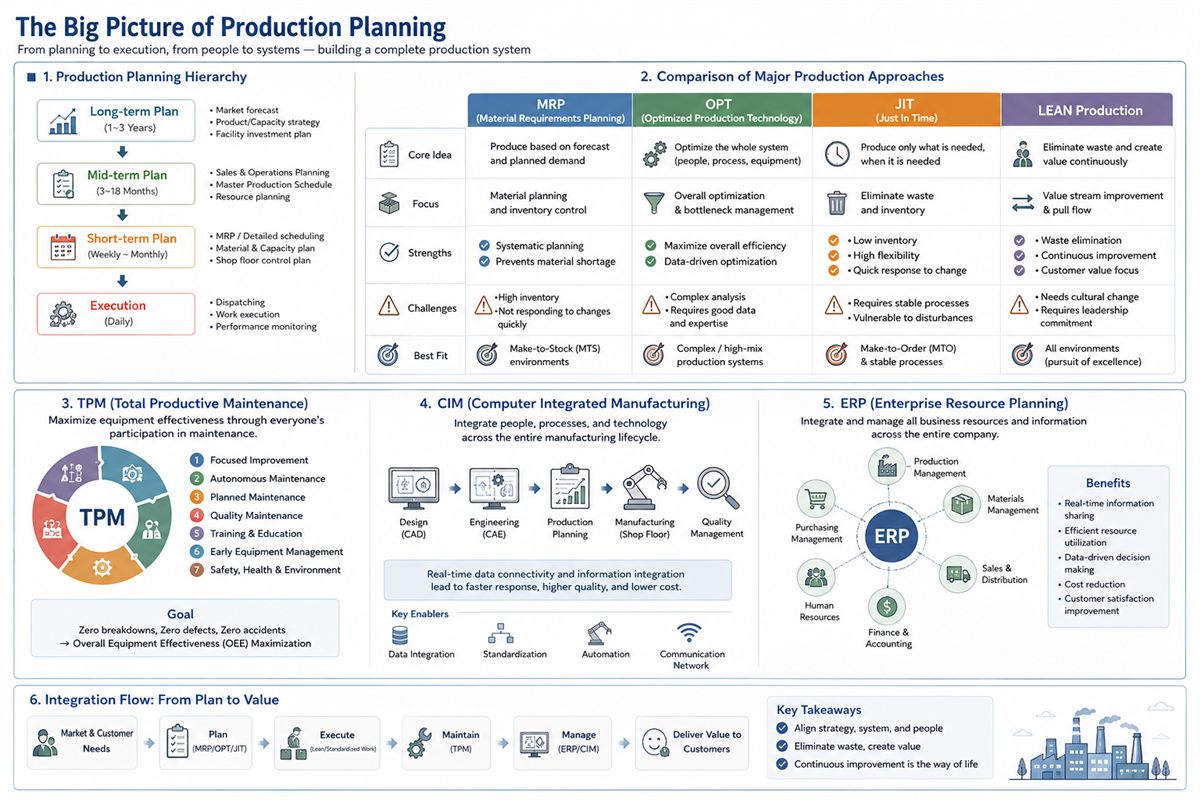
Production planning is a hierarchy
From a time perspective, production planning flows top-down:
Aggregate production plan (long-term) — LP / IP methods
    ↓
Master production schedule (medium-term) — OR methods and heuristics
    ↓
MRP / Capacity requirements planning (short-term) — forward / backward scheduling
    ↓
Job scheduling (detailed) — OR methods, AI, dispatching rules
The same hierarchy appears in product granularity. Aggregate plans work at the product-type level ("mid-size car, compact car"), then move down to product families ("Sonata, Excel"), and finally to individual items ("Sonata 1.8, 2.0, 2.5"). Higher plans hold the big picture; lower plans handle the detail of individual lines and machines.
Make-to-stock vs. make-to-order
The fundamental fork in how a production system is set up:
Make-to-stock: Used when customer demand can be predicted with reasonable accuracy. Finished goods inventory drives production control; the key tasks are leveling output and finding the right lot size to minimize operating cost.
Make-to-order: Used when demand is hard to predict or inherently one-off. Customer service level becomes the key metric; reducing production lead time and work-in-process inventory is the main challenge.
MRP (Material Requirements Planning)
How MRP works
MRP takes three inputs:
Planned output per time period (the Master Production Schedule, MPS)
BOM (Bill of Materials)
Current inventory levels and lead times
The procedure:
Calculate gross requirements from the MPS and BOM
Subtract on-hand inventory to get net requirements
Convert net requirements into planned orders using lead times and a lot-sizing policy (L4L, fixed order quantity, fixed order period, economic approaches, etc.)
Two critical assumptions underlie MRP: infinite production capacity, and fixed, pre-known lead times. Both of these become MRP's principal limitations.
The MRP loop and its limits
MRP runs in a loop: production plan → rough-cut capacity planning → MPS → MRP → detailed capacity planning → shop floor execution → purchasing. The problem is that MRP's assumptions — fixed lead times and infinite machine capacity — can produce plans that are physically impossible to execute.
Lead time is actually the sum of setup time, processing time, transport time, and queue time, and predicting it in advance is very hard. This creates a gap between MRP's backward scheduling (working back from due dates) and forward scheduling via CRP (assigning work from the earliest feasible start). That gap is MRP's most cited structural flaw.
OPT (Optimized Production Technology)
Core principles
OPT starts from the premise that "the goal is to balance flow, not capacity." Its key principles:
The utilization of a non-bottleneck resource must be determined by the system's other constraints, not by the resource's own capacity
One hour lost at a bottleneck is one hour lost for the whole system
Conversely, one hour saved at a non-bottleneck saves nothing for the system
The bottleneck governs both throughput and inventory for the entire system
Additional principles:
Transfer batch size and process batch size can — and often should — be different
Process batch size is not fixed; it should vary with the situation
Scheduling must consider all constraints simultaneously; lead time is not an input to scheduling — it's an output
In practice
Applying OPT means separating the "critical network" (paths through the bottleneck) from the "non-critical network," and calculating how transfer batch size affects overall flow. Batch sizes are determined using dynamic programming, integer programming, and heuristics.
Where MRP assumes infinite capacity, OPT puts the constraint — the bottleneck — at the center of planning from the start. That's the fundamental difference.
JIT (Just-In-Time)
What it's for
JIT is designed for flexibility in the face of process disruptions and demand shifts. The goal is to minimize lead time from raw material to finished product, producing only what's needed when it's needed, and carrying as little inventory as possible. Inventory level and production lead time are managed as policy variables, tracked continuously, and used to expose waste in equipment and labor.
The view of inventory
JIT's framing of inventory is distinctive. Inventory is often compared to water that hides rocks (problems) beneath the surface. Lowering the water level reveals what's been hidden — equipment failures, quality defects, slow changeovers — and fixing those problems one by one is how JIT drives improvement.
The four JIT principles
Pull from the downstream process: the upstream process doesn't push what it made — the downstream process pulls what it needs
One unit produced, one unit moved: only possible if setup times are short and production methods allow it
Level production: if downstream pull quantities fluctuate, inventory builds and JIT breaks down
Eliminate overproduction waste: inventory is treated as the root cause of problems, not a solution to them
The kanban system
Kanbans reduce information-processing cost, give a fast and accurate read of floor conditions, and prevent upstream processes from making more than what's needed.
Withdrawal kanban: specifies the quantity the downstream process retrieves from upstream
Production-order kanban: specifies the quantity the upstream process should produce
Each kanban card carries: kanban number, part number, point of use, and lot size. This maps directly onto the FULL WORK control concept covered in the TPS wastes article.
Jidoka
"Stop the machine or activity immediately whenever an abnormal or defective condition arises." This is the same jidoka (automation with a human touch) discussed in the TPS 7 wastes article. It prevents overproduction and makes abnormal conditions far easier to control.
MRP, OPT, and JIT side by side
Dimension
MRP
JIT
OPT
Capacity assumption
Infinite
Finite
Finite
Capacity control mechanism
—
Kanban cards
Bottleneck workstation
Batch size
Large (to offset setup)
Relatively small
Small (process batch + transfer batch split)
Lead time
Pre-set, typically long
Short
Output of scheduling; shorter than MRP
Buffer against imbalance
Safety stock
Kanban cards
Safety stock + detailed scheduling
Data accuracy required
Highest
Minimal
Lower than MRP
Flexibility
Low
Highest (small batches, low inventory)
Higher than MRP
Org restructuring needed
Yes
Yes
No
Control target
Capacity
Physical flow of resources
Flow of resources
Operating cost
High (demands precise data)
Low
Between MRP and JIT
In a sentence: MRP relies on sophisticated calculation against an assumption of infinite capacity; JIT accepts finite capacity and controls the physical flow directly; OPT focuses on one constraint — the bottleneck — and optimizes the whole system around it.
TPM (Total Productivity Management)
TPM is the systematic effort to eliminate all losses — waste, defects, breakdowns — that prevent the production system from reaching its maximum efficiency. It runs in two directions simultaneously:
Top-down: company-wide direction set and deployed using TPI-style methods
The aim is to push toward the limit of productive capacity. In practice, TPM means building a system that covers the full range of maintenance-related work — PM information management, general job management, process improvement tracking, inspection management, budget management, equipment information, spare parts management — and making it usable by both managers and operators.
Improving Overall Equipment Effectiveness (OEE) requires building a structure that uses flow management and MP (Maintenance Prevention) information from the earliest stage of equipment introduction, and systematically incorporating reliability, maintainability, and safety data from the design phase onward. Done well, this shortens installation time and surfaces problems and difficult-to-maintain areas before they occur — raising the quality of the installation itself.
3-Fixed and 5S as the foundation of TPM
3-Fixed (三定)
Fixed location: decide in advance where each item belongs. Distinguish between location markings and address markings.
Fixed item: only the designated item goes in the designated location. Label what belongs there; keep the kanban function intact so labels can be removed or locations changed when needed.
Fixed quantity: only the designated quantity of the designated item goes in the designated location. Limit storage area and shelf size; use color coding (red/yellow) to mark maximum and minimum inventory levels so quantity is visible at a glance.
5S
Sort: distinguish what's needed from what isn't; discard what isn't
Set in order: arrange needed items so they can be retrieved immediately when required
Shine: eliminate dust, debris, and dirt
Standardize: maintain the workplace in a clean, orderly state consistently
Sustain: build the habit of following established rules correctly
3-Fixed and 5S are two sides of the same idea. 3-Fixed defines the rules — where, what, and how much. 5S is the behavioral process of establishing and sustaining those rules.
CIM (Computer Integrated Manufacturing)
CIM uses computer and communications technology to raise efficiency and business speed across the full span of company activity — marketing, development and design, manufacturing, shipping, and returns.
Concept: a market-strategic production system that integrates manufacturing, sales, engineering, and management functions via network to maximize customer satisfaction.
Expected benefits fall into three categories:
Integration of order-to-design-to-manufacturing-to-sales information
Integration of sales-logistics-manufacturing information
Information support for corporate strategy
Practical outcomes include: management efficiency through integration, stronger organizational capability through faster business cycles, and reinforced global strategy through networked operations.
CIM is a step toward the 21st-century multimedia enterprise — paperless inter-company transactions, EDI, e-commerce. It evolves alongside related concepts (CE, AM, VC, EC) into CALS (Continuous Acquisition and Life-cycle Support). The underlying infrastructure is information systems, networks, and databases; in-company standardization and industry-wide standardization form its base.
ERP (Enterprise Resource Planning)
What ERP is
ERP is a packaged system that embeds the latest IT on the technology side and industry best practices on the business side, supporting enterprise-wide information management and business process innovation. It reflects the accumulated knowledge of industry experts and companies across multiple sectors, with ongoing R&D continuously incorporating new management thinking and technology research.
Five characteristics of ERP
Pre-validated, enterprise-wide integrated business processes: best-practice processes for manufacturing, sales, procurement, equipment, and finance are already built in, supported by a unified ledger-type enterprise database
Improved data accuracy: an integrated enterprise database combined with document-based methods raises data quality across the board
Global readiness: supports multiple languages, currencies, accounting systems, and tax regulations; manages global manufacturing and sales networks
Advanced IT adoption with cost reduction: continuously absorbs new IT developments while reducing overall IT operating costs
Strategic management support: ERP data serves as the foundation for data warehouses, enabling advanced management frameworks like ABM (Activity Based Management) and VBM (Value Based Management)
ERP vs. legacy systems
Dimension
Legacy system
ERP
Process
Built around user-specific requirements
Based on best-practice processes
System structure
Manufacturing, logistics, sales, accounting as separate systems
All functions integrated in a single system
Database
Separate database per system
Single unified database
IT infrastructure
Mainframe-centric
Client/server-centric
Development approach
Custom-built, continuously maintained in-house
Pre-built modules configured and deployed
The fundamental distinction is "build a system to fit how we work" versus "realign how we work to fit a proven system." That's why ERP adoption is never just an IT project — it's a business process redesign effort.
This article operates at a different altitude than the earlier pieces on line-level improvement. MRP, OPT, and JIT are three different answers to the question "on what principle do we control production?" TPM and 3-Fixed/5S are the physical foundation that sustains those systems on the floor. CIM and ERP are the information infrastructure that binds everything together at the enterprise level. If the earlier articles were about shaping individual trees, this one is about the design of the forest.
댓글Comments