[생산관리] 표준시간, 스톱워치 하나로 현장을 측정하는 법[Production Management] Standard Time: How to Measure the Shop Floor with a Stopwatch
FREEWAYFREEWAY·2026년 8월 4일August 4, 2026·12분 읽기12 min read
앞서 생산성 관리 글에서 표준시간을 잠깐 다뤘는데, 이번엔 표준시간이 정확히 뭘 의미하고, 실제로 어떻게 측정하는지를 좀 더 깊게 정리해봤습니다. 산업공학(IE) 쪽에서 다루는 스톱워치법, 레이팅, 여유율 개념까지 포함해서요.
표준시간의 정의, 다시 제대로
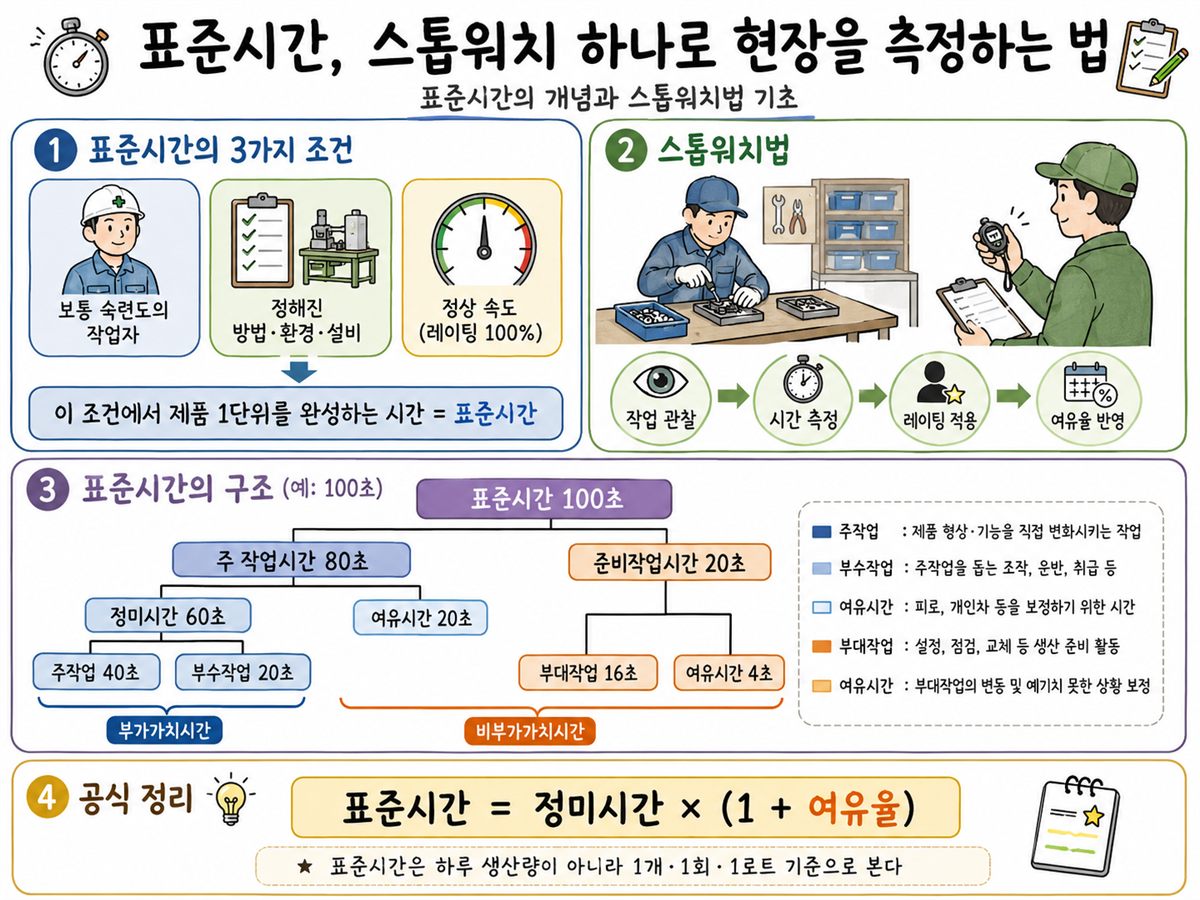
표준시간을 정의하는 세 가지 조건은 이렇습니다.
보통 숙련도의 작업자가
정해진(표준의) 방법으로 — 정해진 환경조건(조명·온도·습도·소음), 정해진 설비·치공구, 정해진 작업순서에 따라
정상 속도로 — 레이팅 100%, 몸에 무리를 주지 않으면서 적정한 휴식을 포함해서
이 세 조건을 만족했을 때 제품 1단위를 완성하는 데 걸리는 시간이 표준시간입니다. 표준시간은 하루 단위가 아니라 1개, 1회, 1로트 단위로 정의됩니다. "하루에 몇 개 만드는가"가 아니라 "하나 만드는 데 몇 초 걸리는가"를 보는 개념입니다.
표준시간의 구조: 부가가치와 비부가가치로 쪼개기
표준시간을 100초라고 가정하면 이렇게 쪼개볼 수 있습니다.
표준시간(100초)
├─ 주 작업시간(80초): 1단위 생산마다 발생
│ ├─ 정미시간(60초): 규칙적으로 발생하는 작업
│ │ ├─ 주작업(40초) ─┐
│ │ └─ 부수작업(20초) ┘ → 부가가치시간
│ └─ 여유시간(20초): 불규칙적으로 발생
└─ 준비작업시간(20초): 1로트 생산마다 발생
├─ 부대작업시간(16초)
└─ 여유시간(4초)
표준시간 = 정미시간 + 여유시간 = 정미시간 × (1 + 여유율)
이 중 실제로 고객이 값을 지불하는 "부가가치시간"은 주작업과 부수작업뿐이고, 나머지는 전부 비부가가치시간입니다.
표준시간을 구성하는 용어들
용어
정의
예시
주체작업
작업 목적 그 자체가 진행되는 작업
가공, 조립, 변형, 절삭
부수작업
주체작업과 같은 사이클로 일어나는 부수 작업
부품 부착·제거, 기계 조작, 계측·검사
부대작업
로트당 1회 발생하는 준비·정리 시간
작업교체, 작업준비, 작업장 정비
생리적여유
생리적 욕구에 의한 행위 보상
화장실, 물 마시기, 땀 닦기
피로여유
신체적·정신적 피로 회복을 위한 보상
회복 휴식, 작업속도 감속
작업여유
불규칙·우발적으로 발생해 정규작업에 넣기 어려운 작업 보상
절삭 찌꺼기 제거, 급한 연락·협의
직장여유
관리 목적상 정해진 간접 작업의 보상
조회·종례·체조, 정리정돈
특수여유
습숙여유, 기계간섭여유, 소로트여유, 장려여유 등
사용 목적에 따라 포함 여부가 다름
표준시간의 목적: 계획과 실적 확인
표준시간은 크게 두 방향으로 쓰입니다.
계획수립: 어떤 계획에 필요한 "시간"을 미리 예측하는 기초 자료
실적확인: 표준에 맞춰 작업을 완수했을 때, 그 결과를 확인하는 지표
표준시간을 "과학적 관리 기준"이라는 말에 지나치게 얽매이지 말고, 어디까지나 경영관리의 도구로 실용적으로 써야 한다는 것이 중요합니다. 계획에 쓰면 "이래야 한다"는 모습이 명확해지는 시간이 되고, 실적 확인에 쓰면 바람직하지 않은 조건(손실)을 정확히 짚어내는 시간이 됩니다.
흥미로운 국가별 차이도 있습니다. 일본은 작업개선이나 라인편성 쪽에, 한국과 미국은 상대적으로 원가계산이나 생산계획 쪽에 더 무게를 두는 경향이 있다고 합니다 — 표준시간을 "현장을 바꾸는 도구"로 보느냐, "숫자를 만드는 도구"로 보느냐의 차이라고 볼 수 있습니다.
표준시간 측정법의 역사
경험견적: 관리자의 경험치로 대충 견적
실적환산: 과거 작업기록을 기준으로 환산
시간연구(스톱워치법): 실제 작업자를 대상으로 직접 시간을 측정
PTS(Predetermined Time Standards): 작업을 직접 관찰하지 않고 객관적으로 분석하는 기법
SD(Standard Data): 개별로 다 측정하지 않아도 알 수 있도록 표준 데이터베이스를 구축
개선활동 중심의 분석: 표준시간에 과도하게 의존하지 않고, 부수작업·부대작업 시간을 최소화하는 데 초점
OTRS: 동영상과 IT 기술을 활용한 비디오 실측법
이 흐름 전체를 "과학적 관리(Scientific Management)"라는 이름으로 묶습니다. 감으로 어림잡던 시대에서 데이터로 정밀하게 측정하는 시대로 옮겨온 과정입니다.
좋은 표준시간의 조건
공정성(일관성): 어떤 부문·현장에서도 공평한 척도여야 한다
적정성(신뢰성): 경영층·노조·생산기술 모두가 납득할 수 있는 과학적 기법이 필요하다
보편성: 타사와도 수준 비교가 가능하고, 제조 방법이 바뀌어도 과거 수준과 비교할 수 있어야 한다
표준시간 설정 절차
생산조건 파악: 제품 스펙 조사, 제품 공정 분석
표준작업 설정: 공정표·작업표 작성, 작업동작 분석, 작업 개선
작업측정: 작업표준 결정 → 시간 관측(스톱워치+레이팅, PTS 등) → 기계시간·수동작업시간 산출
표준 구성: 정미시간 산출 → 여유시간 산출 → 표준시간 설정
스톱워치법: 8단계로 보는 실측 과정
현장 협조 하에 대상 작업자를 선정하고 내용을 설명한다
작업을 관찰하고 방법을 검토한다
작업을 요소작업으로 분할해서 기록한다
작업을 관측하고 시간을 기록한다
관측 횟수를 통계적으로 검토한다
작업수행도를 평가한다(레이팅)
정미시간 = 관측시간의 대표값 × 레이팅 계수
표준시간 = 정미시간 × (1 + 여유율)
측정 실시 순서 (실무 체크리스트)
사전 준비: 조사 목적을 분명히 하고 대상 라인·모델명·관측용지·스톱워치·계산기를 준비한다. 현장 책임자에게 승인을 받고, 측정 당일의 근무시간·가동시간·생산실적·인원변동 데이터를 요청한다.
측정 계획: 작업내용을 단위 요소작업으로 분할하고 정의한다 — 너무 작거나 크게 나누면 측정도, 문제점 분석도 어려워진다. 측정 횟수는 작업이 불안정하면 10회, 안정적이면 5회 수준으로 결정한다.
측정 실시: 계획대로 측정하되 작업에 불편을 주지 않는 위치를 지킨다. 단위작업별 측정시간을 기록하고 결과를 분석한다.
작업자 관측 시 유의사항
휴식·잡담 등 비작업시간은 관측하지 않되, 2인 이상 연합작업 시 간섭으로 인한 대기시간은 관측한다
손실 여부와 관계없이 주작업·부수작업·부대작업·작업여유·직장여유 등 모든 작업시간은 관측한다
일반 목적이라면 평균 숙련도의 작업자를, 작업개선 목적이라면 최고 숙련자를 선정한다
가급적 작업자가 측정 중임을 의식하지 못하도록 자연스럽게 진행하는 게 원칙이다
기계 시간은 다르게 잡는다
설비 사양 기준: 프레스나 절단기처럼 가공품의 크기·형태·재질에 영향받지 않는 경우, 스트로크 수/분 같은 사양에서 바로 산출
기술적 계산식 기준: 공작기계류는 재질·가공 타입별 회전수, 피딩량, 절입량 등으로 계산
기술표준 기준: 화학 반응시간, 변질시간 같은 프로세스 시간은 제작사의 기술표준을 따름
요소작업 분할: 왜 잘게 쪼개는가
한 작업 사이클을 여러 요소작업으로 나누는 이유입니다.
요소작업을 명확히 설명할 수 있어야 작업 내용을 정확히 파악할 수 있다
같은 유형의 요소작업 데이터를 모아두면 나중에 표준자료로 재활용할 수 있다
작업 내용이 바뀌었을 때 필요한 부분만 다시 분석하면 된다
요소작업마다 수행도(레이팅)와 적정 여유율이 다를 수 있다
분할 원칙:
측정 가능한 범위(0.02~0.04분 이상)에서 가능한 한 잘게 나눈다
사이클마다 규칙적/불규칙적 요소작업을 구분한다
작업자 요소작업과 기계 요소작업을 분리한다
물건 특성에 영향받지 않는 상수요소작업과, 영향받는 변수요소작업을 분리한다
시점과 종점이 명확히 구분되도록 자른다 — 한 요소작업의 끝이 다음의 시작
끊는 시점을 잡을 때는 시각보다 청각(소리)을 활용하는 게 더 정확하다
관측 횟수: 얼마나 필요한가
사이클 타임과 연간 생산량에 따라 필요한 최소 관측 횟수가 달라집니다(Westing House Electric 기준).
사이클 타임이 길고(8시간 이상) 생산량이 적으면 → 관측 1~2회로 충분
사이클 타임이 짧고(7분 12초 수준) 생산량이 많으면(연 1만 개 이상) → 15회까지 관측 필요
작업이 짧고 반복이 잦을수록, 그리고 생산량이 많을수록 더 많이 관측해야 신뢰할 수 있는 표준시간이 나온다는 원리입니다.
레이팅(정상화계수): 사람마다 다른 속도를 보정하기
레이팅이란 작업자의 실제 작업 속도를, "정상 속도(레이팅 100%)"라는 기준에 비교해서 정량화한 값입니다. 관측 대상자의 실제 동작을, 관측자 머릿속에 있는 표준 작업동작과 비교해서 백분율로 평가합니다.
표준 속도는 "과도한 피로 없이 매일 계속할 수 있으면서, 열심히만 하면 표준 성과를 무리 없이 달성할 수 있는 페이스"로 정의됩니다. 참고로 10m 보행 기준으로 의욕적 속도(Incentive Pace)는 6.2초, 정상적 속도(Normal Pace)는 7.8초 정도로 봅니다.
여유시간: 왜 필요한가
여유시간은 작업 수행 중 필연적으로 생기는 지연에 대한 보상입니다. 발생 시기·빈도·소요시간이 일정하지 않기 때문에 비정규 작업으로 따로 종합해서 잡는 게 관행입니다.
종류
내용
대략적 비율
생리여유
물 마시기, 땀 닦기, 세면, 용변 등
남 2~4%, 여 4~6%
피로여유
육체적·정신적 피로 회복
작업 조건에 따라 가변
작업여유
불규칙 발생, 정미시간에 넣기 어려운 지연
3~5%
기계간섭여유
1인이 기계 2대 이상 조작 시 발생하는 간섭 보상
대수에 따라 가변
소로트여유
로트가 작아 능률이 오르기 전에 작업이 끝나버리는 경우 보상
로트 크기에 따라 가변
주의: 관리자·감독자의 조치나 작업자 스스로의 방법으로 없앨 수 있는 지연 — 예를 들어 작업자 책임의 불량, 기계고장 수리, 재료 대기, 공정대기 — 은 여유시간에 포함시키면 안 됩니다. 여유는 "어쩔 수 없는 지연"을 보상하는 개념이지, 관리 소홀을 정당화하는 항목이 아닙니다.
ILO 기준 여유율 참고
고정여유: 개인여유 5~7%, 기초여유 4%
자세: 서 있는 자세 2~4%, 부자연한 자세는 어려움 정도에 따라 0~7%
중량 취급: 2.3kg부터 15.9kg까지, 무게가 늘수록 0~8%까지 증가
주의력: 정밀 작업 2%, 매우 정밀한 작업(현미경·렌즈 조정 등) 5%
소음: 연속음 0%, 간헐적 고음 2%, 매우 시끄러운 경우 5%
조명: 조도가 부족할수록 최대 15%까지
단조로움·정신적 피로: 작업 성격에 따라 0~8%
조작업: 6인 이상 작업 시 9% 가산
실제 현장(2교대, 총 근무 12시간) 사례에서는 공정별로 사출·측정·코팅·조립 등에 따라 11~20% 수준의 여유율이 적용되는 걸 볼 수 있는데, 이건 회사·공정마다 실측을 통해 별도로 산정해야 하는 값입니다.
두 방식의 차이는 여유율의 분모를 "정미시간"으로 보느냐 "전체 근무시간"으로 보느냐입니다. 어느 쪽을 쓰든 결과가 달라질 수 있으니, 사내에서 방식을 통일해야 합니다.
계산 예시 (외경법, DM 단위)
DM(Decimal Minute)은 1분 = 100DM으로 표시하는 단위입니다.
계산 예시
주작업/부수작업: 289DM/개
부대작업: 13.5DM/개 (준비교체 10DM + 검사 1.5DM + 공구교체 2DM)
정미시간 = 289 + 13.5 = 302.5DM/개
여유시간: 작업여유(기계손질·주유 14분 + 정리정돈 10분) + 인적여유(생리·피로 48분) = 총 72분 / 전체 480분
여유율 = 72 / 480 × 100% = 15%
표준시간 = 302.5 × (1 + 0.15) = 318DM/개 = 191초/개
정리하면, 표준시간은 단순히 "이 작업 몇 초 걸려?"라는 질문에 대한 답이 아닙니다. 정미시간·부대작업·여유시간을 각각 원칙에 맞게 쪼개고, 레이팅으로 사람마다 다른 속도를 보정하고, 여유율로 불가피한 지연까지 감안해야 비로소 "누가 봐도 공평하고, 어디에 갖다 대도 신뢰할 수 있는" 숫자가 나옵니다. 그리고 그 숫자를 만드는 이유는 결국 원가 계산이나 인원 산정보다 앞서, 현장을 더 낫게 개선하기 위해서라는 걸 잊지 않는 게 중요합니다.
In an earlier article on productivity management we touched on standard time briefly. This one goes deeper — what standard time actually means, and how to measure it in practice. That includes the stopwatch study method, rating, and allowance concepts from industrial engineering (IE).
The definition of standard time, properly
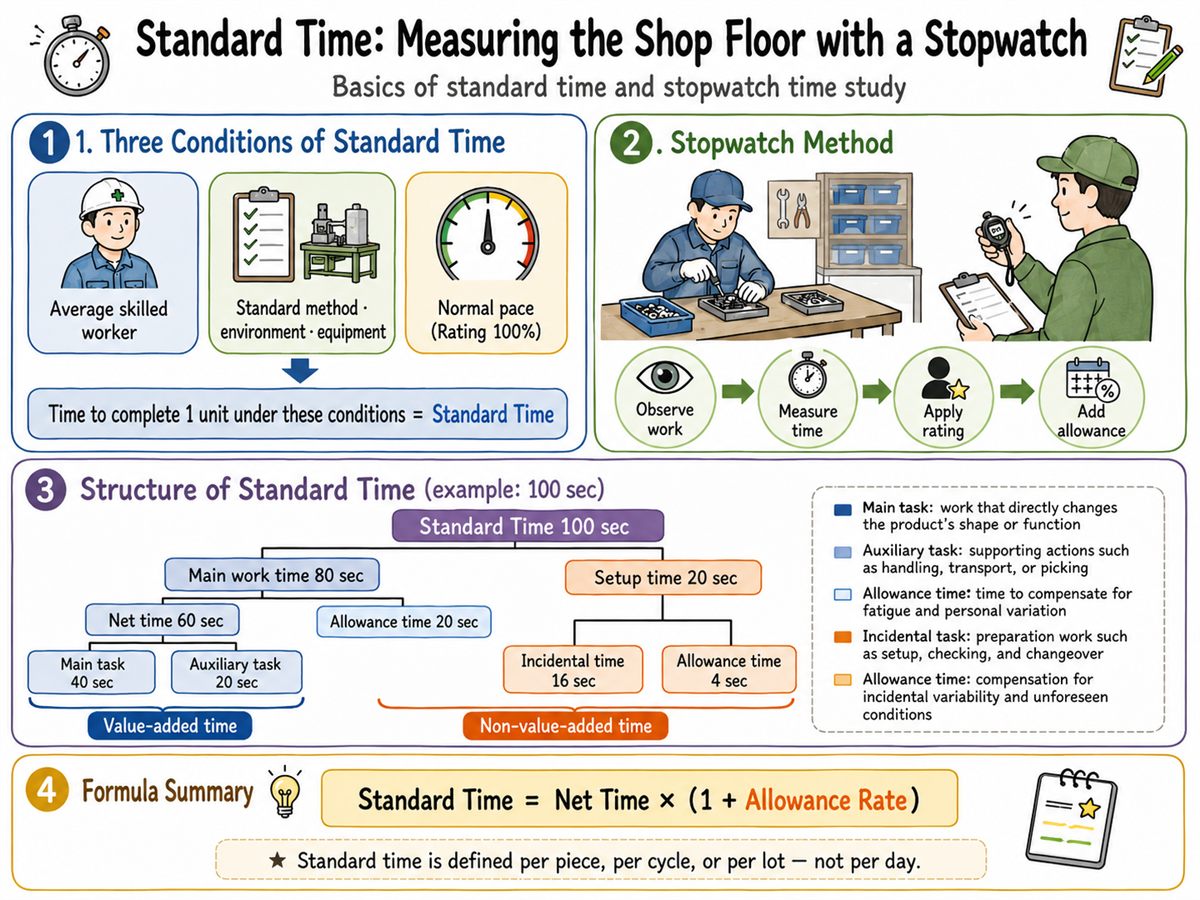
Standard time is defined by three conditions:
A worker of average skill
Working by the defined (standard) method — specified environmental conditions (lighting, temperature, humidity, noise), specified equipment and tooling, specified work sequence
At a normal pace — 100% rating, no physical strain, appropriate rest included
The time required to complete one unit of product under these three conditions is the standard time. Important: standard time is defined per unit — per piece, per cycle, per lot. It's not "how many per day" but "how many seconds per piece."
Standard time structure: value-added vs. non-value-added
If standard time is 100 seconds, here's how it breaks down:
Standard time (100 sec)
├─ Main work time (80 sec): occurs every unit
│ ├─ Normal time (60 sec): regularly occurring work
│ │ ├─ Main work (40 sec) ─┐
│ │ └─ Incidental work (20 sec) ┘ → value-added time
│ └─ Allowance time (20 sec): irregularly occurring
└─ Setup time (20 sec): occurs every lot
├─ Setup work time (16 sec)
└─ Allowance time (4 sec)
Standard time = Normal time + Allowance time = Normal time × (1 + Allowance rate)
Of this, the "value-added time" the customer is actually paying for is only the main work and incidental work. Everything else is non-value-added.
Standard time terminology
Term
Definition
Examples
Main work
Work that directly accomplishes the job objective
Machining, assembly, forming, cutting
Incidental work
Work that occurs in the same cycle as main work
Loading/unloading, machine operation, inspection
Setup work
Preparation and cleanup that occurs once per lot
Changeover, setup, workplace organizing
Personal allowance
Compensation for physiological needs
Restroom, drinking water, wiping sweat
Fatigue allowance
Recovery time for physical and mental fatigue
Recovery rest, pace reduction
Contingency allowance
Irregular, unexpected delays too hard to include in normal time
Chip removal, urgent communication
Workplace allowance
Compensation for scheduled indirect work required by management
Morning meetings, exercises, end-of-shift cleanup
Special allowances
Learning, machine interference, small-lot, incentive allowances, etc.
Included or excluded depending on context
What standard time is actually used for
Standard time serves two main purposes:
Planning: the base data for predicting how much time a plan will require
Performance measurement: the benchmark for evaluating how well work was completed against the standard
The key point is that standard time should be treated as a practical management tool, not fetishized as a "scientific management standard." When used for planning, it makes the target state explicit. When used for performance measurement, it precisely identifies where losses are occurring.
There's an interesting cross-national pattern: Japan tends to use standard time primarily for work improvement and line balancing, while Korea and the US lean more toward cost accounting and production planning. The difference is whether you view standard time as a tool for changing the floor, or a tool for generating numbers.
A brief history of standard time measurement methods
Expert estimation: rough estimates based on a manager's experience
Historical conversion: derived from past work records
Time study (stopwatch method): directly timing actual operators
PTS (Predetermined Time Standards): objective analysis without direct observation
Standard data (SD): building a database so individual measurement isn't needed for each task
Improvement-centered analysis: focusing on minimizing incidental and setup time rather than over-relying on standard time
OTRS: video-based time measurement using IT tools
What makes a good standard time
Fairness (consistency): a fair, consistent measure across all departments and locations
Validity (reliability): a scientific method that management, labor, and engineering all accept as credible
Universality: comparable across companies, and comparable to past performance even when methods change
Standard time setting procedure
Understand production conditions: review product specs, analyze the process flow
Define standard work: create process and work sheets, analyze work motions, improve the work method
Measure work: decide work standards → observe times (stopwatch + rating, or PTS) → determine machine times and manual work times
Build the standard: calculate normal time → calculate allowances → set standard time
Stopwatch study: the 8-step process
With shop floor cooperation, select the operator and explain the purpose
Observe the work and review the method
Break the work into elements and document them
Observe and record times
Statistically validate the number of observations
Evaluate work pace (rating)
Normal time = representative observed time × rating factor
Standard time = normal time × (1 + allowance rate)
Practical checklist
Preparation: Clarify the purpose; prepare the target line/model name, observation sheet, stopwatch, and calculator. Get approval from the floor supervisor and request that day's scheduled hours, actual operating time, production output, and headcount changes.
Planning: Break the work into defined elements — elements that are too small or too large make both measurement and problem analysis harder. Plan 10 observations for unstable work, 5 for stable work.
Execution: Follow the plan and position yourself where you won't interfere with the work. Record times by element and compile the results.
Key points for observing operators
Don't record breaks or personal conversation, but do record waiting time caused by interference in team operations
Regardless of whether it's a loss, record all work time: main work, incidental work, setup work, contingency allowance, workplace allowance
For general purposes, select an average-skilled operator; for work improvement purposes, select the most skilled
As a rule, work so the operator isn't aware they're being timed
Machine time is set differently
Equipment specifications: For presses and cutters unaffected by part size, shape, or material — calculate directly from specs like strokes/minute
Technical formulas: For machine tools — calculate from material type, cut type, RPM, feed rate, depth of cut
Manufacturer's standards: For process times like chemical reaction or curing — use the manufacturer's technical standard
Breaking work into elements: why bother?
Clearly described elements let you accurately understand what the work actually involves
Collected element data can be reused as standard data for future studies
When the work method changes, only the affected element needs to be re-analyzed
Rating and allowance rates may differ by element
Breakdown principles:
Break down as finely as possible within what's measurable (0.02–0.04 min or more per element)
Distinguish between regular and irregular elements within each cycle
Separate operator elements from machine elements
Separate constant elements (unaffected by part characteristics) from variable elements (affected)
Each element's start and end point must be clearly distinguishable — the end of one is the start of the next
When choosing breakpoints, listening for sounds is more accurate than watching for movements
How many observations do you need?
The minimum depends on cycle time and annual production volume (Westinghouse Electric guidelines):
Long cycle time (8+ hours), low volume → 1–2 observations sufficient
Short cycle time (~7 min), high volume (10,000+/year) → up to 15 observations needed
The shorter and more repetitive the work, and the higher the production volume, the more observations you need to get a reliable standard time.
Rating: correcting for differences in operator pace
Rating quantifies the observed operator's actual pace relative to "normal pace" (100% rating). The observer compares the operator's actual movements against the standard working motion in their head, and expresses the difference as a percentage.
Standard time = Normal time × (1 + Allowance rate)
= (Observed time × Rating factor) × (1 + Allowance rate)
Rating
Pace
Motion description
125
Very fast
Highly skilled pace; would cause fatigue over extended periods
100
Ideal
Smooth, uninterrupted motion; working diligently
85
Average
Comfortable pace with slight hesitation between motions
60
Slow
Frequent errors; appears to be deliberately working slowly
Normal pace is defined as "a pace that can be sustained day after day without undue fatigue, and from which a worker who tries hard can achieve the standard output without strain." For reference: walking 10 meters takes about 6.2 seconds at incentive pace and about 7.8 seconds at normal pace.
Allowance time: why it's necessary
Allowance time compensates for delays that inevitably occur during productive work. Because the timing and duration are irregular, they can't be built into normal time and are instead aggregated separately.
Irregular delays too hard to include in normal time
3–5%
Machine interference
Compensation when one operator tends 2+ machines
Varies by machine count
Small-lot
Compensation when lots are so small that efficiency peaks before the run ends
Varies by lot size
Important: Delays that management, supervisors, or operators themselves could eliminate — operator-caused defects, equipment repairs, material shortages, process waiting — should NOT be included in allowance time. Allowances compensate for unavoidable delays; they are not a way to legitimize poor management.
ILO allowance rate reference
Fixed allowances: personal 5–7%, basic 4%
Posture: standing 2–4%; awkward postures 0–7% depending on difficulty
Weight handling: 0–8% depending on load from 2.3 kg to 15.9 kg
Attention: fine work 2%; very fine work (microscope, lens adjustments) 5%
Noise: continuous 0%; intermittent loud noise 2%; very loud 5%
Lighting: up to 15% as illumination decreases
Monotony / mental fatigue: 0–8% depending on nature of work
Team work: 9% added for groups of 6+
Real-world allowance rates (2-shift, 12-hour total) typically run 11–20% across process types like injection molding, inspection, coating, and assembly — these must be measured and set separately for each company and process.
Allowance rate calculation: external vs. internal method
External method (% of normal time)
Allowance rate (%) = Total allowance time / Normal time × 100%
Standard time = Normal time × (1 + Allowance rate)
Internal method (% of working time)
Allowance rate (%) = Total allowance time / Total working time × 100%
Standard time = Normal time × (1 / (1 − Allowance rate))
The difference is whether the denominator for the allowance rate is "normal time" or "total working time." The two methods produce different results, so a company must pick one and apply it consistently.
Allowances: contingency (lubrication 14 min + cleanup 10 min) + personal/fatigue (48 min) = 72 min total / 480 min shift
Allowance rate = 72 / 480 × 100% = 15%
Standard time = 302.5 × (1 + 0.15) = 318 DM/unit = 191 sec/unit
Standard time is not simply the answer to "how many seconds does this take?" It requires properly breaking down normal time, setup time, and allowances; correcting for individual pace differences with rating; and accounting for unavoidable delays through allowance rates. Only then do you get a number that's "fair to everyone and trustworthy anywhere it's applied." And the reason for building that number is, before cost accounting or headcount planning, to make the shop floor better — that's the part that's easy to lose sight of.
댓글Comments