[생산관리] TPS(도요타 생산방식)로 보는 공장의 7대 낭비[Production Management] The 7 Wastes of Manufacturing Through the Lens of TPS
FREEWAYFREEWAY·2026년 8월 4일August 4, 2026·12분 읽기12 min read
앞선 글에서 5S와 눈으로 보는 관리를 다뤘다면, 이번엔 조금 더 근본적인 질문으로 들어갑니다. 왜 개선을 하는가, 낭비를 대하는 마음가짐은 어때야 하는가, 그리고 TPS(도요타 생산방식)에서 말하는 7대 낭비는 구체적으로 뭘 가리키는가 — 옛 교육 자료를 다시 정리하며 제 언어로 풀어봤습니다.
개선은 왜 하는가
개선 활동의 목적은 결국 세 가지로 압축됩니다.
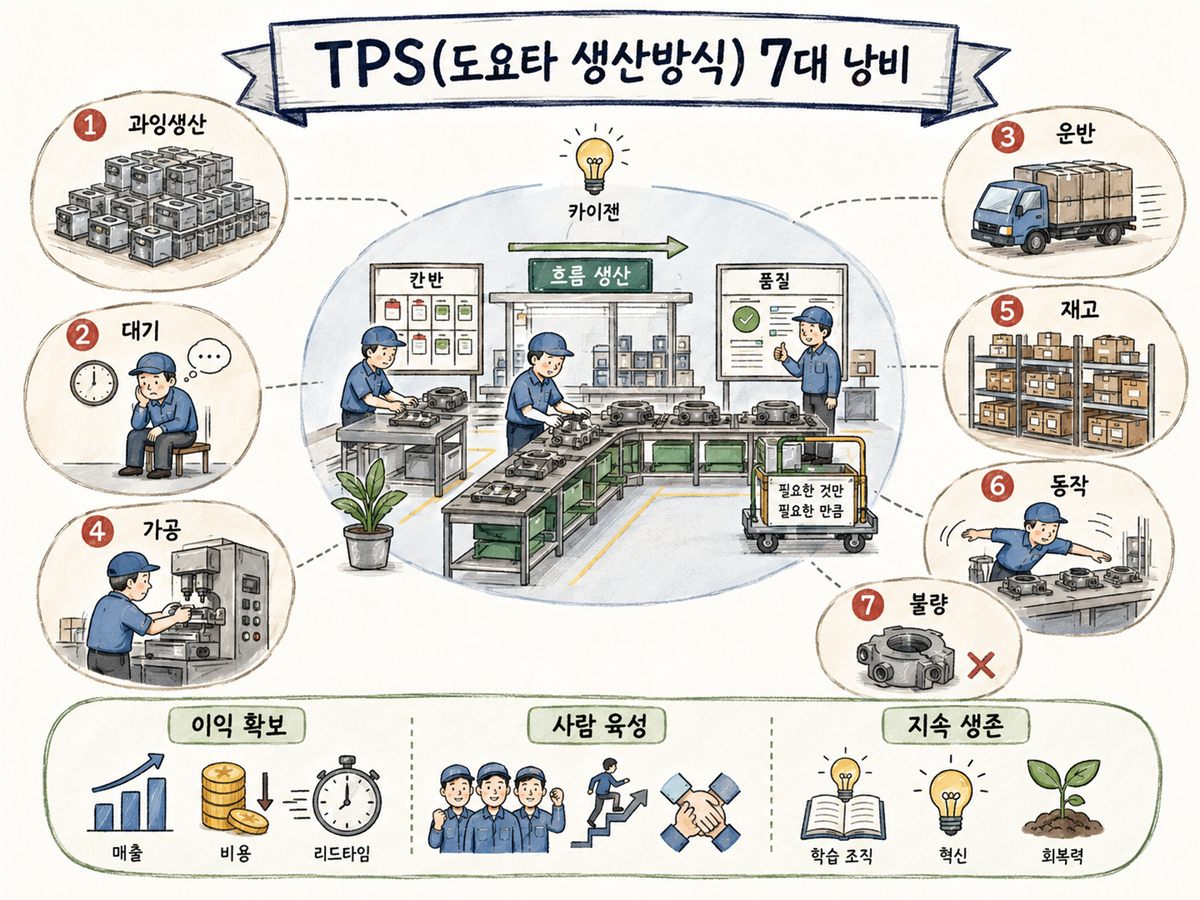
이익 확보 — 매출 증대, 원가 절감, 생산기간 단축
기업은 사람이다 — 종업원의 능력 향상과 조직 활성화
지속 가능한 생존 — 환경에 적응하고 새로운 걸 만들어내는 조직 지식의 축적
세 가지가 따로 노는 게 아니라, 현장에서의 실천 활동이 쌓여서 조직의 지식이 되고, 그게 다시 새로운 기업 문화로 이어지는 순환 구조라는 게 핵심입니다.
개선에 대한 마음가짐 10가지
현장·현물주의에 철저하고, 사실에서 배운다
익숙한 틀에 갇히지 말고 백지 상태로 접근한다
"보고 나서 생각하는 것"과 "생각하고 나서 보는 것"은 다르다 — 선입견 없이 관찰부터 하라는 뜻
비전문가라서 서툴 거라고 미리 단정하지 않는다
늘 절박한 자세로 개선에 임한다
자신이 직접 못 할 일은 남에게도 시키지 않는다
불량이 나오는 건 작업자의 미숙련이 아니라 관리감독자의 지도 부족이다
아이디어를 낼 때는 미리 우군을 만들어두는 게 성공의 열쇠다
"내일 하자"는 사실상 "안 하겠다"는 말이다
모든 걸 "이익"의 관점에서 본다
이 중에서 특히 "불량은 작업자 탓이 아니라 관리감독자 탓"이라는 항목이 인상적입니다. 현장에서 문제가 생겼을 때 책임 소재를 가리는 방식 자체를 바꾸는 관점이기 때문입니다.
목표(目標)와 이상(理想)은 다르다
현상의 문제점을 없애는 접근과, 이상적인 상태에 가깝게 다가가는 접근은 서로 다른 방식입니다.
문제점을 없애는 방식: "불량률 5% → 목표 1%"처럼 현재 상태에서 목표치를 정하고 개선한다
이상에 접근하는 방식: "불량률 0%"라는 이상을 놓고, 직행률 100%나 라인 스톱 같은 수단을 통해 현장 스스로 개선력을 키운다
두 방식 모두 필요하지만, 관성적으로 목표만 낮춰 잡다 보면 정작 이상적인 상태와는 점점 멀어질 수 있다는 게 이 구분의 요점입니다.
의식 개혁이란 판단 기준을 바꾸는 것
같은 낭비라도 어떤 단위로 판단하느냐에 따라 보이는 게 완전히 달라집니다. 예를 들어 운반 낭비를 "팔레트 단위(톤·미터)"로 보면 큰 것만 낭비로 보이지만, "걸음 수(센티미터)"까지 기준을 내리면 훨씬 작은 움직임까지 낭비로 인식하게 됩니다.
의식 개혁이란 결국 사물을 판단하는 기준의 레벨을 얼마나 세밀하게 가져가느냐의 문제입니다. 판단 기준을 바꾸거나(걸음 수로 보기), 사물 자체를 바꾸는(운반을 가공으로 바꾸기) 두 방향 모두 가능합니다.
현장은 조직 전체의 문제가 모이는 곳
현장에서 벌어지는 문제는 사실 현장만의 문제가 아닙니다. 설계의 문제, 설비의 문제, 물류의 문제, 작업 방식의 문제가 전부 현장에 모여서 나타나는 것뿐입니다.
부가가치를 만들지 않는 작업 동작들 — 옮기다, 누르다, 두드리다, 문지르다, 재다, 자르다, 연결하다, 풀다, 감시하다, 기다리다, 확인하다 등 — 이 일상적으로 반복되다 보면 그게 당연한 것처럼 느껴지면서 문제로 인식되지 않는 매너리즘에 빠지기 쉽습니다. 그 결과가 재해, 불량, 생산량 변동, 가동률 변동, 재고 증가, 공정편성 손실(Loss) 같은 형태로 나타납니다.
실패를 대하는 방식
작은 실수를 숨기고 넘어가면 시간이 지나 더 큰 실패로 돌아옵니다. 실패가 성공처럼 보이도록 자료를 왜곡하거나, 체면 때문에 타 부서에 정보를 공유하지 않으면 같은 실패가 반복될 수밖에 없습니다.
그래서 오히려 사소한 실수를 짧은 기간 안에 많이 겪어보는 게 중요하다는 관점이 나옵니다. 실수를 숨기지 않고 드러내는 문화 자체가 개선의 재료가 된다는 뜻입니다.
개선에 대한 저항과 극복 방안
저항 이유
극복 방안
타성이나 습관
솔선수범
외부 개입에 대한 불만
참여 문화 조성, 작업자와의 대화
변화 필요성을 못 느낌
충분한 시간 제공, 외부 환경 정보 공유 강화
분석자에 대한 불신
인간 존엄성 존중, 조직 내 리더십 활용
업무 상실에 대한 불안
중장기 비전 제시, 단계적 진행
자동화(自働化)라는 개념
TPS에서 말하는 자동화는 단순히 기계가 알아서 돌아간다는 뜻이 아닙니다. 사람 인(人) 변이 붙은 자동화, 즉 불량을 스스로 감시하고 이상 상태를 기계 스스로 판단하는 체계를 가리킵니다.
이게 왜 중요하냐면, 불량품이 전(前)공정에서 후(後)공정으로 그대로 흘러 들어가는 걸 막아주기 때문입니다. 이상이 감지되면 사람이 개입해서 원인을 파악하고 재발을 막을 수 있지만, 단순 자동화만으로는 불량이 로트 단위로 발생해도 기계나 치구가 고장 났다는 사실조차 놓칠 수 있습니다.
FULL WORK 제어: 팔린 만큼만 만든다
과잉생산을 막기 위한 대표적인 제어 방식입니다. 원리는 간단합니다.
표준재고를 항상 가득 찬 상태로 유지하는 게 목표
후공정이 재고를 1개 사용하면, 그만큼만 전공정이 생산해서 다시 채운다
표준재고가 이미 가득 차 있으면 전공정은 생산을 멈춘다
"많이 만들 수 있어서" 만드는 게 아니라, "후공정이 실제로 썼기 때문에" 만드는 방식으로 전환하는 게 핵심입니다.
현장 감독자에게 필요한 5가지 능력
일의 지식: 재료·기계·공정·공작법 등 작업에 필요한 기술적 지식
직책의 지식: 방침, 생산계획, 안전규칙 등 감독자로서의 책임과 권한
가르치는 기능: 효율적인 교육으로 다기능공을 길러내는 능력
사람을 다루는 기능: 원만한 인간관계, 전원 참여를 이끌어내는 능력
개선하는 기능: 작업을 합리화하고 낭비를 제거하는 능력
TPS 7대 낭비, 상세히 보기
낭비
관련 자원
① 과잉생산의 낭비
사람 + 설비 + 자재
② 대기의 낭비
사람
③ 운반의 낭비
사람
④ 가공 그 자체의 낭비
사람 + 설비 + 자재
⑤ 재고의 낭비
자재
⑥ 동작의 낭비
사람
⑦ 불량을 만드는 낭비
사람 + 자재
① 과잉생산의 낭비
팔릴 거라는 보장 없이 물건을 미리 만드는 낭비입니다. 거래처 정보에 기반한 생산, 생산관리 부서의 일정에 맞춘 생산, 포장 단위를 맞추기 위한 통합 생산 — 이런 경우들은 흔히 과잉생산이라고 인식조차 되지 않는다는 게 함정입니다. 진짜 과잉생산이 없는 상태는 고객의 최종 주문분 외에는 아무것도 만들지 않는 것입니다. 여유 있는 작업 배분이나 가동률만 중시하는 태도가 과잉생산을 부추기는 원인이 됩니다.
② 대기의 낭비
물건을 만지지 않고 있는 시간 자체가 낭비입니다. 자동 가공 중 그냥 지켜보고 있는 시간, 공정 간 편성이 안 맞아 생기는 대기, 설비 고장이나 재료 불량으로 인한 대기가 모두 여기 속합니다. "공정은 독립된 별개의 영역"이라는 기술자의 착각이나, "인원은 공정 단위로 배치되어야 한다"는 관리자의 느슨한 생각이 대기 낭비를 만드는 주범으로 지목됩니다.
③ 운반의 낭비
필요 이상으로 물건을 옮기거나, 일시적으로 임시 적재하는 낭비입니다. 기계 사이를 깔끔하게 정렬해서 옮기는 것도, 멀리 있는 팔레트에서 조금씩 꺼내 쓰는 것도 다 운반 낭비에 해당합니다. 원칙은 직접 공급·직접 부착 — 즉 중간 단계 없이 필요한 곳에 바로 전달하는 것입니다. 공정별로 독립된 라인 형태(기능별 배치)나, 겉모습만 신경 쓴 레이아웃이 운반 낭비를 키우는 원인입니다.
④ 가공 그 자체의 낭비
기술(설계·가공)이 미숙해서 생기는 낭비입니다. 기계 가공에서 필요 이상의 접근·오버런, 프레스에서의 여분 스트로크, 성형 후 버(burr) 제거 작업, 구멍을 뚫은 뒤의 면취나 리머 작업 등이 예시입니다. 불꽃이나 절삭분이 나오는 실제 가공 외의 겉치레성 작업은 전부 낭비로 볼 수 있습니다.
⑤ 재고의 낭비
트러블을 흡수하기 위한 "안심료" 성격의 낭비입니다. 설비나 품질 트러블을 흡수하려고 쌓아두는 재고, 설비 능력 차이 때문에 생기는 재고, 준비교체 시간이 길어서 생기는 로트 단위 재고가 대표적입니다. 재고는 흔히 "당연히 필요한 것"으로 여겨지지만, 사실은 모든 낭비의 근원이자 그 기업의 기술·관리 수준을 보여주는 바로미터라는 관점이 강조됩니다.
⑥ 동작의 낭비
동작의 흐름을 방해하는 낭비입니다. 공구를 잡을 때 다시 고쳐 잡는 동작, 면취가 안 된 치구에 억지로 맞추는 동작, 부품을 붙일 때 계속 잡고 누르고 있는 동작 등이 여기 속합니다. 이런 낭비의 특징은 발생하고 있다는 사실 자체가 잘 눈에 띄지 않는다는 점입니다.
⑦ 불량을 만드는 낭비
만들면 만들수록 손해가 나는 낭비입니다. "어차피 재활용되니까", "나중에 고칠 수 있으니까", "숙련도가 낮아서 어쩔 수 없다"는 식으로 불량을 만드는 것에 대한 죄책감 자체가 없어지는 게 이 낭비의 가장 큰 문제로 지적됩니다.
낭비를 찾는 절차
물자의 흐름을 본다 (흐름선도, 공정분석)
정체되는 공정을 찾는다 (표준 정체량, 용기 수 등 확인)
정체 원인을 조사한다 (정점 관측, 공수 측정, 표준작업조합표)
표준 정체량을 표시한다 (MIN/MAX)
사실을 관찰할 때 조심할 점
보이지 않는 곳에 속지 않는다: 관심 있는 것만 보이기 쉽다는 걸 항상 경계해야 합니다
사실이 곧 진실은 아니다: 사실은 있는 그대로의 결과일 뿐이고, 측정 오류나 조건 차이, 신뢰성 문제로 진실과 다를 수 있습니다
사실을 완벽하게 정보화하는 건 불가능하다: 그래서 데이터는 늘 "사실의 그림자"일 뿐이라는 겸손한 태도가 필요합니다
"본다"에도 여러 층위가 있다: 그냥 눈에 들어오는 것, 목적을 갖고 집중해서 살피는 것(시찰), 눈에 잘 띄게 만들어서 보는 것(간판), 여러 감각을 총동원해서 보는 것 — 이 층위를 구분해서 접근해야 합니다
현상을 분석할 때는 원리·원칙 위주로, 수치나 사진으로 보여주는 게 원칙입니다. 어떤 작업의 이동 거리가 사이클당 30cm이고 1일 생산량이 460개라면, 20명·12개월 기준으로 누적 계산해보면 수십 km 단위의 숫자가 나옵니다. 작은 동작 하나도 누적해서 보면 무시할 수 없는 규모라는 걸 보여주는 방식입니다.
현장의 낭비 제거 순서
사람의 움직임을 본다
물건의 흐름을 본다
이상 상황이 눈으로 봐도 바로 드러나는 관리 체계인지 확인한다
사이클 타임 기준으로 생산되고 있는지 확인한다
낭비를 발견하고 원인을 생각해서 개선 아이디어를 낸다
개선이 현장의 일상 업무로 자리 잡았는지 확인한다
TPS의 7대 낭비는 결국 "부가가치를 만들지 않는 모든 것"을 일곱 가지 얼굴로 구체화한 목록입니다. 각각을 따로 떼어놓고 보기보다는, 과잉생산이 재고를 부르고, 재고가 운반과 대기를 부르고, 그 과정에서 불량 발견이 늦어지는 식으로 서로 연결되어 있다는 걸 이해하는 게 더 중요합니다. 그리고 그 전제에는 항상 "사실을 있는 그대로, 현장에서, 데이터로 확인한다"는 원칙이 깔려 있습니다.
The previous article covered 5S and visual management. This one goes deeper — into why we improve at all, what mindset to bring to waste elimination, and specifically what the 7 wastes of TPS (Toyota Production System) actually refer to. I went back through old training materials and rewrote them in my own words.
Why improve at all?
Improvement activity comes down to three purposes:
Securing profit — growing revenue, cutting costs, reducing lead times
The company is its people — developing employee capability and energizing the organization
Sustainable survival — building organizational knowledge that adapts to change and creates new things
These three aren't separate — hands-on practice on the floor accumulates into organizational knowledge, which feeds back into company culture. That cycle is the point.
10 principles for approaching improvement
Be committed to the actual site and actual objects — learn from facts
Don't be trapped by familiar frameworks; approach with a blank slate
"See first, then think" is different from "think first, then see" — observe without preconceptions
Don't assume non-specialists will be clumsy before you've seen them work
Bring a sense of urgency to every improvement effort
Don't ask others to do what you wouldn't do yourself
Defects reflect a failure of supervision and instruction — not operator incompetence
When proposing ideas, build your coalition in advance — that's the key to getting things done
"Let's do it tomorrow" is functionally "we won't do it"
View everything through the lens of profit
The one that stands out most: defects are a management failure, not a worker failure. It reframes how responsibility gets assigned when something goes wrong on the floor.
Target vs. ideal: they're not the same thing
There are two different approaches to improvement:
Eliminating the current problem: set a target relative to the current state — "defect rate 5% → target 1%"
Approaching the ideal: set the ideal as the anchor — "defect rate 0%" — and use mechanisms like 100% first-pass yield and line stops to build the floor's own improvement capability
Both are valid, but reflexively setting targets just above current performance can drift the organization further and further from the ideal without anyone noticing.
Changing mindset means changing the unit of measurement
The same waste looks completely different depending on what unit you use to measure it. If you track transport waste in pallet units (tons, meters), only large moves register as waste. Switch to steps and centimeters and suddenly small movements become visible too.
Mindset change is fundamentally about how fine-grained your judgment criteria are. You can change the criteria (measure in steps) or change the thing itself (convert transport into processing). Both directions are valid.
The shop floor is where the whole organization's problems show up
Problems on the floor aren't just floor problems. Design issues, equipment issues, logistics issues, and method issues all converge and surface there.
Non-value-adding actions — move, press, tap, rub, measure, cut, connect, untighten, monitor, wait, verify — repeat daily until they feel normal and stop registering as problems. That complacency shows up as accidents, defects, output variation, utilization variation, inventory growth, and line balance loss.
How to treat failure
Hiding small mistakes lets them compound into larger failures later. Distorting results to look like success, or withholding information from other departments to save face, guarantees the same failures repeat.
The counterintuitive principle: it's actually better to experience many small failures quickly. A culture where mistakes are surfaced rather than buried makes every mistake a source of improvement material.
Resistance to improvement and how to overcome it
Why people resist
How to overcome it
Inertia and habit
Lead by example
Resentment of outside intervention
Build a participation culture; talk with workers
Can't see the need for change
Give adequate time; share more external environment information
Distrust of the analyst
Respect human dignity; leverage trusted internal leaders
Fear of job loss
Present a mid-to-long-term vision; proceed in stages
Jidoka: automation with a human touch
The TPS concept of automation isn't simply "machines run by themselves." It's automation with the kanji for "person" embedded — meaning machines that detect defects and judge abnormal conditions themselves.
Why this matters: it prevents defective parts from flowing from an upstream process into a downstream one. When an abnormality is detected, a person can intervene, find the cause, and prevent recurrence. Simple automation without this intelligence can let defective lots flow through undetected, even if a machine or fixture has already failed.
FULL WORK control: make only what was consumed
The standard mechanism for preventing overproduction is simple:
Maintain a standard inventory level — always kept "full"
When the downstream process consumes one unit, the upstream process produces exactly one unit to replenish it
If the standard inventory is already full, the upstream process stops
The shift is from "we can make it, so we will" to "the downstream process used it, so now we make it."
5 capabilities a floor supervisor needs
Job knowledge: technical knowledge of materials, machines, processes, and methods
Role knowledge: policies, production plans, safety rules — the responsibilities and authority of a supervisor
Teaching skills: the ability to develop multi-skilled operators through effective instruction
People skills: building good relationships and drawing out full team participation
Improvement skills: rationalizing work and eliminating waste
The 7 wastes of TPS, in detail
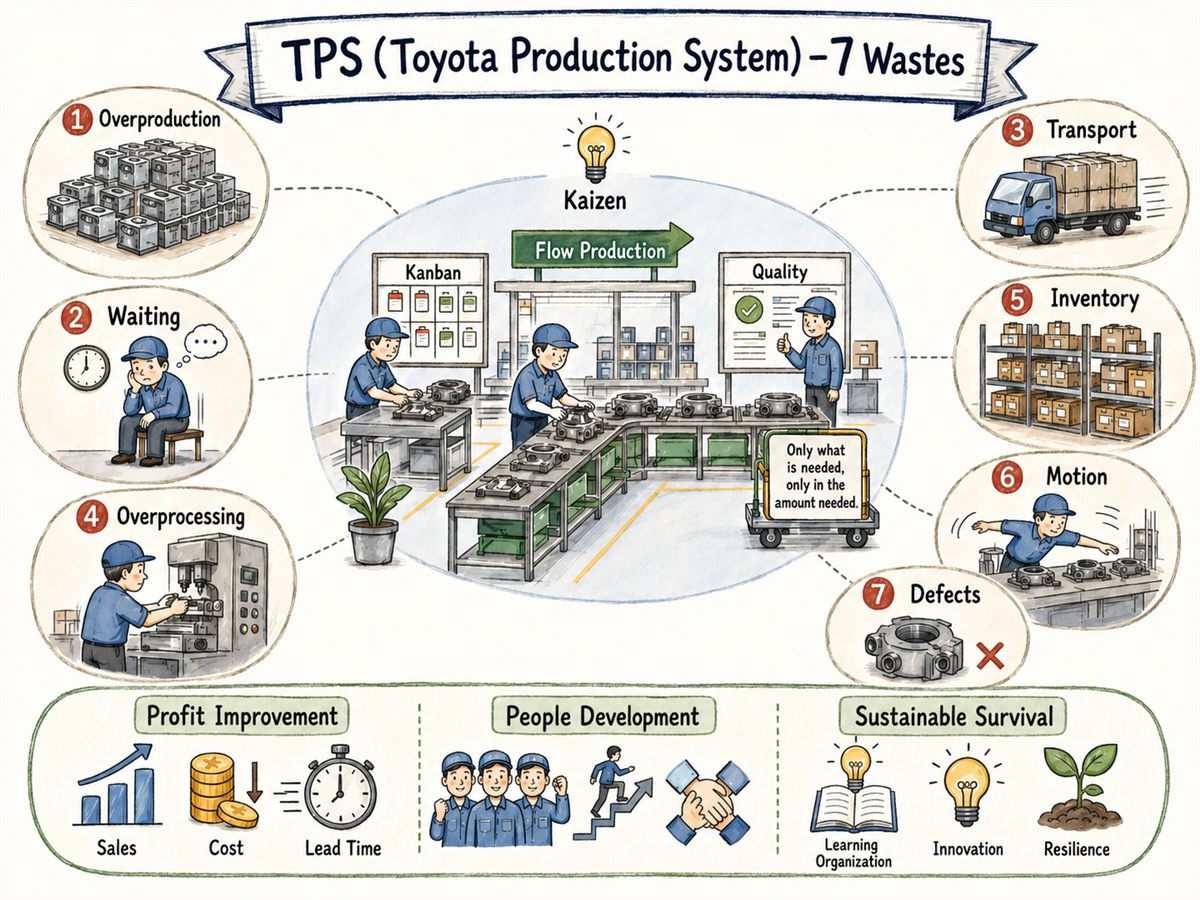
Waste
Resources involved
① Overproduction
Man + Machine + Material
② Waiting
Man
③ Transport
Man
④ Over-processing
Man + Machine + Material
⑤ Inventory
Material
⑥ Unnecessary motion
Man
⑦ Defects
Man + Material
① Overproduction
Making things before there's a confirmed customer for them. Production based on distributor forecasts, scheduled runs driven by the production control department's calendar, consolidated runs to match packaging minimums — none of these typically register as overproduction, which is exactly the trap. The true state of zero overproduction is making nothing beyond confirmed customer orders. Over-emphasis on utilization rates and convenient work distribution are the usual culprits.
② Waiting
Any time spent not touching the product is waste. Watching an automated machine run its cycle, waiting caused by mismatched cycle times between stations, waiting due to equipment breakdowns or incoming defective material — all of this is waiting waste. The root causes are often a technician's assumption that "each process is its own independent domain" or a manager's loose thinking that "headcount should be fixed per process."
③ Transport
Moving things further than necessary, or temporarily staging them in transit. Neatly transferring parts between machines, pulling small quantities from a distant pallet — both qualify as transport waste. The ideal is direct supply and direct attachment: deliver to where it's needed with no intermediate steps. Functional layouts (machines grouped by type rather than by product flow) and aesthetically-motivated floor arrangements are common causes.
④ Over-processing
Waste created by design or machining limitations. Examples: excessive approach and overrun in machining, extra press strokes, deburring after forming, chamfering and reaming after drilling. Anything beyond the actual cutting or forming that produces sparks or chips — the "real" work — is a candidate for elimination.
⑤ Inventory
Buffer stock kept as "insurance" against problems. Inventory held to absorb equipment or quality issues, inventory created by mismatched machine capacities, lot-size inventory generated by long changeover times — these are the typical forms. Inventory is commonly treated as a necessity, but in TPS it's viewed as the root of all other wastes and a direct readout of the organization's technical and managerial capability.
⑥ Unnecessary motion
Motions that interrupt the flow of work. Re-gripping a tool after picking it up, forcing a part onto a fixture with a sharp edge, holding a component in place while waiting for adhesive to cure — these are the typical examples. What makes this waste especially insidious is that it's hard to notice it's happening at all.
⑦ Defects
The waste that loses money with every unit made. The core problem is that the sense of guilt about making defects disappears: "it'll get recycled anyway," "we can fix it later," "we can't help it with this skill level." When defect-making stops registering as a problem, it stops being treated as one.
The waste-hunting process
Map the flow of materials (flow diagrams, process analysis)
Find where things stagnate (check standard WIP levels, container counts)
Investigate why (spot observations, work content measurement, standardized work combination sheets)
Mark standard WIP levels visually (MIN/MAX)
Cautions when observing facts on the floor
Don't be fooled by what you can't see: it's easy to see only what you're already interested in — stay vigilant about this
Facts aren't the same as truth: facts are just results; measurement error, condition differences, and reliability issues mean the fact and the truth can diverge
You can't perfectly convert reality into information: data is always "a shadow of the fact" — approach it with humility
"Seeing" has layers: what passively enters your eye, what you actively inspect with purpose, what you make visible (kanbans, signs), what you perceive with all senses — knowing which layer you're working at matters
When analyzing a situation, lead with principles and show things in numbers and photos rather than narration. If a motion covers 30 cm per cycle and daily output is 460 units, calculate the cumulative distance across 20 people over 12 months — the number runs into tens of kilometers. That's how you make a small motion impossible to dismiss.
Waste elimination sequence (summary)
Watch how people move
Watch how things flow
Check whether abnormal conditions are immediately visible without anyone having to look for them
Check whether production is running to cycle time
Identify waste, think through root causes, generate improvement ideas
Verify that improvement has become part of daily floor work — not a special event
The TPS 7 wastes are ultimately a list that puts seven specific faces on "everything that doesn't add value." Looking at them individually matters less than understanding how they connect: overproduction creates inventory, inventory creates transport and waiting, and problems in that inventory get discovered late. Underneath all of it is the same principle — confirm facts as they are, on the floor, with data.
댓글Comments