[생산관리] 공장 낭비를 없애는 가장 기본적인 방법: 눈으로 보는 관리[Production Management] The Most Basic Way to Eliminate Factory Waste: Visual Management
FREEWAYFREEWAY·2026년 8월 4일August 4, 2026·10분 읽기10 min read
생산라인을 관리하다 보면 "낭비를 줄이자"는 말은 늘 나오는데, 정작 낭비가 정확히 뭘 가리키는지, 어디서부터 손을 대야 하는지는 애매할 때가 많습니다. 예전 현장 교육 자료를 다시 정리하면서, 공장 낭비의 개념부터 5S, 그리고 실제로 현장에서 쓰는 "눈으로 보는 관리" 기법까지 순서대로 풀어봤습니다.
낭비란 무엇인가
낭비를 가장 간단하게 정의하면 이렇습니다.
낭비 = 지금 하고 있는 일 − 돈이 되는 일(부가가치가 있는 일)
생산은 기본적으로 "흐름"이 있어야 합니다. 자재든 정보든 사람이든 설비든, 흐르지 않고 멈춰 있는 상태가 바로 낭비입니다. 그래서 낭비를 찾는 첫걸음은 물자가 정체되어 있는 지점을 찾는 것입니다.
낭비를 찾는 절차는 대략 이런 흐름을 따릅니다.
물자의 흐름을 본다 (흐름선도, 공정분석)
정체되는 공정을 찾는다 (표준 정체량, 용기 수, 준비교체·운반·불량 등 확인)
정체 원인을 조사한다 (작업자 관측, 공수 측정, 표준작업조합표)
근본 원인을 제거한다 (작업자 인터뷰, 작업 분석, 즉시 실천)
정미작업 vs 부수작업 vs 낭비
실제 작업을 세밀하게 관찰하면 동작은 크게 세 가지로 나뉩니다.
정미작업(35%): 실제로 고객이 비용을 지불하는 가공·조립·도장·포장 같은 순수 작업
부수작업(25%): 정미작업을 위해 어쩔 수 없이 필요한 보조 동작
낭비(40%): 부가가치를 만들지 않는 나머지 전부
이 비율이 보여주듯, 현장 작업시간의 상당 부분(자료에 따라 40% 안팎)이 실제로는 낭비일 수 있습니다. 집는다, 놓는다, 운반한다, 쌓는다, 옮긴다, 찾는다, 전수검사한다, 바라본다, 청소한다 — 이런 동작 대부분은 지금 당장은 필요해 보여도 사실은 앞으로 없앨 수 있는 것들입니다.
생산 현장의 7대 낭비
낭비를 유발하는 자원을 사람(Man)·설비(Machine)·자재(Material)로 나눠보면, 아래 7가지로 정리됩니다.
낭비
관련 자원
과잉생산의 낭비
사람 + 설비 + 자재
대기의 낭비
사람
운반의 낭비
사람
가공 그 자체의 낭비
사람 + 설비 + 자재
재고의 낭비
자재
동작의 낭비
사람
불량을 만드는 낭비
사람 + 자재
이 중에서도 과잉생산은 다른 낭비를 전부 유발하는 근본 원인으로 꼽힙니다. 필요 이상으로 만들면 그만큼 재고가 쌓이고, 재고를 두려면 운반과 보관 공간이 필요해지고, 그 과정에서 불량 발견도 늦어지는 식으로 연쇄적으로 번지기 때문입니다.
현장에서 낭비를 제거하는 순서
작업자의 움직임과 제품·자재의 흐름을 본다
이상 상황이 눈으로 봐도 바로 알 수 있게 관리되고 있는지, 사이클 타임 기준으로 생산되고 있는지 확인한다
낭비를 발견하고 원인을 생각해서 개선 아이디어를 낸다 — 이게 일상 업무의 일부가 되어야 한다
공장관리의 기본, 5S
5S는 정리·정돈·청소·청결·습관화를 가리키는, 현장 개선의 가장 기초적인 활동입니다.
항목
의미
정리(整理)
필요품과 불필요품을 구분해서, 불필요품을 가치 있게 처리하는 활동
정돈(整頓)
필요품을 누구나 알기 쉽고 쓰기 쉽게 정해진 위치·수량으로 보관하는 활동
청소(淸掃)
이물질·오염·먼지·쓰레기를 제거해 깨끗한 상태를 만드는 활동
청결(淸潔)
정리·정돈·청소 상태를 계속 유지하는 활동
습관화(習慣)
정해진 표준을 항상 올바르게 지키도록 습관을 만드는 활동
5S는 단순히 "청소 잘하자"는 캠페인이 아닙니다. 낭비를 사전에 예방하고, 여유 공간을 만들어 생산성 향상을 돕고, 품질 향상의 기본 환경을 조성하고, 안전사고와 설비 고장을 줄이는 데까지 이어지는 활동입니다. 그리고 무엇보다 전원 참가가 핵심입니다 — 몇몇 담당자만의 일이 아니라는 뜻입니다.
정리(整理): 필요·불필요를 나누기
정리 활동은 보통 이런 단계로 진행됩니다.
추진 팀 구성
일정 계획 수립
필요품·불요품·불용품 기준 설정
붉은 표찰 부착
표찰 부착품 처리 (폐기/매각/반납/전환사용)
활동 수준 평가
붉은 표찰(Red Tag)은 대표적인 "눈으로 보는 정리" 도구입니다. 불필요해 보이는 물품에 표찰을 붙여두고, 일정 기간이 지나도 아무도 찾지 않으면 처리 대상으로 확정하는 방식입니다.
불필요품 기준은 장소마다 다르게 잡는 게 보통입니다. 예를 들어 생산공장은 "0.5개월 이내 미사용 제품", 창고는 "3개월 이내 미사용품" 식으로 구역별 특성에 맞춰 정합니다.
정돈(整頓): 찾기 쉽고 쓰기 쉽게
정돈은 필요한 물품을 누구나 쉽게 찾고, 쉽게 쓰고, 정해진 수량만 보관하는 활동입니다. 핵심은 3정(定) — 정품(무엇이), 정량(얼마나), 정위치(어디에) — 를 지키는 것입니다.
어디에 → 장소·번지 표시로 정위치를 만든다
무엇이 → 보관 품목을 표시해서 정품을 만든다
얼마나 → 최대량·최소량(MIN/MAX)을 표시해서 정수량을 만든다
정돈이 잘 되어 있으면 재고의 최대·최소량이 한눈에 보이고, 통로·작업장·보관장이 색선으로 명확히 구분되어 있으며, 공구·지그·측정기기가 지정된 자리에서 바로 쓸 수 있는 상태가 됩니다.
청소(淸掃): 청소는 곧 점검이다
청소는 단순히 깨끗하게 만드는 게 아니라, 설비의 결함을 발견하는 점검 활동이라는 게 핵심입니다. 3단계로 나눠 볼 수 있습니다.
일상 청소: 먼지·오염·이물질을 제거해서 반짝반짝하게 만드는 단계
점검 청소: 기계·설비를 청소하면서 구동부·전기계장부·유공압부 등의 결함을 감지하는 단계
보전 청소: 발견된 결함을 작업자가 직접 복원·개선하거나, 어려우면 담당 부서에 의뢰하는 단계
청소를 제대로 하면 설비 열화를 막고, 결함을 사전에 조치할 수 있고, 품질이 안정되고, 무엇보다 설비에 대한 애착심도 생긴다고 합니다 — 마지막 항목이 은근히 중요한 포인트입니다.
청결(淸潔)과 습관화(習慣化)
청결은 정리·정돈·청소 상태를 계속 유지하는 것이고, 습관화는 정해진 것을 항상 올바르게 지키는 습관 자체를 만드는 것입니다. 습관화가 안 되면 아무리 3S를 잘해도 금방 원래 상태로 돌아갑니다 — 치워도 곧 다시 어질러지고, 부품을 제자리에 둬도 며칠 안 가 흐트러지는 식입니다.
습관화 단계는 결국 3S 활동(정리·정돈·청소)을 "불필요품이 아예 생기지 않는 구조", "정돈하지 않아도 정돈되는 구조", "더러워지지 않는 구조"로 끌어올리는 것을 목표로 합니다. 단순히 치우는 데서 그치지 않고, 애초에 문제가 생기지 않도록 구조 자체를 바꾸는 상급 단계입니다.
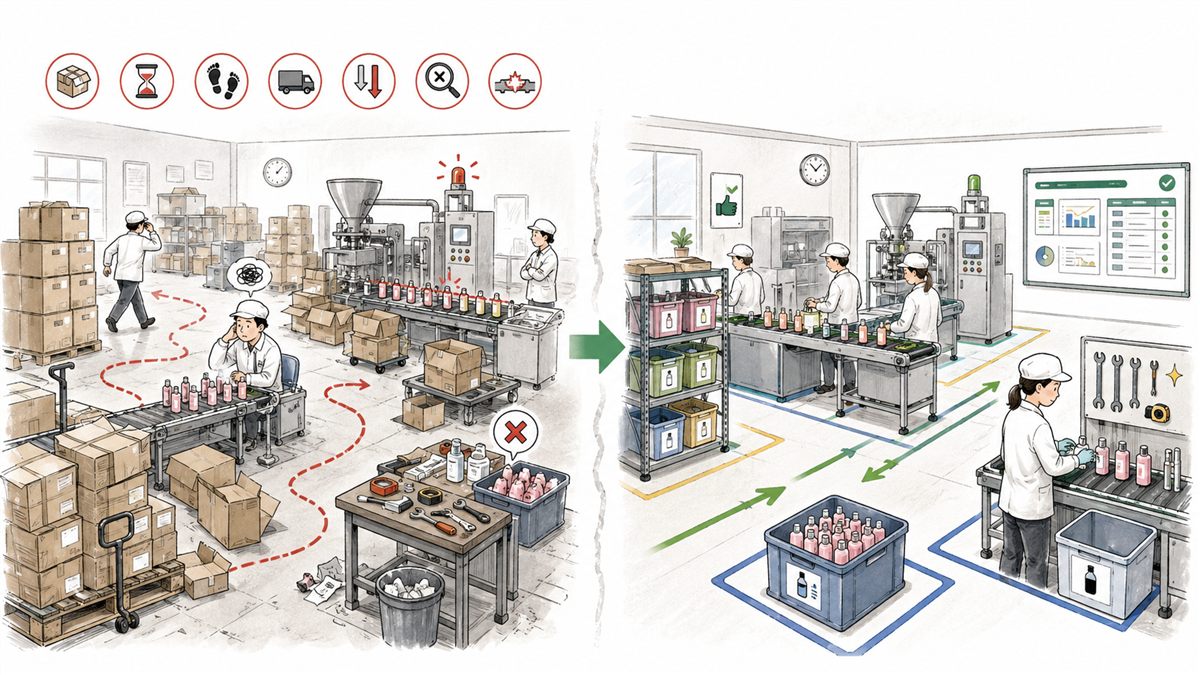
눈으로 보는 관리: 정상과 이상을 한눈에 구분하기
"눈으로 보는 관리"의 핵심은 이겁니다.
무엇이 정상이고 무엇이 이상인지, 누구나 한눈에 알 수 있게 만든다.
기계, 라인, 재고 보관 방법, 간판 운용, 작업자의 작업 방법 — 이 모든 것에서 정상과 이상을 구별할 수 있으면, 문제점이나 개선이 필요한 부분이 저절로 드러납니다. 굳이 관리자가 매번 돌아다니며 확인하지 않아도 되는 상태를 만드는 게 목표입니다.
부품 보관장 운영 원칙
생산라인 가까이에 보관장을 두어 작업자가 바로 확인할 수 있게 한다
부품은 종류별로 두고, 각 종류마다 수량을 알 수 있게 한다
가공 순서대로 후공정이 가져갈 수 있도록 선입선출(FIFO)이 되게 한다
보관장 크기는 필요량만 담을 수 있도록 제한해서, 넘치면 바로 "이상 상태"임을 알 수 있게 한다
보관장에 주소를 명시하고 간판과 대응시켜 둔다
실제로 쓰이는 눈으로 보는 관리 도구들
도구
역할
로스 표시 (붉은 딱지)
불필요한 것과 필요한 것을 나눠 불필요한 것을 제거
간판 작전
필요한 것을 알아보기 쉽게 명시 (눈으로 보는 정돈)
구역 표시
보관장·통로·작업 구역을 구획선으로 명확히 구분
관리 수위 (MIN/MAX)
재고의 최대·최소량을 표시
표시등 (Andon)
호출·이상·가동 상태를 알리는 신호
문자 간판
JIT(Just In Time) 풀(Pull) 생산을 지키기 위한 인수/작업지시 도구
생산 관리판
라인의 생산 상황을 실시간으로 표시
표준 작업표
사이클 타임·작업 순서·표준대기 3요소로 구성된 표준 작업 정의
불량 전시
불량품을 전시해서 재발을 방지
이 중 표준 작업표의 3요소 — 사이클 타임, 작업 순서, 표준대기 — 는 하나라도 빠지면 표준 작업이 성립하지 않는다고 여길 만큼 중요하게 다뤄집니다.
3불(不) 추방 운동: 불필요·불합리·불균일
낭비를 다른 각도에서 보면 "3불"로 정리할 수 있습니다.
불필요: 부가가치가 없는 동작이나 작업. 대기, 불필요한 동작, 불필요한 운반, 과다한 재공·재고, 불량, 과잉 정밀도 요구 등이 여기 속합니다.
불합리: 피로의 원인이 되는 동작. 무리한 운반, 부자연스러운 자세, 억지로 맞추는 작업, 추측으로 하는 작업 등입니다.
불균일: 불합리와 불필요를 일으키는 근본 원인. 작업 동작이 리듬 없이 불규칙하거나, 공구·자재의 위치가 매번 바뀌는 상태를 말합니다.
세 가지가 서로 얽혀 있다는 점이 포인트입니다. 위치가 매번 바뀌는 불균일한 상태(3번)는 결국 작업자가 매번 찾아 헤매는 불필요한 동작(1번)과 무리한 자세(2번)로 이어집니다.
물품 비치 방법: 딱 보면 알 수 있게
물품을 비치할 때 가장 중요한 건 "무엇이 몇 개 있고, 그게 몇 시간 분량인지"를 한눈에 알 수 있게 하는 것입니다.
완성품은 라인 출구에 두고, 적치량으로 진척이 정상보다 빠른지 늦은지 판단한다 — 결품이 잦으면 지연, 재고가 계속 쌓이면 과잉생산 신호
품번별로 1일 필요 수량을 표시한다
선입선출이 지켜지도록 배치한다
MAX 표시를 명확히 해서, 그 이상 쌓이면 "이제 그만 만들어야 한다"는 신호로 쓴다
MIN 표시는 결품 위험과 작업교체 타이밍을 알리는 가공지시 신호로 쓴다
정리하면, 낭비 제거와 5S, 눈으로 보는 관리는 결국 하나로 이어지는 이야기입니다. 낭비를 알아채려면 정상과 이상을 구분할 수 있어야 하고, 그러려면 현장이 정리·정돈되어 있어야 하고, 그 상태를 유지하려면 습관화가 되어야 합니다. 그리고 이 모든 걸 사람이 매번 판단하지 않아도 되도록 만드는 게 눈으로 보는 관리의 목적입니다 — 관리자가 없어도 현장 스스로 "지금 정상인지 이상인지"를 말해주는 상태를 만드는 것, 그게 핵심입니다.
In manufacturing, "let's reduce waste" comes up constantly — but what exactly counts as waste, and where do you even start? Going back through some old shop floor training materials, I put together a walkthrough from the basics of factory waste, through 5S, and into the visual management tools that actually get used on the floor.
What is waste?
The simplest definition:
Waste = What you're doing now − What adds value (what the customer pays for)
Production requires flow — materials, information, people, equipment all need to keep moving. Anything that has stopped flowing is waste. So the first step to finding waste is finding where things are piling up.
The general process for hunting waste looks like this:
Map the flow of materials (flow diagrams, process analysis)
Find where things stagnate (check standard WIP levels, container counts, changeover time, transport, defects)
Investigate why (operator observation, work content measurement, standardized work combination sheets)
Remove the root cause (operator interviews, work analysis, immediate action)
Value-added work vs. incidental work vs. waste
Break down observed work time and you get roughly three categories:
Value-added work (~35%): Pure processing, assembly, coating, packaging — the work the customer is actually paying for
Incidental work (~25%): Support actions that have to happen to enable value-added work
Waste (~40%): Everything else — no value added
As that breakdown suggests, a large share of floor work time — around 40% by many measures — may be pure waste. Picking up, putting down, transporting, stacking, moving, searching, 100% inspection, watching, cleaning — most of these look necessary in the moment, but many can eventually be eliminated.
The 7 wastes on a production floor
Sorting waste by the resource that drives it — Man, Machine, Material — gives you the classic 7 wastes:
Waste
Resources involved
Overproduction
Man + Machine + Material
Waiting
Man
Transport
Man
Over-processing
Man + Machine + Material
Inventory
Material
Unnecessary motion
Man
Defects
Man + Material
Overproduction is widely considered the root cause that triggers all the others. Make more than you need and you accumulate inventory; inventory requires transport and storage space; problems hide in inventory and surface late — one waste spawns the rest.
How to eliminate waste on the floor
Watch how operators move and how products and materials flow
Check whether abnormal conditions are immediately visible to anyone, and whether production is running to cycle time
Identify waste, think through root causes, and generate improvement ideas — this needs to be part of everyday work, not a special event
The foundation of factory management: 5S
5S — Sort, Set in order, Shine, Standardize, Sustain — is the most fundamental improvement activity on any production floor.
Step
What it means
Sort (整理)
Separate needed from unneeded items; dispose of unneeded items appropriately
Set in Order (整頓)
Store needed items so anyone can find and use them — at defined locations, in defined quantities
Shine (淸掃)
Remove contaminants, dirt, and debris; create and maintain a clean state
Standardize (淸潔)
Maintain the Sort / Set in Order / Shine conditions consistently
Sustain (習慣)
Build habits that keep the defined standards in place — always, correctly
5S is not a "clean up the workplace" campaign. It prevents waste before it forms, creates space that enables productivity improvement, builds the environment quality needs, and reduces safety incidents and equipment failures. Crucially, it requires everyone's participation — not just a few people assigned to it.
The Red Tag is the defining "visual sort" tool. Attach a tag to anything that looks unneeded; if nobody claims it after a set period, it gets processed out. Criteria vary by area — a production floor might use "not used within 0.5 months," a warehouse "not used within 3 months."
Set in Order: easy to find, easy to use
Set in Order is about storing needed items where anyone can find them quickly, use them immediately, and return them — in defined quantities. The core is the 3-Fixed rule: fixed item (what), fixed quantity (how many), fixed location (where).
Where → label locations and addresses to create fixed spots
What → label stored items to define what belongs where
How many → mark MIN/MAX quantities to control how much is kept
A well-organized area lets you see maximum and minimum inventory at a glance, has aisles, workstations, and storage zones clearly separated by color lines, and keeps tools, jigs, and measuring instruments at their designated spots — ready to use immediately.
Shine: cleaning is inspection
The key insight in the Shine step is that cleaning isn't just about cleanliness — it's an inspection activity that finds equipment defects. It runs in three stages:
Daily cleaning: Remove dust, dirt, and contaminants — get things shining
Inspection cleaning: While cleaning machinery, detect defects in drive components, electrical systems, hydraulics, pneumatics
Maintenance cleaning: Restore or improve what you find, or escalate to the maintenance team if it's beyond the operator's scope
Doing this consistently prevents equipment degradation, catches defects before they become failures, stabilizes quality — and, surprisingly important, builds operator pride in the equipment they work with.
Standardize and Sustain
Standardize means maintaining the Sort / Set in Order / Shine conditions continuously. Sustain means making the correct behaviors automatic — a habit rather than a task. Without Sustain, even excellent 3S work reverts within days: the clutter comes back, tools end up in random spots, the floor gets dirty again.
The real goal of the Sustain step is to elevate the first three S's to a structural level: "a structure where unneeded items never appear," "a structure that stays organized without deliberate organizing," "a structure that doesn't get dirty." Not just cleaning up — redesigning the system so the problem doesn't arise.
Visual management: anyone can see normal vs. abnormal at a glance
The core idea of visual management:
Make it so that anyone can tell at a glance what is normal and what is abnormal.
When machines, lines, inventory storage, kanban flow, and operator methods all show their normal state visibly — problems and improvement opportunities surface on their own. The goal is a floor that doesn't require a manager walking around to check on things.
Parts storage principles
Keep storage close to the production line so operators can check it immediately
Store parts by type, with quantity visible for each type
Arrange for FIFO (first in, first out) so downstream processes take in sequence
Limit storage size to the necessary quantity — overflow immediately signals an abnormal condition
Label storage locations with addresses and link them to their kanbans
Visual management tools in use
Tool
Role
Red Tag
Separate unneeded from needed items; eliminate the unneeded
Kanban signs
Label what belongs where — visual Set in Order
Zone markings
Clearly delineate storage, aisles, and work areas with color lines
MIN/MAX indicators
Show maximum and minimum inventory levels at a glance
Andon lights
Signal calls for help, abnormalities, or equipment status
Text kanbans
Pull-system work instructions supporting JIT production
Production status board
Real-time display of line production status
Standardized work sheet
Defines the 3 elements of standard work: cycle time, work sequence, standard WIP
Defect display
Display defective parts to prevent recurrence
Of these, the standardized work sheet's 3 elements — cycle time, work sequence, and standard WIP — are treated as non-negotiable: remove any one of them and standardized work ceases to exist.
The 3 MUs: eliminating muda, muri, and mura
Another angle on waste is the 3 MU framework:
Muda (waste / 불필요): Activities or motions that add no value — waiting, unnecessary movement, unnecessary transport, excess WIP/inventory, defects, over-precision.
Muri (overburden / 불합리): Activities that cause fatigue — excessive lifting, unnatural postures, forced fitting, guesswork.
Mura (unevenness / 불균일): The root cause that generates muda and muri — irregular work rhythm, tool and material positions that change each time.
The important point is that they feed each other. Mura (storage location changes every day) inevitably produces muda (the operator searches every time) and muri (awkward postures while searching).
How to lay out materials: visible at a glance
The most important thing when placing materials and finished goods: "what's here, how many, and how many hours' worth" should be instantly readable.
Place finished goods at the line exit; use the pile level to judge whether production is ahead or behind — frequent shortages signal delay, ever-growing stock signals overproduction
Mark the daily required quantity by part number
Arrange for FIFO
Mark MAX clearly — anything above it is a "stop producing" signal
Use MIN as a production trigger — a signal that replenishment or changeover is needed before a shortage occurs
Waste elimination, 5S, and visual management are ultimately one continuous story. To notice waste, you need to be able to distinguish normal from abnormal. To do that, the workplace needs to be sorted and organized. To keep it that way, the behavior has to become habitual. And to take the burden off people having to judge this constantly — that's what visual management is for. Building a floor that tells you "normal or abnormal right now" without a manager having to check: that's the point.
댓글Comments