[산업공학(IE)] 1편: IE란 무엇인가 — 테일러부터 호손 실험까지[Industrial Engineering (IE)] Part 1: What Is IE? — From Taylor to the Hawthorne Experiments
FREEWAYFREEWAY·2026년 8월 5일August 5, 2026·10분 읽기10 min read
시리즈 안내 — 이 글은 「산업공학(IE)」 6편 시리즈의 1편입니다.
1편: IE란 무엇인가 — 테일러부터 호손 실험까지 (현재 글)
2편 이후: 공정분석 · 동작연구 · 작업측정 · PTS법 · 라인 밸런싱 예정
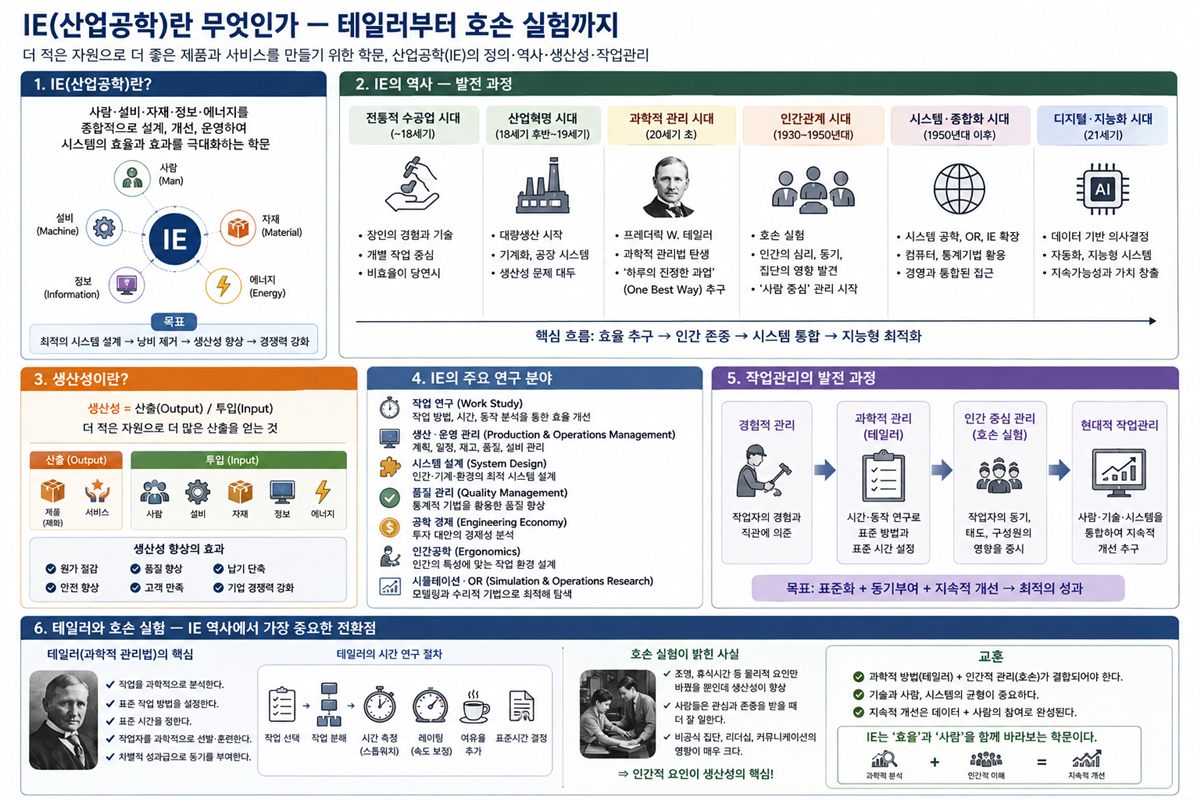
지금까지 다룬 생산성·5S·TPS·표준시간·MRP/JIT 같은 개념들은 사실 전부 하나의 뿌리에서 나왔습니다. 바로 IE(Industrial Engineering, 산업공학)입니다. 이번엔 그 뿌리로 내려가서, IE가 뭘 하는 학문이고 어떻게 시작됐는지를 정리해봤습니다. 이번 편은 IE의 정의·역사·생산성 개념·작업관리까지입니다.
IE란 무엇인가
산업공학을 한 줄로 정의하면 이렇습니다.
사람, 자재, 설비, 에너지 등 모든 자원의 이용 가치를 최대로 끌어올리기 위해, 수학·자연과학·사회과학을 아우르는 모든 공학적 기법을 동원해서 생산성을 향상시키는 기술.
여기서 몇 가지 짚어볼 포인트가 있습니다.
목적: 사람의 생산성을 높여서 조직의 경제성을 향상시키는 것
대상: 기업 전체 — 말단 직원부터 최고경영층까지 모든 계층, 모든 부문의 사람
목표: 현실적인 목표치에 그치지 않고, 최고의 이상적인 상태를 목표로 삼아 거기에 최대한 가까이 다가가려는 지향점을 갖습니다
경영과의 관계: IE는 사람을 대상으로 하는 활동이기 때문에 조직 전체의 적극적인 지지와 참여가 필요하고, 최고경영층과 직결되는 전문 조직에 의해 추진되어야 합니다
앞서 다룬 TPS 7대 낭비 글에서 "이상(理想)과 목표는 다르다"고 정리했던 부분이, 사실 IE 전체를 관통하는 사고방식이라는 걸 여기서도 확인할 수 있습니다.
IE의 역사: 원시적 IE부터 근대 IE까지
IE의 뿌리는 1760년대 영국 산업혁명까지 거슬러 올라갑니다. 아크라이트의 방적공장제도나 와트의 표준설정 시대를 "원시적 IE의 시대"라고 부릅니다. 하지만 우리가 지금 말하는 근대 IE는 미국의 프레더릭 테일러(F.W. Taylor, 1856~1915)가 내세운 과학적 관리법에서 시작됩니다.
테일러: 스톱워치의 시작
테일러는 미드베일 제철소에서 30세의 나이로 기사장으로 일하며, 하루의 올바른 작업량을 정하기 위해 스톱워치를 이용한 시간 연구를 처음 고안했습니다. 이후 여러 회사를 지도하면서 시간연구, 피로연구, 생산량연구, 직장(職長)제도 도입 등을 꾸준히 연구했고, 그 밑바탕에는 "높은 능률과 높은 임금으로 노사 양측이 함께 번영한다"는 생각이 깔려 있었습니다.
하지만 테일러는 사회적으로 상당한 오해도 받았습니다. 1910년 미국 철도회사들의 운임 인상 논쟁에서, 테일러가 "관리를 합리화하면 운임을 올리지 않고도 임금을 올릴 수 있다"고 발언해 큰 반향을 일으켰는데, 이게 노사 양쪽 모두로부터 "결국 노동 강화 아니냐"는 의심을 샀습니다. 2년 뒤에는 연방 하원의 '과학적 관리법 특별위원회'에 증인으로 불려가 강한 비판을 받기도 했습니다. 결국 그는 '혁명적 경영관리를 주장한 사람'이라는 오해와 불안을 남긴 채 1915년 세상을 떠났습니다.
이런 배경 때문에 당시 미국에서는 관계자들조차 "과학적 관리법"이라는 표현을 꺼려서, 대신 "Industrial Engineering"이라는 말을 쓰게 됐다고 합니다 — IE라는 이름 자체가 일종의 우회 표현에서 비롯된 셈입니다. 1908년에는 켄트(R.K. Kent)에 의해 'Industrial Engineering'이라는 전문지가 창간되기도 했습니다.
길브레스 부부: 동작연구의 시작
테일러와 어깨를 나란히 하는 인물이 길브레스(F.B. Gilbreth, 1868~1924)입니다. 그도 17세부터 작업자로 시작했고, 벽돌쌓기 작업 연구로 유명합니다. 원래 벽돌 하나를 쌓는 데 18가지 동작이 필요했던 걸 관찰한 뒤, 이를 5개 동작으로 줄이는 개선을 해냈습니다.
이후 그는 모든 작업 동작이 17개의 기본 동작으로 구성된다는 걸 발견했고, 이를 기호로 만들었습니다. 심리학자였던 부인의 아이디어를 따라 자기 이름(Gilbreth)을 거꾸로 늘어놓아 서블릭(Therblig)이라는 이름을 붙였습니다. 이 기호를 활용해서 작업을 개선하거나 설계하는 방법을 "동작연구"라 부르고, 이 단위로 작업을 관찰하는 자세를 "motion mind"라고 부르게 됐습니다. 길브레스는 또한 공정분석 기호를 처음 고안한 사람이기도 한데, 이게 나중에 미국기계학회에 의해 단순화되어 지금 쓰는 5가지 기본 기호가 됐습니다.
이후의 발전: 메이나드와 포드
테일러와 길브레스의 연구는 훗날 메이나드(H.B. Maynard)에 의해 "작업연구"라는 체계로 발전합니다. 한편 포드(H. Ford)는 식품 공업의 단순화 라인 작업을 보고 자동차 조립공장에 이를 도입할 것을 구상했는데, 그 과정에서 테일러의 시간연구와 길브레스의 동작연구를 함께 활용했습니다. 작업을 철저히 분업화·세분화·단순화·기계화하고 이를 재편성해서 초기 형태의 메커니컬 오토메이션을 성공시켰는데, 그 배경에는 수많은 공정을 하나의 라인으로 동기화해간 여러 선구자들의 숨은 노력이 있었습니다.
생산성이란
앞선 글에서도 다뤘던 내용이지만, IE 원론에서는 조금 더 체계적으로 정리됩니다.
생산성 = 산출량 / 투입량
생산량을 자본으로 나누면 자본생산성, 설비로 나누면 설비생산성, 노동(시간)으로 나누면 노동생산성이 됩니다. 최근에는 생산량 자체보다 "부가가치"에 주목하는 경우가 많은데, 원가·재료비·외주비를 절감하고 그 기업이 실제로 만들어낸 부가가치가 얼마인지를 보는 게 기업 내 활동과 더 직접 연결되어 판단하기 편하기 때문입니다.
부가가치(노동) 생산성 = 부가가치액 / 노동량(시간)
종합노동효율: 생산성을 쪼개서 보는 지표
제조 현장을 관리할 때는 "종합노동효율"이라는 지표를 흔히 씁니다.
종합노동효율 = 유효율 × 실시효율
유효율 = 가치효율 × 방법효율 — 개선을 통한 공수절감율의 추이를 관리하는 지표
종합능율(실시효율) = 가동율 × 능율 — 각각의 측정치를 사용해 관리하는 지표
이걸 조금 더 풀어서 보면, 하루의 재적공수(보유하고 있는 총 인력 시간)에서 시작해 아래 순서로 손실이 빠져나갑니다.
재적공수
 └─ (결근, 지각, 조퇴, 조회 등) 제외 → 취업공수
     └─ (가동Loss: 회사행사, 재료대기/결품, 작업대기, 설비고장, 회의 등) 제외 → 실동공수
         └─ (퍼포먼스Loss: 작업자 미숙련·노력부족·불량·수리·편성 등) 제외 → 표준생산량공수
작업능율을 측정하려면 가동율 측정에 쓰는 실적 데이터에 "양품수"를 곱한 표준시간이 필요합니다. 즉 Performance Loss는 실적 시간과, 정확히 설정된 표준시간을 비교해야만 측정할 수 있다는 뜻입니다 — 표준시간이 왜 그렇게 정밀하게 다뤄져야 하는지를 여기서도 다시 확인할 수 있습니다.
흥미로운 구분은, 가동율은 관리자의 계획 수립과 예기치 못한 사고에 대한 대응력으로 향상되고, 작업능율은 관리·감독자가 작업자에게 제공하는 교육·훈련이나 동기부여로 향상된다는 것입니다. 즉 같은 "효율" 저하라도 원인과 해법이 서로 다른 층위에 있다는 뜻입니다.
호손 공장의 실험: 과학적 관리법을 뒤집은 발견
테일러이즘이 지배하던 시대에, 이 흐름을 완전히 다른 방향으로 틀어놓은 사건이 있습니다. 바로 1924년 웨스턴 일렉트릭사의 호손(Hawthorne) 공장에서 진행된 실험입니다.
조명 실험: 예상을 뒤엎은 결과
당시 이 공장은 복리후생 시설이 나쁘지 않았지만, 약 3만 명 종업원의 인간관계는 그다지 좋지 못했습니다. 작업능율 개선을 위해 IE 그룹이 조사·연구를 진행했지만 별 효과가 없었고, 결국 메이요와 뢰슬리스버거가 이끄는 연구팀이 새롭게 조직됩니다.
첫 번째 연구는 "조명이 작업에 미치는 영향"을 조사해서 최적 조도를 찾는 것이었습니다. 작업자를 두 조로 나눠, 테스트 그룹은 조명을 계속 바꾸고 컨트롤 그룹은 조명을 원래대로 유지하며 생산량을 비교했습니다.
테스트 그룹의 조명을 24, 46, 76촉광으로 점점 높이자 예상대로 생산량이 올랐습니다
그런데 조명을 바꾸지 않은 컨트롤 그룹도 똑같이 생산량이 올랐습니다
이번엔 테스트 그룹 조명을 10촉광으로 낮췄는데, 예상을 뒤엎고 생산량이 또 증가했습니다
3촉광, 이후 계속 낮춰도 생산량은 계속 올랐습니다
결국 달빛 수준인 0.06촉광에 도달하고 나서야 생산량 상승이 멈췄습니다
이 결과로 연구팀은 조명보다 훨씬 더 큰 요인이 작업능율을 지배하고 있다는 걸 깨닫고, 실험의 목적을 그 원인을 찾는 방향으로 바꿉니다.
계전기 조립 실험: 인간관계가 만드는 변화
두 번째 실험에서는 여자 종업원 2명을 뽑고, 그들이 좋아하는 친구 4명을 더해 총 6명으로 구성된 그룹을 5년간 관찰했습니다. 이들은 별도의 작업실에서 전화 계전기를 조립했고, 작업조건·태도·심리·능율이 계속 관측됐습니다. 조사원은 항상 이들과 접촉하며 의견을 듣고 불평에 귀를 기울였습니다.
이 기간 동안 놀랍게도 피로 축적이 거의 보이지 않았고 결근도 극히 적었습니다. 이들에게는 상당한 자유가 주어졌습니다 — 피곤하면 작업을 중단할 수 있었고, 각자 좋아하는 방법으로 작업할 수 있었고, 단조로움을 줄이기 위해 작업 방법을 바꾸는 것도 허용됐습니다.
흥미로운 점은, 이렇게 자유를 준 결과 오히려 그룹으로서의 책임감이 높아지고, 위에서 내려오는 권력이 아니라 그룹 내부에서 생기는 압력으로 각자의 행동이 규제됐다는 것입니다. 이 실험과 병행해서 1928~1930년 사이 2만 1천 명을 대상으로 한 면접조사도 진행됐습니다.
결론: 집단에 관한 인간행동의 과학
이 연구들에서 나온 핵심 결론을 정리하면 이렇습니다.
기업 내 사람의 생산능율을 지배하는 것은 인간의 감정이다
피로나 단조로움도 대부분은 마음속 불만의 결과다
불만은 종종 마음속 불안의 표시이며, 이 불안은 자신이 속한 그룹 내에서 사회적 지위가 낮다고 느낄 때 강해진다
감정은 개인의 경력과 현장에서의 체험에 좌우된다
그룹 내 사회적 지위를 확보하려면 그룹의 기준에 따라 행동해야 한다
일정 기간 접촉을 유지하는 사람들 사이에는 비공식적인 그룹이 자연스럽게 생긴다
인간의 감정을 무시한 합리주의는 오히려 산업상의 불안을 조장한다
테일러의 과학적 관리법이 "작업 동작·물리적 환경 조건"에 초점을 맞췄다면, 호손 실험은 "인간관계와 심리적 요인"이 생산성을 좌우한다는 걸 실증적으로 보여준 사건입니다. 이후 IE는 순수 공학적 접근에서 인간관계론(Human Relations)까지 아우르는 방향으로 확장됩니다.
작업관리란
호손 실험 이후의 흐름을 포함해서, IE의 실무 영역인 "작업관리"를 정의하면 이렇습니다.
현장의 작업방법·작업조건 등을 조사·연구해서 무리와 낭비 없이 작업을 원활히 수행할 수 있도록 최선의 작업방법을 찾고, 작업효율을 저하시키는 조건을 개선해서 최적의 작업조건을 만드는 활동.
작업관리의 발전 과정 (인물별 정리)
인물
주요 기여
테일러(Taylor)
과학적 관리법의 원칙, 과업관리 원칙, 시간연구의 시작, 차별성과급 제도
길브레스 부부(Gilbreth)
최선의 작업방법 주장, 서블릭 동작분석 기호 창안, 마이크로모션 스터디, 벽돌쌓기 동작연구, 사이클 그래프·크로노 사이클 그래프 분석
시걸(Segar)
PTS법의 기초가 되는 MTA법 개발
티페트(Tippet)
워크 샘플링법 개발
퀵(Quick)
PTS법 중 WF법 개발
메이나드(Maynard)
PTS법 중 MTM법 개발
메이요(Mayo)
호손 실험을 통해 물리적 조건보다 사회적 조건이 생산성에 영향을 미친다고 주장, 비공식 조직의 중요성 제기
이 표를 보면 IE가 어떻게 발전해왔는지 흐름이 보입니다. 테일러·길브레스가 "정량적으로 측정하는 방법"을 만들었다면, 시걸·티페트·퀵·메이나드는 그 측정을 더 정교하고 효율적으로 할 수 있는 기법으로 발전시켰고, 메이요는 그 반대편에서 "측정만으로는 부족하다"는 걸 보여준 셈입니다.
작업관리에서 작업자의 역할
작업관리가 궁극적으로 추구하는 여덟 가지 목표입니다.
공평한 작업성과의 측정 및 배분
작업의 능률화
품질의 개선
생산성의 향상
최적 작업환경의 유지
작업시간의 단축
원가의 절감
작업자의 만족
마지막 항목 "작업자의 만족"이 다른 일곱 항목과 나란히 놓여 있다는 게 눈에 띕니다. 생산성·원가·품질 같은 경영 지표와 작업자의 만족도를 별개로 보지 않고 동등한 목표로 취급한다는 건, 앞서 살펴본 호손 실험의 교훈이 IE 실무에 그대로 반영된 결과라고 볼 수 있습니다.
작업관리의 영역: 방법연구와 작업측정
작업관리는 크게 두 축으로 나뉩니다.
방법연구: 작업방법·재료·공구·설비·작업조건을 대상으로, 작업의 표준화·공정분석·작업분석·동작연구를 통해 최적의 작업 공법을 찾는 활동. 접근 방식은 "문제해결절차(기본형 5단계)"와 "디자인 방식" 두 갈래로 나뉩니다
작업측정: 표준시간을 설정하는 활동으로, 스톱워치법·표준자료법·워크샘플링·PTS 등 여러 기법이 있습니다
앞선 글에서 다룬 스톱워치법과 표준시간 설정 절차가 바로 이 "작업측정" 영역에 해당하고, 다음 편에서 다룰 공정분석·동작연구는 "방법연구" 영역에 해당합니다.
정리하면, IE는 단순히 "시간을 재고 효율을 계산하는 기술"이 아니라, 테일러의 정량적 접근과 호손 실험이 보여준 인간적 요인까지 함께 아우르는 학문입니다. 다음 편에서는 이 중 "방법연구"에 해당하는 공정분석 — 어떤 기호로 작업을 도표화하고, 그걸로 실제 낭비를 어떻게 찾아내는지 — 를 구체적인 사례와 함께 다뤄보겠습니다.
Series note — This is Part 1 of 6 in the Industrial Engineering (IE) series.
Part 1: What Is IE? — From Taylor to the Hawthorne Experiments (this article)
Parts 2–6: Process analysis · Motion study · Work measurement · PTS methods · Line balancing (upcoming)
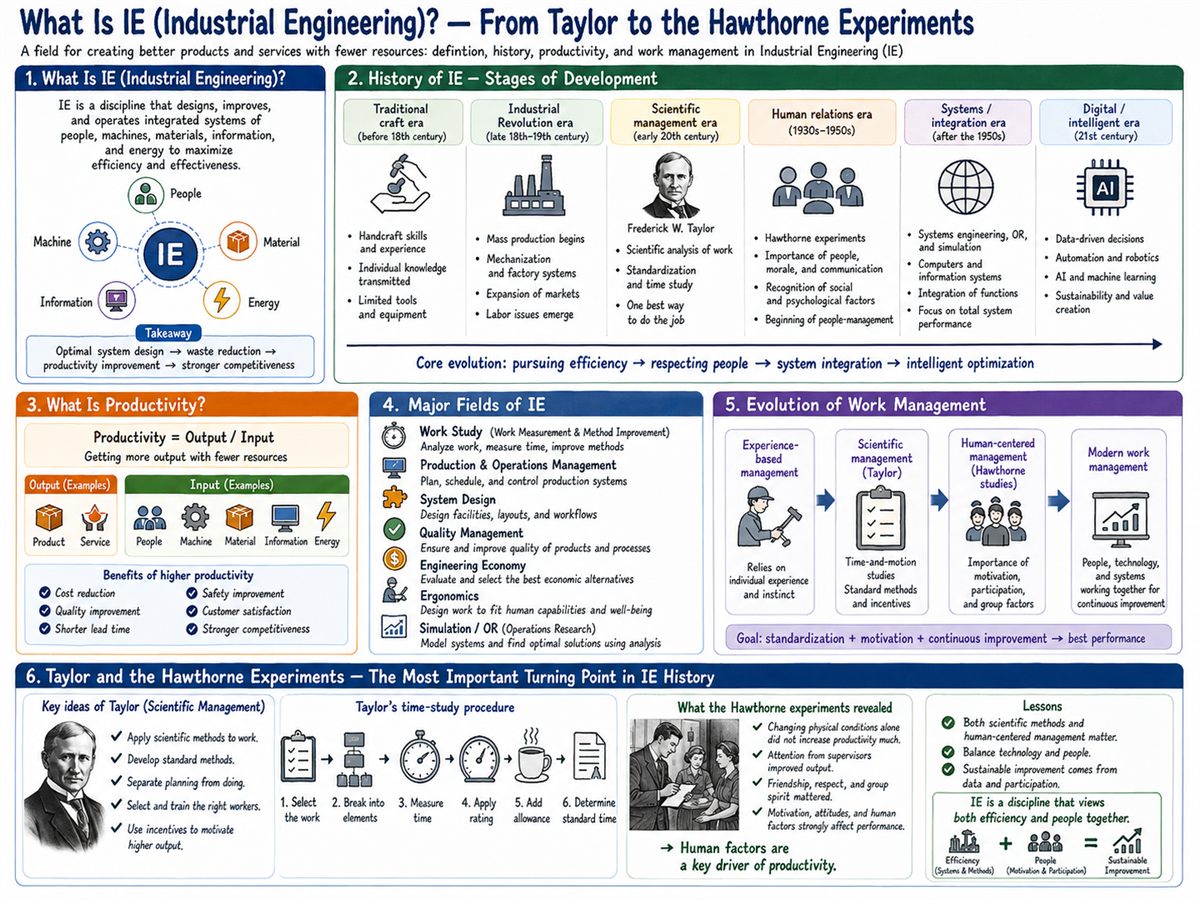
Every concept we have covered so far — productivity, 5S, TPS, standard time, MRP, JIT — traces back to a single root: Industrial Engineering (IE). This article goes back to that root and explains what IE is as a discipline and how it started. This installment covers IE's definition, its history, the concept of productivity, and work management.
What Is Industrial Engineering?
IE can be defined in one sentence:
The technology of improving productivity by applying every engineering technique drawn from mathematics, natural science, and social science in order to maximize the value derived from all resources — people, materials, equipment, and energy.
A few key points stand out.
Purpose: raise the productivity of people to improve the economic performance of the organization
Scope: the entire enterprise — every level and every department, from the shop floor to top management
Goal: pursuit of the ideal, not just a realistic target — IE aims for the best possible state and works to get as close to it as possible
Relationship to management: because IE's subject is people, it needs active support from the whole organization and must be driven by a specialist team that has direct access to top management
The point made in an earlier article on TPS — "the ideal and the target are not the same thing" — is in fact the mindset that runs through all of IE.
A History of IE: From Primitive to Modern
IE's roots go back to the British Industrial Revolution of the 1760s — Arkwright's factory system and Watt's era of standardization are sometimes called the "age of primitive IE." Modern IE, however, begins with the scientific management of the American Frederick W. Taylor (1856–1915).
Taylor: The Stopwatch Begins
Taylor was working as chief engineer at Midvale Steel at age 30 when he devised the first time study using a stopwatch, intending to determine the correct amount of work for a day. He went on to study time measurement, fatigue, output levels, and foreman systems at many companies, always guided by the conviction that high efficiency and high wages could bring prosperity to both labor and management.
Taylor was also widely misunderstood. In 1910, during a dispute over US railroad freight rates, he argued that rationalized management could raise wages without raising fares — a statement that drew suspicion from both sides, each fearing it meant intensified labor. Two years later he was called before a special congressional committee and subjected to heavy criticism. He died in 1915 leaving behind an image of someone who had stirred up anxiety with radical management ideas.
It was partly this climate that led people in the field to avoid the term "scientific management" and use "Industrial Engineering" instead — the name IE was itself a kind of workaround. In 1908 R.K. Kent launched a journal under that title.
The Gilbreths: Motion Study Begins
Frank B. Gilbreth (1868–1924) stands beside Taylor as a founding figure of IE. Starting as a worker at age 17, he became famous for his study of bricklaying. He observed that laying a single brick required 18 motions and reduced that to 5.
He later discovered that all work motions are composed of 17 fundamental elements, which he codified as symbols. At his wife's suggestion (she was a psychologist), he named these elements Therbligs — "Gilbreth" rearranged. Using these symbols to improve or design work became known as "motion study," and the habit of observing work at this level of granularity became known as the "motion mind." Gilbreth also invented the first process chart symbols, which were later simplified by ASME into the five basic symbols still in use today.
Later Developments: Maynard and Ford
Taylor and Gilbreth's work was eventually systematized by H.B. Maynard as "work study." Meanwhile Henry Ford, inspired by simplified line work in food production, applied both Taylor's time study and Gilbreth's motion study to automobile assembly. By thoroughly dividing, segmenting, simplifying, and mechanizing tasks, and reorganizing them on a synchronized line, Ford achieved early mechanical automation — built on the hidden contributions of many predecessors who had learned to synchronize multiple processes into a single line.
Productivity — Defined from IE First Principles
This topic was covered in an earlier article, but IE's original framework provides a more structured take.
Productivity = Output / Input
Divide output by capital and you get capital productivity; by equipment, equipment productivity; by labor hours, labor productivity. Today, many organizations focus on value added rather than raw output — because cutting costs, materials, and outsourcing to reveal how much value the company itself created connects more directly to internal activities and is easier to judge.
Value-added labor productivity = Value added / Labor hours
Work logs are used to collect scheduled hours and operating loss data as actual figures.
Measuring Work Efficiency
Work Efficiency = Standard production hours / Active hours = (Standard time × Good units) / (Scheduled hours − Operating losses)
Measuring work efficiency requires standard times multiplied by the number of good units — which means performance losses can only be measured by comparing actual hours against accurately set standard times. This is one more reason why standard time must be set with precision.
A useful distinction: the operating rate is improved by managers' planning ability and their response to unexpected events, while work efficiency is improved by training, coaching, and motivation provided to workers by supervisors. The same drop in efficiency may have entirely different causes — and require entirely different responses.
The Hawthorne Experiments: The Discovery That Upended Scientific Management
At the height of Taylorism, a series of experiments at the Western Electric Hawthorne plant (starting 1924) turned the field in a completely different direction.
The Lighting Experiments: Results Nobody Expected
The plant had decent facilities, but interpersonal relations among its roughly 30,000 workers were poor. IE teams had investigated and worked on improving efficiency without much success. A new research team under Mayo and Roethlisberger was formed.
Their first study aimed to find the optimal lighting level by measuring how illumination affected output. Workers were split into a test group (lighting changed) and a control group (lighting unchanged).
Raising the test group's lighting from 24 to 46 to 76 candlepower produced the expected rise in output
But the control group — whose lighting never changed — showed the same increase
When the test group's lighting was cut to 10 candlepower, output rose again — contrary to expectation
Output continued rising as lighting was cut further
Only at 0.06 candlepower — moonlight level — did the rise finally stop
The researchers concluded that something far more powerful than lighting was driving output, and redirected the study to find that factor.
The Relay Assembly Experiments: Human Relations at Work
The second study selected two female workers and added four friends they chose, forming a group of six observed continuously for five years. They assembled telephone relays in a separate room while their working conditions, attitudes, mental states, and efficiency were recorded. A researcher stayed in constant contact, listening to opinions and grievances.
Over the five years, fatigue barely accumulated and absenteeism was extremely low. The group was given considerable freedom — they could stop work when tired, work in whatever way they preferred, and vary their methods to reduce monotony.
The striking result was that giving this freedom increased the group's sense of collective responsibility, and behavior was regulated not by authority from above but by pressure generated within the group itself. A parallel interview survey of 21,000 workers ran from 1928 to 1930.
Conclusions: The Science of Human Behavior in Groups
What governs people's productive capacity inside an organization is human emotion
Fatigue and monotony are mostly products of inner dissatisfaction
Dissatisfaction is often a sign of inner anxiety, which intensifies when a person feels their social standing within the group is low
Emotions are shaped by an individual's personal history and on-the-job experiences
To secure social standing in a group, a person must act in accordance with the group's norms
Informal groups naturally form among people who interact over time
Rationalism that ignores human emotion actually breeds industrial instability
Where Taylor's scientific management focused on work motions and physical conditions, the Hawthorne experiments proved empirically that human relations and psychological factors drive productivity. After Hawthorne, IE expanded from pure engineering approaches to embrace Human Relations theory.
Work Management Defined
Including the lessons of the Hawthorne experiments, "work management" — IE's operational domain — can be defined as:
The activity of investigating and studying on-site work methods and conditions, finding the best working method that allows work to proceed smoothly without strain or waste, and improving conditions that reduce work efficiency to create the optimal working environment.
Development of Work Management — Key Figures
Person
Key Contribution
Taylor
Principles of scientific management; task management principles; time study; differential piece-rate system
Developed MTM (Methods-Time Measurement), a PTS method
Mayo
Demonstrated through the Hawthorne experiments that social conditions matter more than physical conditions; introduced the concept of informal organizations
The progression is clear: Taylor and Gilbreth created the tools for quantitative measurement; Segar, Tippett, Quick, and Maynard made those measurements more precise and efficient (enabling standard-time setting without direct observation); and Mayo came from the other direction to show that measurement alone is not enough.
Eight Goals of Work Management
Fair measurement and distribution of work performance
Improvement of work efficiency
Quality improvement
Productivity improvement
Maintenance of an optimal work environment
Reduction of working hours
Cost reduction
Worker satisfaction
It is worth noting that "worker satisfaction" appears alongside the seven business metrics — not as an afterthought, but as an equal goal. That reflects directly the lesson of the Hawthorne experiments, built into IE's practical framework.
Two Pillars: Methods Research and Work Measurement
Methods research: investigating work methods, materials, tools, equipment, and conditions through standardization, process analysis, work analysis, and motion study — in two modes: "problem-solving procedure (five-step model)" and "design approach"
Work measurement: setting standard times using stopwatch study, standard data, work sampling, and PTS methods
The stopwatch method and standard-time procedures covered in an earlier article fall under "work measurement." Process analysis and motion study — the subject of the next installment — fall under "methods research."
In summary, IE is not simply "the technology of timing tasks and computing efficiency." It is a discipline that integrates Taylor's quantitative rigor with the human dimension revealed by the Hawthorne experiments. The next installment covers process analysis under methods research — the symbols used to chart work, and how those charts expose waste — with concrete examples including a buffing wheel reconditioning improvement case.
댓글Comments