[생산관리 시리즈 ①] 기업전략이란 무엇인가 — 기업전략·사업전략·기능전략[Production Mgmt Series ①] What Is Corporate Strategy? — Three Strategy Tiers
FREEWAYFREEWAY·2026년 8월 24일August 24, 2026·8분 읽기8 min read
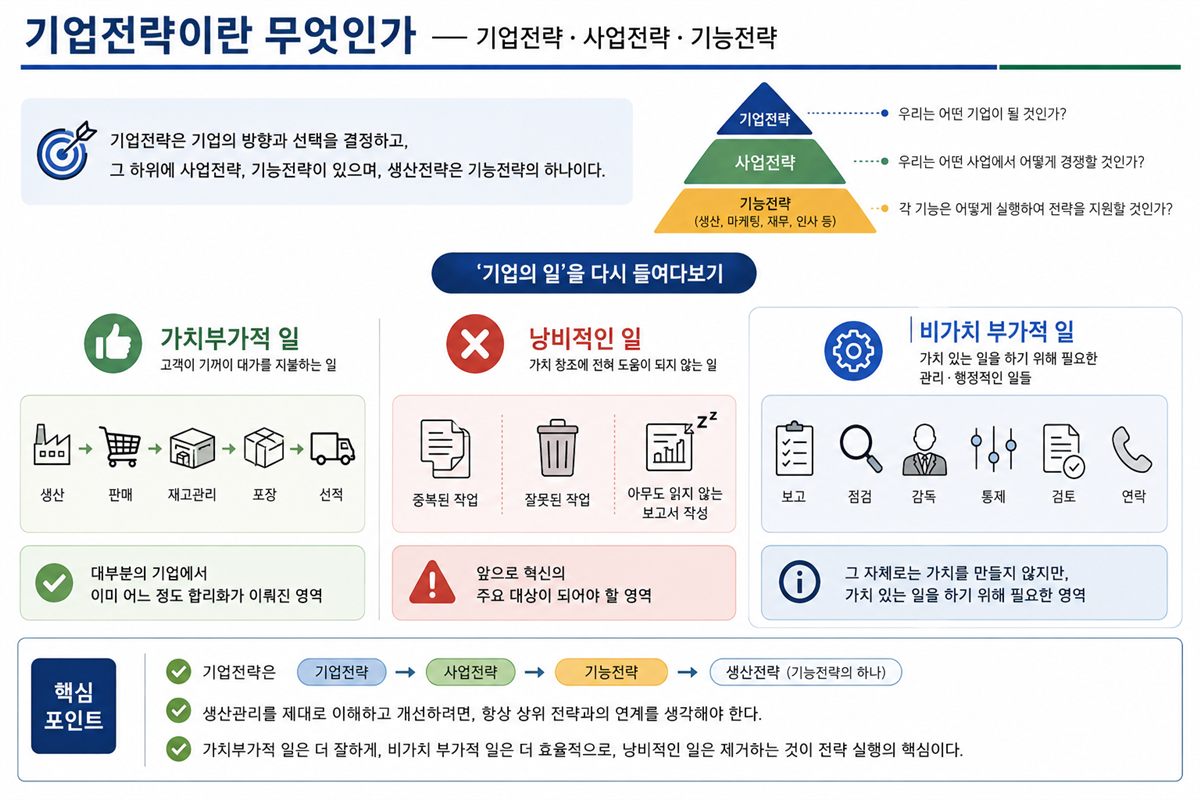
이 글은 생산관리를 체계적으로 다루는 시리즈의 첫 번째 편입니다. 생산관리를 제대로 이해하려면 먼저 그 상위 개념인 '기업전략'부터 짚고 넘어가야 합니다. 생산전략은 결국 기업전략의 하위 개념이기 때문입니다.
'기업의 일'을 다시 들여다보기
기업 안에서 벌어지는 일들을 가치 기준으로 나눠보면 세 가지로 구분할 수 있습니다.
가치부가적 일: 고객이 기꺼이 대가를 지불하는 일. 생산, 판매, 재고관리, 포장, 선적 작업 등이 여기 해당합니다. 대부분의 기업에서 이미 어느 정도 합리화가 이뤄진 영역입니다.
낭비적인 일: 가치 창조에 전혀 도움이 되지 않는 일. 중복된 작업, 잘못된 작업, 아무도 읽지 않는 보고서 작성 등이 대표적입니다. 혁신의 주요 대상이 되어야 할 영역입니다.
비가치 부가적 일: 그 자체로는 가치를 만들지 않지만, 가치 있는 일을 하기 위해 필요한 관리·행정적인 일들. 보고, 점검, 감독, 통제, 검토, 연락 등이 여기 속합니다.
흥미로운 점은 이 세 번째 유형입니다. 흩어진 업무를 묶고 조정·통제하는 기능을 담당하기 때문에, 기존 조직에서 이 기능을 통째로 없애면 조직이 와해될 수 있습니다. 그런데 동시에 이 일들은 지연, 비유연성, 권위주의, 부서 이기주의의 원인이 되기도 합니다. 실제로 상당수의 기존 조직에서 이런 성격의 업무가 전체 업무의 80~90%를 차지한다는 점은 곱씹어볼 만합니다.
전략이란 무엇인가
전략(Strategy)은 기업이 경쟁에서 이기고 이점을 얻기 위해 세우는 계획 및 정책을 말합니다. 안소니(Anthony)의 계획 수준(전략계획-경영통제-운영통제)과 사이먼(Simon)의 의사결정 단계(정보-설계-선정)가 결합된 개념으로 볼 수 있습니다.
경영학에 전략 개념이 처음 등장한 것은 챈들러(Chandler)의 1962년 저서 『경영전략과 경영구조』였습니다. 챈들러는 경영전략을 이렇게 정의했습니다.
경영전략이란 기업에 기본적인 장기목표를 설정하고, 그 목표달성을 위한 행동방향을 결정하며, 목표달성에 필요한 자원을 배분하는 것
이후 경영전략은 조직 수준에 따라 기업전략 → 사업전략 → 기능전략의 세 층위로 나뉘어 발전했습니다.
기업전략 — 회사 전체의 큰 그림
기업전략은 기업의 목적과 목표 설정, 사업의 선택, 이를 위한 자원의 획득과 배분에 관한 장기계획입니다. 사업부가 여러 개인 기업이라면, 각 사업부에 자원을 어떻게 배분할지 분석하고 평가하는 것이 핵심 과제가 됩니다.
BCG 매트릭스
이 자원배분 분석에 가장 널리 쓰이는 도구가 BCG 매트릭스입니다. 보스턴컨설팅그룹(Boston Consulting Group)이 개발한 성장-점유율 매트릭스로, 시장성장률과 상대적 시장점유율이라는 두 축을 기준으로 사업부를 4개 영역으로 나눠 평가합니다.
물음표(Question Mark): 도입기~성장기 초반. 시장성장률은 높지만 점유율은 낮아, 앞으로 별이 될지 Dogs가 될지 알 수 없는 상태입니다. 그 불확실성 때문에 '물음표'라는 이름이 붙었습니다. 신규 자금 투하가 필요하며, 계속 투자할지 철수할지 결정해야 하는 단계입니다.
별(Star): 성장기. 시장성장률과 시장점유율이 모두 높아 그야말로 '별'처럼 빛나는 사업군입니다. 자금 투하가 계속 필요하지만, 잘 키우면 이후 캐시카우로 전환됩니다.
캐시카우(Cash Cow): 성장기 후기~쇠퇴기. 시장점유율은 높지만 성장률은 낮아, 젖소가 꾸준히 우유를 내듯 별다른 투자 없이도 현금을 지속적으로 창출한다는 의미에서 붙은 이름입니다. 규모의 경제와 생산성이 높아 다른 사업 영역을 지원하는 재원이 됩니다.
Dogs: 성장기 후기~쇠퇴기. 시장점유율과 시장성장률이 모두 낮아 '개처럼 쓸모가 없다'는 의미에서 붙은 이름입니다. 자금 투입은 적지만 이익률도 낮아, 유지할지 축소·철수할지 판단해야 합니다.
기업의 성장전략
기업전략 수준에서 성장을 추구하는 방식도 몇 가지로 나뉩니다.
집중적 성장전략: 현재의 제품이나 시장과 관련된 사업 중에서 성장 기회를 찾는 방식
다각화 성장전략: 현재의 제품·시장과 관련 없는 사업을 새로 추가하는 방식
통합적 성장전략: 원료와 제품의 흐름을 따라 기업의 성장을 추구하는 방식으로, 다시 세 가지로 나뉩니다.
전방통합(forward integration): 유통업자 쪽으로 사업 확장
후방통합(backward integration): 원료공급업자 쪽으로 사업 확장
수평통합(horizontal integration): 동일 단계의 경쟁업체를 통합
사업전략 — 어떻게 경쟁에서 이길 것인가
사업전략은 사업부 수준에서 사업영역을 정의하고, 목표를 설정하며, 경쟁우위를 어떻게 획득할지 다루는 전략입니다. 보통 1~3년 정도의 중기계획으로 수립되며, 상위의 기업전략과 일관성을 유지해야 합니다.
이 영역에서 가장 널리 인용되는 것이 포터(Porter)의 본원적 전략입니다. 포터는 경쟁우위 요소(고객이 인식하는 제품특성 vs 비용우위)와 경쟁범위(전체시장 vs 목표시장)라는 두 축으로 사업전략을 네 가지로 분류했습니다.
전체시장
목표시장(집중화)
제품특성 중심
차별화 전략
차별적 집중화
비용우위 중심
원가우위 전략
원가우위 집중화
차별화 전략은 상표 이미지, 기술·품질 이미지, 소비자 서비스 등으로 승부하고, 원가우위 전략은 생산방식과 총원가 관리로 승부합니다. 집중화 전략은 특정 목표시장(거점)에 자원을 몰아 그 안에서 형태·품질의 경쟁우위를 확보하는 방식입니다.
기능전략 — 각 부서의 실행 전략
기능전략은 사업전략의 하위 전략으로, 생산·마케팅·재무 등 각 기능 부문 수준에서의 목표 설정과 경쟁력 제고 방안을 다룹니다. 보통 1년 미만의 단기계획이며, 상위의 사업전략을 유지하는 선에서 수립됩니다.
여기서 우리가 이 시리즈에서 다루려는 생산전략이 바로 기능전략의 하나입니다. 다음 편에서는 생산전략이 구체적으로 무엇을 다루는지, 어떤 요소들로 구성되는지 살펴보겠습니다.
다음 편: [생산관리 시리즈 ②] 생산전략의 기본요소와 생산관리의 정의
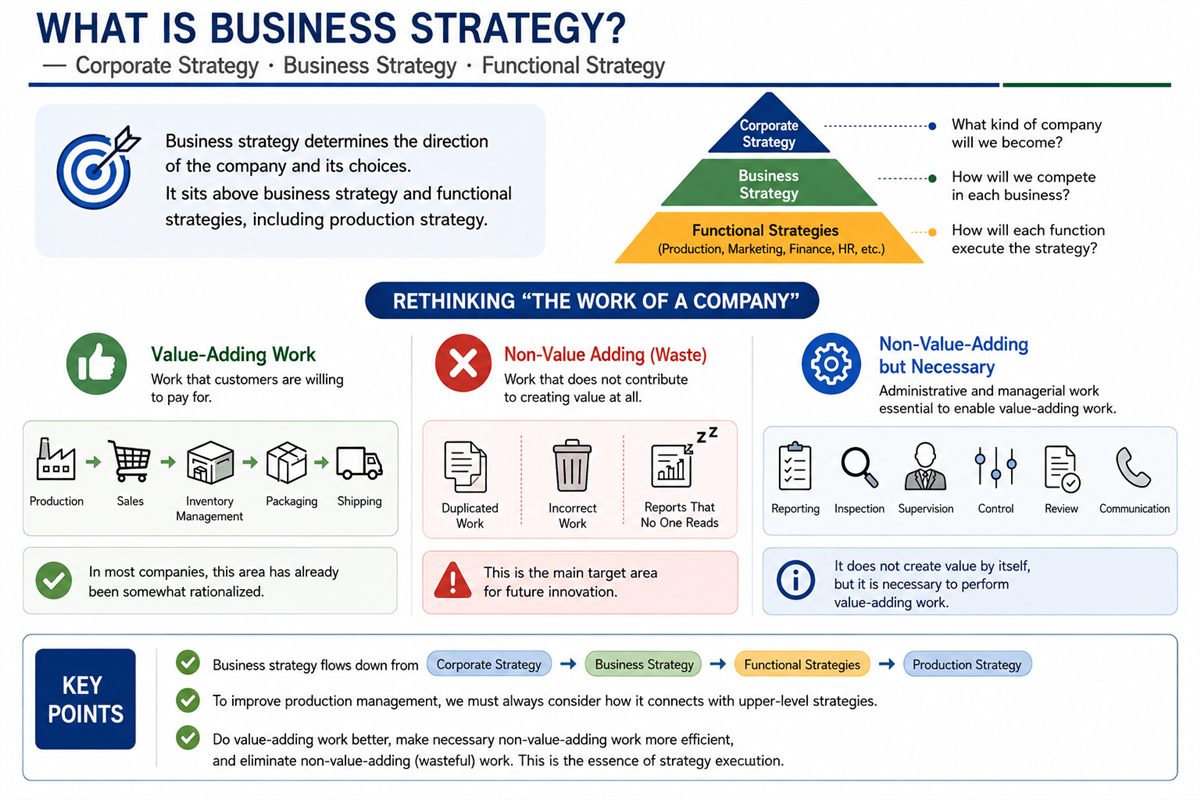
This is the first article in a series on production management. To truly understand production management, we need to start one level up — with corporate strategy. Production strategy is, after all, a subset of the broader corporate strategy framework.
Rethinking what a company actually does
Sort the activities inside any company by value created, and you get three categories.
Value-adding work: work customers are willing to pay for — production, sales, inventory management, packaging, shipping. Most companies have already rationalized this layer to some degree.
Wasteful work: work that creates no value at all — duplicated tasks, rework, reports nobody reads. This is the primary target for improvement initiatives.
Non-value-adding work: work that doesn't create value directly but is necessary to enable value-creating work — reporting, inspection, supervision, control, coordination, communication.
The third category is the interesting one. It holds the organization together by coordinating and controlling dispersed activities — eliminate it wholesale and the organization falls apart. At the same time, this layer is also the source of delays, inflexibility, bureaucracy, and silo behavior. The striking fact is that in many traditional organizations, work of this type accounts for 80–90% of all activity.
What strategy means
Strategy is the plans and policies a company forms to win in competition and gain advantage. It draws on Anthony's planning hierarchy (strategic planning → management control → operational control) and Simon's decision-making stages (intelligence → design → choice).
The concept of strategy entered business thinking with Chandler's 1962 book Strategy and Structure. Chandler defined business strategy as:
The determination of the basic long-term goals and objectives of an enterprise, and the adoption of courses of action and the allocation of resources necessary for carrying out these goals.
Since then, strategy has been organized into three tiers by organizational level: corporate strategy → business strategy → functional strategy.
Corporate strategy — the big picture
Corporate strategy covers long-range plans for setting the company's purpose and goals, choosing which businesses to be in, and acquiring and allocating the resources to pursue them. For multi-division companies, the central challenge is deciding how to distribute resources across business units.
The BCG matrix
The most widely used tool for this resource-allocation analysis is the BCG matrix — the growth-share matrix developed by the Boston Consulting Group. It maps business units on two axes — market growth rate and relative market share — and classifies them into four zones.
Question Marks: Introduction through early growth phase. Market growth rate is high but market share is low — it's unclear whether the unit will become a Star or slide into Dogs. That uncertainty is exactly why it's called a Question Mark. Fresh capital investment is required, and the key decision is whether to keep investing or exit.
Stars: Growth phase. Both market growth rate and market share are high — the unit truly shines, hence the name. Continuous investment is still required, but managed well, Stars transition into Cash Cows.
Cash Cows: Late growth through decline. Little new investment needed; high economies of scale and productivity make them the funding source for other business units.
Dogs: Late growth through decline. The name reflects that both market share and market growth rate are low — the unit pulls little weight. Low investment needs but also low margins; the question is whether to maintain, scale down, or exit.
Growth strategies
At the corporate level, companies can pursue growth in several ways.
Intensive growth: seeking growth opportunities within the current product and market domain
Diversification: adding new businesses unrelated to current products or markets
Integrative growth: expanding along the product flow chain, in three directions:
Forward integration: expanding toward distributors and retailers
Backward integration: expanding toward raw material suppliers
Horizontal integration: absorbing competitors at the same stage
Business strategy — how to win in competition
Business strategy operates at the business unit level: defining the competitive domain, setting objectives, and determining how to build competitive advantage. Typically a medium-term plan covering one to three years, it must be consistent with the corporate strategy above it.
The most cited framework here is Porter's generic strategies. Porter classified business strategies on two axes — the source of competitive advantage (perceived product differentiation vs. cost advantage) and the competitive scope (broad market vs. focused target segment).
Broad market
Focused segment
Product differentiation
Differentiation
Focused differentiation
Cost advantage
Cost leadership
Focused cost leadership
Differentiation competes on brand image, technological or quality perception, and customer service. Cost leadership competes on production method and total cost management. Focus strategies concentrate resources on a specific target segment and build competitive advantage — whether in form, quality, or cost — within that niche.
Functional strategy — execution at the department level
Functional strategy sits beneath business strategy and covers goal-setting and competitiveness improvements within individual functions — production, marketing, finance, and so on. Typically a short-term plan of less than a year, it operates within the constraints set by the business strategy above it.
Production strategy — the subject of this series — is one of those functional strategies. The next article looks at what production strategy specifically covers and what elements it consists of.
Next: [Production Mgmt Series ②] Elements of Production Strategy and the Definition of Production Management
댓글Comments