[지나가는 글] 혁신(革新)이란 무엇인가 — 독수리의 재탄생 우화로 보는 창조적 파괴[In Passing] What Is Innovation? — Creative Destruction Through the Eagle Rebirth Fable
FREEWAYFREEWAY·2026년 8월 18일August 18, 2026·4분 읽기4 min read
혁신, 한자를 뜯어보면
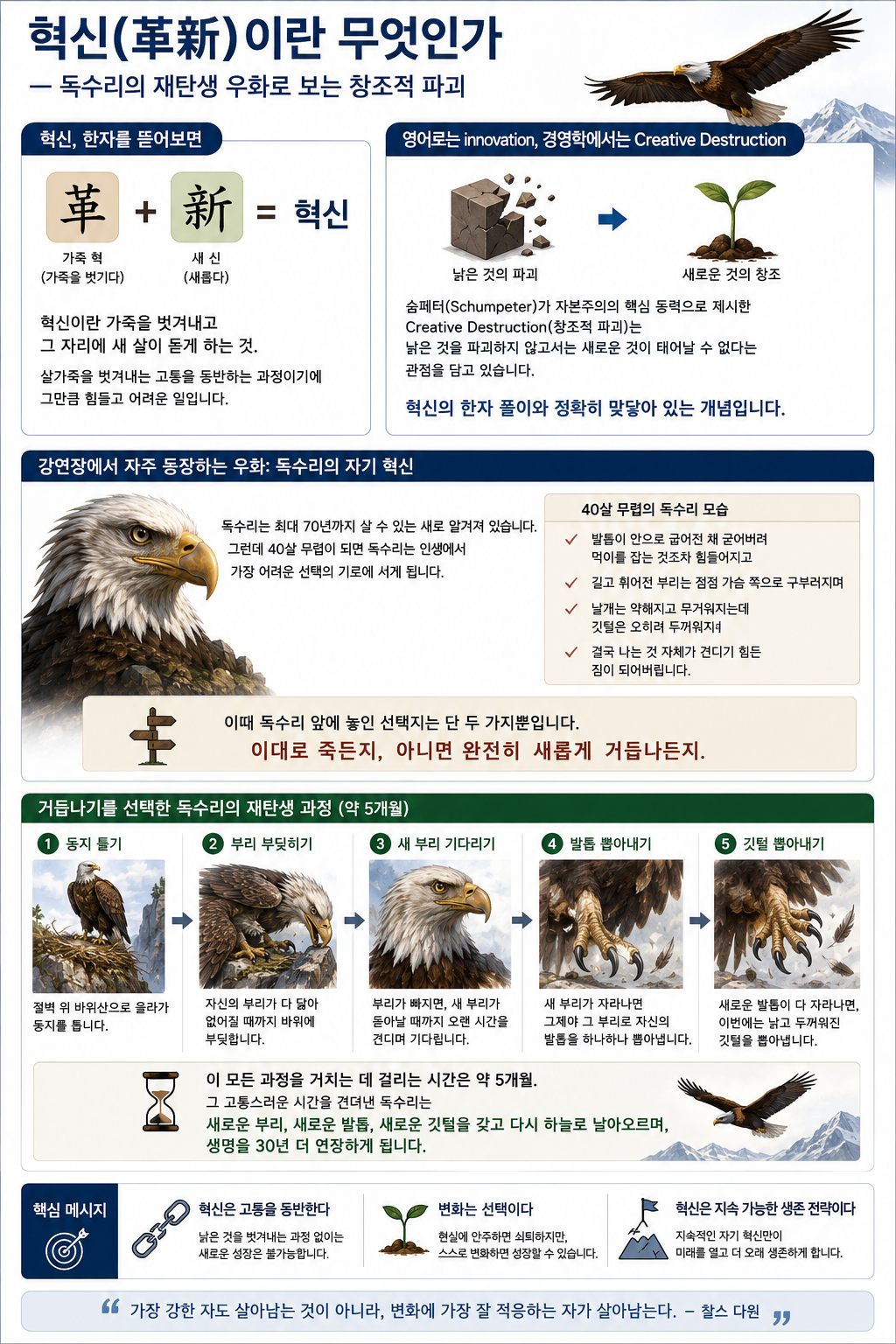
혁신(革新)이라는 단어를 한자 그대로 풀어보면 의미가 더 선명해집니다. '가죽 혁(革)'은 짐승의 가죽을 벗겨낸다는 뜻이고, '새 신(新)'은 새것을 의미합니다. 즉 혁신이란 가죽을 벗겨내고 그 자리에 새 살이 돋게 하는 것입니다.
말 그대로 살가죽을 벗겨내는 고통을 동반하는 과정이니, 그만큼 힘들고 어려운 일이라는 뜻이 이 한자 두 글자 안에 이미 담겨 있는 셈입니다.
영어로는 innovation이라고 옮기지만, 경영학에서는 종종 Creative Destruction(창조적 파괴)이라는 말로도 통합니다. 슘페터(Schumpeter)가 자본주의의 핵심 동력으로 제시한 이 개념은, 낡은 것을 파괴하지 않고서는 새로운 것이 태어날 수 없다는 관점을 담고 있습니다. 혁신의 한자 풀이와 정확히 맞닿아 있는 지점입니다.
강연장에서 자주 등장하는 우화: 독수리의 자기 혁신
혁신을 설명할 때 강사들이 즐겨 인용하는 이야기가 하나 있습니다. 바로 독수리의 자기 혁신 우화입니다.
독수리는 최대 70년까지 살 수 있는 새로 알려져 있습니다. 그런데 40살 무렵이 되면 독수리는 인생에서 가장 어려운 선택의 기로에 서게 됩니다.
이 시기의 독수리는 몸 전체가 노쇠의 징후로 뒤덮입니다.
발톱이 안으로 굽어진 채 굳어버려 먹이를 잡는 것조차 힘들어지고
길고 휘어진 부리는 점점 가슴 쪽으로 구부러지며
날개는 약해지고 무거워지는데 깃털은 오히려 두꺼워져
결국 나는 것 자체가 견디기 힘든 짐이 되어버립니다
이때 독수리 앞에 놓인 선택지는 단 두 가지뿐입니다. 이대로 죽든지, 아니면 완전히 새롭게 거듭나든지.
거듭나기를 선택한 독수리는 스스로 절벽 위 바위산으로 올라가 둥지를 틉니다. 그리고 자신의 부리가 다 닳아 없어질 때까지 바위에 부딪칩니다. 부리가 빠지면, 새 부리가 돋아날 때까지 오랜 시간을 견디며 기다립니다.
새 부리가 자라나면 그제야 그 부리로 자신의 발톱을 하나하나 뽑아냅니다. 새로운 발톱이 다 자라나면, 이번에는 낡고 두꺼워진 깃털을 뽑아냅니다.
이 모든 과정을 거치는 데 걸리는 시간은 약 5개월. 그 고통스러운 시간을 견뎌낸 독수리는 마침내 새로운 부리, 새로운 발톱, 새로운 깃털을 갖고 다시 하늘로 날아오르며, 생명을 30년 더 연장하게 됩니다.
이 우화가 혁신에 주는 메시지
이 이야기가 강연에서 자주 인용되는 이유는 명확합니다. 혁신은 일부만 고치는 것으로 완성되지 않는다는 것, 그리고 스스로 고통을 감수하지 않으면 낡은 습관과 방식에서 벗어날 수 없다는 것을 상징적으로 보여주기 때문입니다.
낡은 부리, 굳은 발톱, 무거워진 깃털은 각각 기업이나 조직이 오랫동안 붙잡고 있던 관행, 제도, 사고방식에 비유할 수 있습니다. 겉으로는 멀쩡해 보여도 이미 제 기능을 하지 못하고, 오히려 짐이 되어버린 것들입니다. 혁신은 이를 하나씩 도려내고 새로 채우는 과정이며, 그 과정은 결코 짧거나 편안하지 않습니다.
참고로 이 우화는 생물학적 사실이라기보다 오래전부터 강연·자기계발서 등에서 널리 회자되어 온 이야기로, 실제 독수리의 생태와는 차이가 있다는 지적도 있습니다. 다만 비유로서의 메시지 — 스스로 낡은 것을 벗어내야 새로워질 수 있다 — 는 여전히 유효하게 받아들여지고 있습니다.
혁신(革新)이라는 한자 두 글자와 독수리의 우화는 결국 같은 이야기를 하고 있습니다. 새로워지려면 익숙하고 편안했던 것을 스스로 벗겨내야 한다는 것입니다. 조직이든 개인이든, 혁신을 "일부 개선"이 아니라 "가죽을 벗겨내는 수준의 재구성"으로 받아들일 때 비로소 진짜 변화가 시작되는지도 모릅니다.
What the Characters Tell You
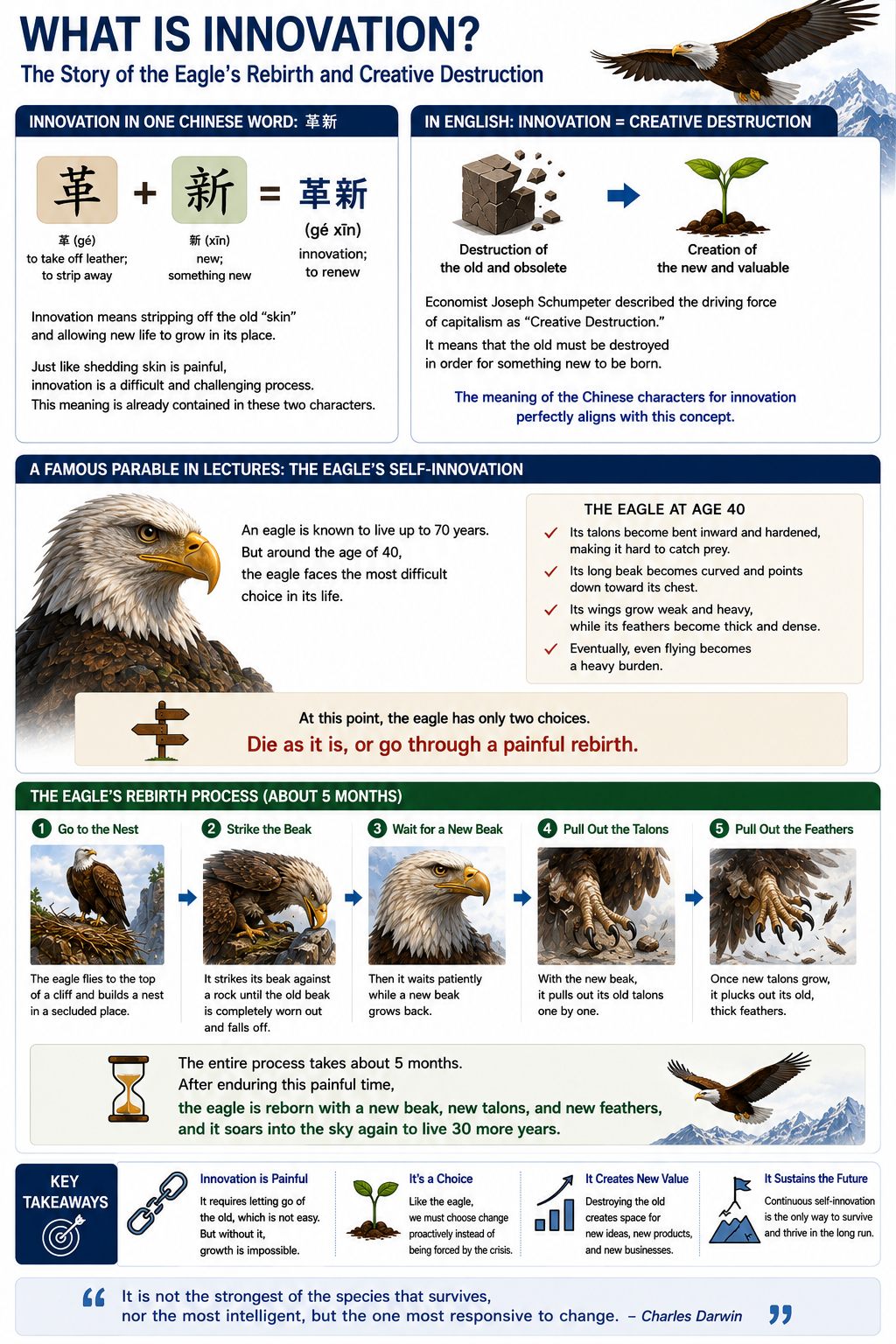
The Korean word for innovation, 혁신 (革新), becomes clearer when you read the characters literally. 革 (hyeok) means to strip the hide from an animal. 新 (sin) means new. Innovation, then, is stripping the skin away so that new flesh can grow in its place.
The pain of literally peeling skin is already written into the word. Those two characters carry within them the message that this is a hard and costly process.
In English the word is innovation, but in management it is often expressed as Creative Destruction — the term Joseph Schumpeter identified as the central driving force of capitalism. The idea is that nothing new can be born without first destroying the old. It maps exactly onto what those two Chinese characters say.
A Fable That Appears in Many Lectures: The Eagle's Self-Renewal
When speakers want to illustrate innovation, one story appears again and again: the eagle's self-renewal.
The eagle is said to live up to seventy years. But around the age of forty, it faces the hardest choice of its life.
By this point the eagle's body is covered in signs of decline:
Its talons have curled inward and hardened — catching prey has become nearly impossible
Its long, curved beak has bent further and further toward its chest
Its wings have grown weak and heavy while its feathers have thickened
Flight itself has become an almost unbearable burden
Only two options remain: die as it is, or be completely reborn.
An eagle that chooses rebirth climbs alone to a rocky cliff and builds a nest. There it beats its beak against the rock until the beak is worn away entirely. When the beak falls off, the eagle waits — enduring a long, empty stretch — until a new one grows in.
Once the new beak has grown, the eagle uses it to pull out its talons, one by one. When new talons have grown in, it pulls out the old, heavy feathers.
The whole process takes roughly five months. Having endured that pain, the eagle takes flight again with a new beak, new talons, and new feathers — and lives for another thirty years.
What This Fable Says About Innovation
The reason this story appears in so many lectures is clear. It shows, in concrete terms, that innovation is not completed by fixing a few things at the edges — and that without willingly accepting the pain, you cannot escape old habits and old ways of doing things.
The worn beak, the rigid talons, the heavy feathers — each is an analogy for the practices, rules, and assumptions an organization has held onto for years. They may look fine on the surface, but they have already stopped serving their purpose and become, instead, a burden. Innovation is the process of cutting them out, one by one, and growing something new in their place. That process is never short, and it is never comfortable.
Note: this story has circulated widely in lectures and self-help literature for many years. Ornithologists point out that it does not reflect actual eagle biology. The message as a metaphor — you can only become new by stripping away what is old — continues to be taken seriously on its own terms.
The two Chinese characters and the fable are telling the same story. To become new, you must strip away what has become familiar and comfortable — by your own hand. Whether for an organization or an individual, perhaps real change only begins when innovation is understood not as "incremental improvement" but as "reconstruction at the level of stripping the hide."
댓글Comments