[생산관리] 물류관리, 큰 그림으로 훑어보기[Production Management] Logistics Management: The Big Picture
FREEWAYFREEWAY·2026년 8월 13일August 13, 2026·8분 읽기8 min read
지금까지 다룬 생산라인·IE 시리즈가 "공장 안에서" 벌어지는 일이었다면, 이번엔 시야를 조금 더 넓혀서 원자재부터 고객 손에 제품이 닿기까지의 흐름 전체, 즉 물류관리를 정리해봤습니다. 원본 자료가 개론 강의 목차 수준이라, 각 항목이 실무에서 무슨 의미인지 풀어서 설명하는 식으로 구성했습니다.
물류란 무엇인가
물류를 정의하면 이렇습니다.
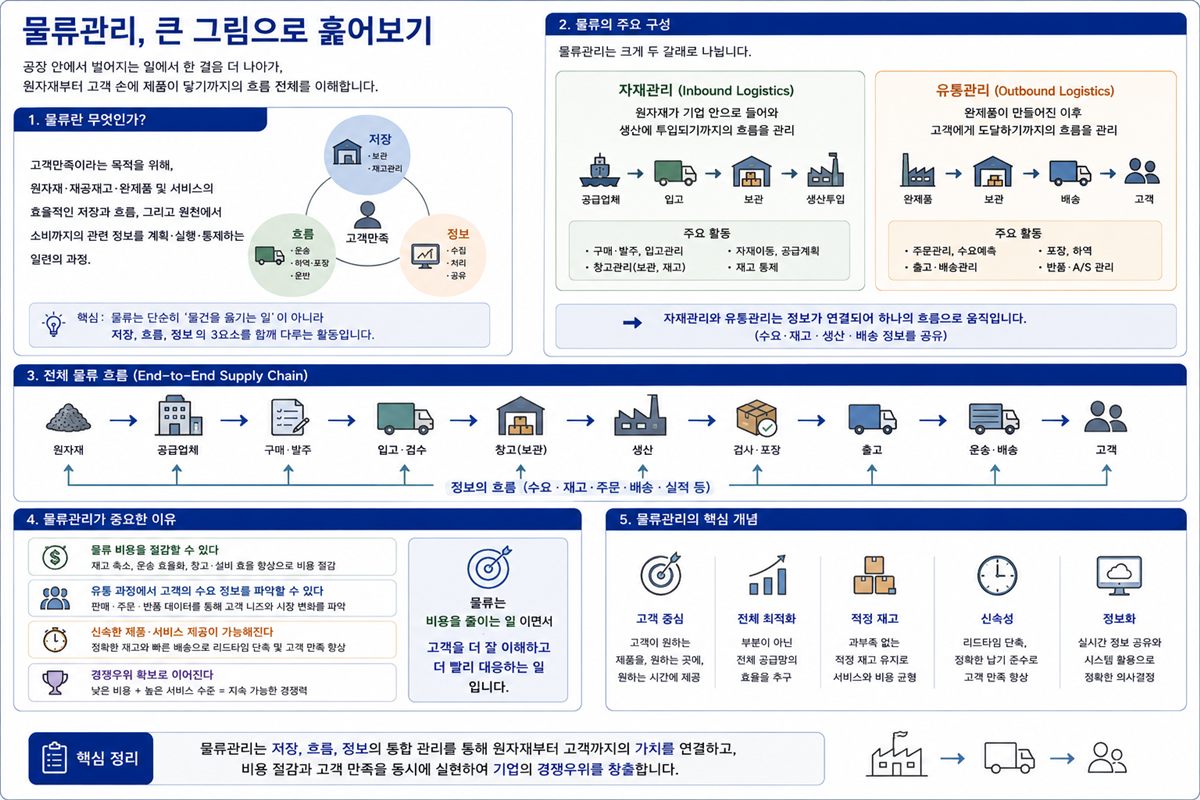
고객만족이라는 목적을 위해, 원자재·재공재고·완제품 및 서비스의 효율적인 저장과 흐름, 그리고 원천에서 소비까지의 관련 정보를 계획·실행·통제하는 일련의 과정.
여기서 핵심은 물류가 단순히 "물건을 옮기는 일"이 아니라 저장, 흐름, 정보라는 세 요소를 함께 다루는 활동이라는 점입니다. 물건이 어디에 얼마나 있는지 모르면, 아무리 빨리 옮겨도 소용이 없습니다.
물류의 주요 구성은 크게 두 갈래로 나뉩니다.
자재관리: 원자재가 기업 안으로 들어와서 생산에 투입되기까지의 흐름을 관리
유통관리: 완제품이 만들어진 이후 고객에게 도달하기까지의 흐름을 관리
물류관리가 중요한 이유
물류 비용을 절감할 수 있다
유통 과정에서 고객의 수요 정보를 파악할 수 있다
신속한 제품·서비스 제공이 가능해진다
이 모든 게 합쳐져 경쟁우위 확보로 이어진다
즉 물류는 "비용을 줄이는 일"이면서 동시에 "고객을 더 잘 이해하고 더 빨리 대응하는 일"이라는 두 가지 성격을 함께 갖습니다.
물류의 원칙: 7R과 3S 1L
물류 현장에서 자주 인용되는 두 가지 원칙 체계가 있습니다.
7R의 원칙은 물류가 갖춰야 할 조건을 7개의 R로 정리한 것으로, 일반적으로 다음과 같은 항목들을 가리킵니다: 적절한 상품(Right Product)을, 적절한 품질(Right Quality)로, 적절한 양(Right Quantity)만큼, 적절한 시간(Right Time)에, 적절한 장소(Right Place)에, 적절한 인상/상태(Right Impression)로, 적절한 가격(Right Price)에 전달하는 것. 결국 "무엇을, 얼마나, 언제, 어디로, 어떤 상태로, 얼마에" 보낼 것인가라는 물류의 본질적인 질문들을 압축한 원칙입니다.
3S 1L의 원칙은 조금 더 간결합니다.
Speedy — 신속하게
Surely — 확실하게
Safely — 안전하게
Low — 싸게
이 네 글자가 물류 실무의 거의 모든 의사결정 기준이 됩니다. 배송을 빠르게 하되 확실하게(오배송·분실 없이), 안전하게(파손 없이), 그러면서도 비용은 낮게 — 이 네 가지는 서로 트레이드오프 관계에 있는 경우가 많아서, 실제 물류 설계는 이 네 원칙 사이에서 균형점을 찾는 작업이라고 볼 수 있습니다.
전략적 물류계획과 물류시스템
물류 계획은 하나의 층위가 아니라 네 단계로 나눠서 봅니다.
전략적 수준: 고객의 기대를 충족시키는 고객 서비스 전략 자체를 개발하는 단계
구조적 수준: 물류 채널을 어떻게 설계할지, 어떤 네트워크 전략을 쓸지 결정하는 단계
기능적 수준: 전략적·전술적 고려사항들을 실제 기능 단위로 구체화하는 단계
실행 수준: 적시의 정확한 정보, 신중하게 설계된 물류 프로세스, 기능성을 갖춘 통합 소프트웨어, 고도화된 의사결정 지원시스템까지 갖춰야 하는 가장 구체적인 단계
위에서 아래로 내려갈수록 "무엇을 할 것인가"에서 "어떻게 실제로 돌아가게 할 것인가"로 초점이 옮겨갑니다. 앞서 IE 시리즈에서 다뤘던 생산계획의 계층 구조(총괄생산계획 → 세부 스케줄링)와 비슷한 논리입니다.
주문처리: 접수부터 선적까지
주문처리란 기업이 주문을 접수받은 시점부터 물건을 선적하는 시점까지의 모든 활동을 가리킵니다. 이 흐름은 다섯 단계로 나뉩니다.
주문 계획 → 주문 접수 → 주문 취급 → 주문 선적 → 주문 전달
이 다섯 단계를 통과하는 데 걸리는 시간이 "주문처리기간"이고, 이게 왜 중요하냐면 물류 프로세스에서의 경쟁력을 결정짓는 핵심 지표이기 때문입니다. 아무리 제품이 좋아도 주문 처리가 느리면 고객 경험이 나빠지고, 경쟁사 대비 물류 우위를 잃게 됩니다.
자재관리: 생산의 출발점
자재관리는 원자재가 기업에 들어와서 생산에 투입되기까지를 다루는데, 여기서 중요한 개념이 기회비용(opportunity cost)입니다. 자재관리가 부실하면 생산 지연으로 인한 손실, 즉 "다른 곳에 쓸 수 있었던 자원을 못 쓰게 된 비용"이 발생합니다. 자재관리는 생산 자체에도, 기업의 이익에도 직결되는 활동입니다.
수요예측
자재관리의 밑바탕에는 수요예측이 있습니다. 수요를 정확히 예측할수록 생산능력을 효율적으로 활용하고, 생산 소요기간을 단축하고, 재고를 줄일 수 있습니다.
수요의 특성을 파악할 때 핵심 개념이 시계열(time series)입니다. 시계열이란 제품이나 서비스의 수요를 발생 시간에 따라 관찰한 데이터를 말합니다. 이 시계열 데이터를 바탕으로 예측시스템을 설계하는데, 계절성이 있는지, 추세가 있는지, 불규칙한 변동이 있는지에 따라 적용하는 예측 기법이 달라집니다.
재고관리와 재고수준 결정
재고관리란 미래의 수요를 위한 비축물을 다루는 활동입니다. 재고가 생기는 원리는 단순합니다 — 유입속도가 유출속도를 초과할 때 재고가 쌓입니다. 반대로 유출이 유입을 앞지르면 재고는 줄어들고, 심하면 품절이 됩니다.
유통자원계획(DRP)
DRP(Distribution Resource Planning)는 유통망 전체에 걸친 재고를 계획하는 기법입니다. 여기엔 두 갈래 이슈가 함께 얽혀 있습니다.
인적 이슈: 물자 선적·수령에 필요한 인력을 어떻게 배치할 것인가
기술적 이슈: 시스템으로 어떻게 이걸 자동화·최적화할 것인가
DRP를 실제로 활용하는 방식은 이렇습니다.
일정한 공급원으로부터 재고를 보충하는 방법을 조정
수송 방편(트럭, 철도, 항공 등)을 선택
물자 선적 및 수령에 필요한 인력을 배치
소싱 및 공급자 관리
소싱(공급처 선정)과 공급자 관리가 최근 물류에서 점점 더 중요해지고 있는데, 그 배경에는 몇 가지 흐름이 있습니다.
구매환경의 추세 변화: 단순히 값싼 공급자를 찾는 게 아니라 전략적 파트너십으로 접근하는 경향
정보시스템의 활성화: 공급자와의 실시간 정보 공유가 가능해짐
기술개발(R&D)에서의 공급자 참여: 공급자가 단순 납품업체가 아니라 제품 개발 단계부터 협력하는 파트너가 됨
아웃소싱(제3자 위탁): 물류 기능 자체를 외부 전문업체에 맡기는 추세
이런 변화 속에서 공급자를 체계적으로 평가하는 공급자 평가시스템이 공급 프로세스의 핵심 도구로 자리잡고 있습니다.
창고·공장·유통시설의 입지
입지 선정은 물류 흐름 전체에 큰 영향을 미치는 결정입니다. 입지에 영향을 주는 요인은 업종에 따라 다릅니다.
일반적 요인: 원자재 접근성, 노동력, 시장
제조업: 노동 분위기(노사관계 등), 시장 근접성, 부동산 가격이 주요 고려사항
서비스업: 고객 근접성, 수송비용, 경쟁자의 입지가 더 중요
입지 선정 기법
근접성 평가: 부담(가중치) 방법이나 거리 방법으로 후보지를 비교
다수 설비의 입지 문제: 여러 물류거점을 동시에 배치해야 할 때 수송계획법(Transportation Problem) 같은 최적화 기법을 사용
기타: 시뮬레이션이나 다양한 최적화 방법을 동원
창고와 유통시설 관리
창고 설계
창고는 크게 두 가지 성격으로 나뉩니다.
저장시설 위주 창고: 재고를 안정적으로 보관하는 데 초점
유통 위주 창고: 물건이 빠르게 들어오고 빠르게 나가도록 흐름에 초점 (Cross-docking 방식과 유사한 개념)
창고 설계에는 늘 상충효과(trade-off)가 존재합니다. 물자의 반입·반출량, 반입·반출 빈도, 창고의 성격, 제품의 특성을 모두 고려해서 설계해야 하는데, 예를 들어 저장 효율을 극대화하면 접근성이 떨어지고, 접근성을 높이면 공간 활용도가 떨어지는 식의 균형점을 찾아야 합니다.
창고운영 관련 장비
컴퓨터를 이용한 창고관리: 재고 위치·수량을 시스템으로 실시간 추적
저장 및 물자취급 장비: 적재 설비와 자동화 설비를 도입하면 창고 운영 효율이 크게 증대됩니다
창고관리의 자동화
자동인도차량(AGV, Automated Guided Vehicle): 무인 소형 트럭 형태로 자재를 운반
자동창고 시스템(AS/RS, Automated Storage/Retrieval System): 선반·저장고·스태커(stacker) 크레인 등을 이용해서 물건을 자동으로 저장하고 인출하는 제어 시스템
창고 운영 시 고려사항
위험 요소 제거
안전 요소 반영
화재예방 교육
창고의 청결 상태 유지
앞서 5S/눈으로 보는 관리 글에서 다뤘던 정리·정돈·청결의 원칙이, 창고 관리에서도 똑같이 안전과 효율의 기초가 됩니다.
물류정보시스템(LIS)
물류 환경이 변하면서 정보시스템의 역할과 중요성도 함께 커졌습니다. 초기의 "거래지향적" 시스템(주문 입력·처리, 재고 수령·선적, 수송 계획·서류 발생 위주)에서, 점점 "정보지향적" 시스템(자료 수집, 정보 교환, 효율성·정확성 달성 위주)으로 무게 중심이 옮겨가고 있습니다.
전자문서교환(EDI)
EDI(Electronic Data Interchange)는 컴퓨터 간의 직접적인 자료 교환을 의미합니다. 정보 투자는 이제 단순한 부가 비용이 아니라, 자산집약적 전략을 정보집약적 통제시스템으로 보완하는 핵심 요소로 여겨집니다. EDI는 거래 문서(주문서, 송장, 배송 확인서 등)를 사람이 직접 입력하지 않고 시스템 간에 자동으로 주고받게 해서, 오류를 줄이고 처리 속도를 크게 높입니다.
전략적 정보연계
기업 간 정보를 연계할 필요성은 결국 구매자-공급자 관계의 변화에서 나옵니다. 예전처럼 "주문하고 받는" 단발성 거래가 아니라, 정보를 실시간으로 공유하는 파트너십 관계로 바뀌고 있다는 뜻입니다. 이 흐름의 대표적인 형태가 공급체인관리(SCM, Supply Chain Management)와 기업 간 제휴 협정입니다.
제휴가 성립하는 이유, 성공 요인, 실패 요인은 각각 따로 살펴볼 만한 주제지만, 공통적으로는 정보 접근성, 연결성, 그리고 기업 간 규칙과 절차를 얼마나 명확히 정립했는지가 성패를 가릅니다. 정보 연결만 있고 규칙과 절차가 불명확하면, 데이터는 오가지만 실제 협업으로 이어지지 못하는 경우가 많습니다.
물류조직의 변화
물류 조직을 어떻게 짜느냐도 전략의 일부입니다. 핵심 메시지는 이렇습니다.
효과적인 물류 조직이란 기능 중심이 아니라 프로세스 중심으로 통합된 조직이다.
전통적인 조직은 구매팀, 창고팀, 운송팀처럼 기능별로 나뉘어 있어서 각 팀이 자기 KPI만 신경 쓰다 보면 전체 흐름이 최적화되지 않는 문제가 생깁니다. 반면 프로세스 중심 조직은 "주문부터 배송까지"라는 흐름 전체를 하나의 단위로 보고, 고객의 요구를 정확하고 빠르게 파악해서 대응하는 데 초점을 맞춥니다.
최근 물류 관련 이슈
제3자 물류(3PL, Third-Party Logistics): 기업이 물류 기능 전체 또는 일부를 전문 물류업체에 위탁하는 흐름. 앞서 언급한 아웃소싱 추세와 맞닿아 있습니다
환경문제의 대두: 탄소 배출, 포장재 문제 등 물류 활동이 환경에 미치는 영향에 대한 관심이 커지면서, 친환경 물류(그린 로지스틱스)가 중요한 화두로 떠오르고 있습니다
기술의 발전: AGV·AS/RS 같은 자동화 설비부터 정보시스템까지, 기술 발전이 물류 전반의 효율을 계속 끌어올리고 있습니다
정리하면, 물류관리는 "물건을 옮기는 기술"이 아니라 원자재부터 고객까지 이어지는 전체 흐름을 계획·실행·통제하는 경영 활동입니다. 3S1L 같은 단순한 원칙부터, DRP·EDI·SCM 같은 정보 시스템, 그리고 AGV·AS/RS 같은 물리적 자동화까지 — 결국 "필요한 걸, 필요한 때, 필요한 곳에, 낭비 없이 보내는" 문제를 여러 층위에서 동시에 풀어가는 게 물류관리의 본질이라고 할 수 있습니다. 이 관점에서 보면 앞서 다룬 생산라인의 낭비 제거, 표준시간 관리, MRP/JIT 같은 개념들도 결국 물류라는 더 큰 흐름의 한 부분이었다는 걸 확인할 수 있습니다.
The production line and IE articles in this series covered what happens inside the factory. This piece widens the lens to look at the entire flow from raw materials to the moment a finished product reaches the customer — logistics management. The source material reads like an introductory lecture outline, so the goal here is to unpack each point in terms of what it actually means in practice.
What Is Logistics?
The definition reads:
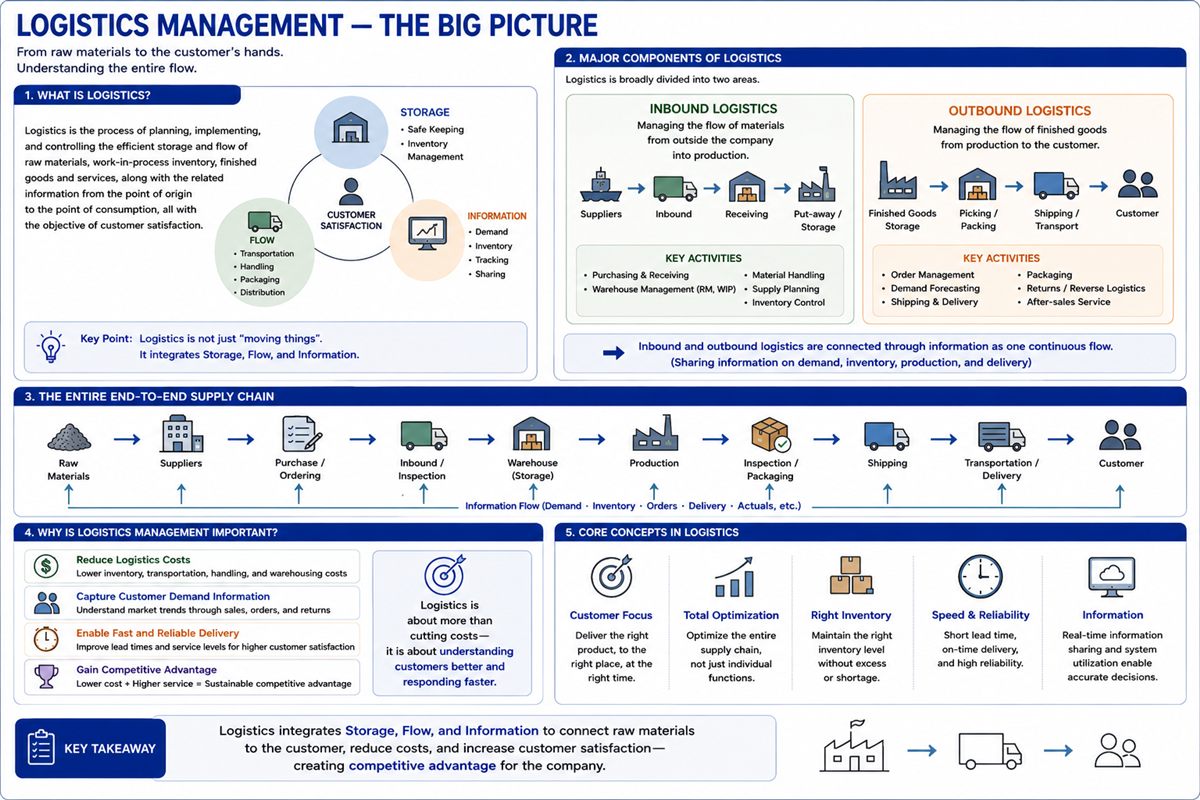
The process of planning, implementing, and controlling the efficient storage and flow of raw materials, work-in-process inventory, finished goods, and related information from point of origin to point of consumption, for the purpose of customer satisfaction.
The key insight is that logistics is not simply "moving things." It encompasses three elements together: storage, flow, and information. Knowing where things are and in what quantity is a prerequisite — speed of movement means nothing without that foundation.
Logistics breaks into two broad branches:
Materials management: managing the flow from the point raw materials enter the company to the point they are fed into production
Distribution management: managing the flow from finished goods through to the end customer
Why Logistics Management Matters
Logistics costs can be reduced
Customer demand information becomes visible through the distribution process
Faster product and service delivery becomes possible
All of the above combine to create competitive advantage
In short, logistics is simultaneously about cutting costs and understanding customers better — and responding faster. It carries both characters at once.
Principles: The 7Rs and 3S1L
Two principle frameworks appear repeatedly in logistics practice.
The 7R Principle specifies the conditions logistics must satisfy: delivering the Right Product, at the Right Quality, in the Right Quantity, at the Right Time, to the Right Place, in the Right Impression (condition), at the Right Price. In short, it compresses the fundamental logistics questions — what, how much, when, where, in what condition, and at what cost — into seven words starting with R.
The 3S1L Principle is more concise:
Speedy
Surely — reliably, without mis-delivery or loss
Safely — without damage
Low — cost-efficiently
These four words cover almost every logistics decision. In practice the four often trade off against each other, so logistics system design is fundamentally about finding the right balance among them.
Strategic Logistics Planning and the Logistics System
Logistics planning operates on four levels:
Strategic level: developing the customer service strategy itself — what level of service the company commits to providing
Structural level: deciding how to design logistics channels and what network strategy to pursue
Functional level: translating strategic and tactical considerations into concrete functional units
Implementation level: the most concrete layer — timely and accurate information, carefully designed logistics processes, integrated software with the required functionality, and advanced decision-support systems
Moving down the levels shifts the question from "what should we do" to "how do we make it actually work." The logic parallels the production planning hierarchy covered in the IE series — aggregate plan down to detailed scheduling.
Order Processing: From Receipt to Shipment
Order processing refers to all activities from the moment an order is received to the moment goods are shipped. The flow runs through five stages:
Order planning → Order entry → Order handling → Order shipment → Order delivery
The time required to pass through all five stages is the "order cycle time," and it matters because it is the central metric of logistics competitiveness. No matter how good the product, slow order processing degrades the customer experience and surrenders logistics advantage to competitors.
Materials Management: Where Production Begins
Materials management covers everything from raw materials entering the company to their entry into production. A key concept here is opportunity cost: poor materials management causes production delays — which represent the cost of resources that could have been used productively but were not. Materials management connects directly to both production continuity and company profitability.
Demand Forecasting
Demand forecasting underpins everything in materials management. More accurate forecasting means more efficient use of production capacity, shorter lead times, and lower inventory levels.
The central concept for understanding demand patterns is the time series — demand data for a product or service observed over time. A forecasting system is designed around this data. The appropriate forecasting technique depends on whether the series shows seasonality, trend, irregular variation, or some combination of these.
Inventory Management and Setting Inventory Levels
Inventory management deals with stock held in anticipation of future demand. The underlying logic is simple: inventory accumulates when the rate of inflow exceeds the rate of outflow. When outflow exceeds inflow, inventory falls — and if the gap is large enough, stockout results.
Distribution Resource Planning (DRP)
DRP is a technique for planning inventory across the entire distribution network. Two categories of issues are intertwined here:
Personnel issues: how to staff the people needed to ship and receive goods
Technical issues: how to automate and optimize the system
DRP is applied to:
Coordinate replenishment from a stable supply source
Select transport modes (truck, rail, air, etc.)
Staff the people needed for shipment and receipt
Sourcing and Supplier Management
Sourcing and supplier management have grown increasingly important in modern logistics, driven by several trends:
Shifting purchasing environment: a move from searching for the cheapest supplier toward strategic partnerships
Information system integration: real-time information sharing with suppliers is now feasible
Supplier involvement in R&D: suppliers are becoming partners from the product development stage, not just vendors
Outsourcing (third-party contracting): the trend toward delegating logistics functions to specialist providers
Against this backdrop, the supplier evaluation system has become a core tool of the supply process.
Facility Location: Warehouses, Plants, and Distribution Centers
Location decisions have large and lasting effects on the entire logistics flow. The factors that matter vary by industry:
General factors: access to raw materials, labor availability, market proximity
Manufacturing: labor relations climate, market proximity, and real estate costs are primary considerations
Service operations: customer proximity, transportation costs, and competitor locations matter more
Location Analysis Techniques
Proximity evaluation: comparing candidate sites using a weighted-factor or distance-based method
Multi-facility location: when placing several logistics nodes simultaneously, optimization techniques such as the Transportation Problem are used
Other approaches: simulation and various additional optimization methods
Warehouse and Distribution Facility Management
Warehouse Design
Warehouses divide into two types by primary purpose:
Storage-oriented: emphasis on stable, high-density holding of inventory
Distribution-oriented: emphasis on fast inbound and outbound flow (conceptually similar to cross-docking)
Warehouse design always involves trade-offs. Volume and frequency of inbound/outbound movements, the warehouse's intended role, and product characteristics all feed into the design. Maximizing storage density reduces accessibility; maximizing accessibility reduces space utilization — finding the right balance is the design task.
Warehouse Equipment
Computer-based warehouse management: real-time tracking of inventory location and quantity by system
Storage and material-handling equipment: adding racking systems and automation can dramatically increase warehouse operating efficiency
Warehouse Automation
AGV (Automated Guided Vehicle): unmanned vehicles in a small-truck form that move materials without a driver
AS/RS (Automated Storage and Retrieval System): a control system using racks, storage bays, and stacker cranes to automatically store and retrieve goods
Warehouse Operating Considerations
Eliminate hazards
Build in safety features
Fire prevention training
Maintain cleanliness throughout
The sort, set in order, and shine principles from the 5S and visual management articles apply just as directly here — they are the foundation of both safety and efficiency in the warehouse.
Logistics Information Systems (LIS)
As the logistics environment has changed, the role and importance of information systems have grown with it. The emphasis has shifted from "transaction-oriented" systems — focused on order entry, inventory receipts and shipments, transport scheduling, and document generation — toward "information-oriented" systems focused on data collection, information exchange, and achieving efficiency and accuracy.
Electronic Data Interchange (EDI)
EDI means direct computer-to-computer exchange of data. Information investment is no longer treated as a supplementary cost; it is seen as the essential complement — an information-intensive control system — to an asset-intensive logistics strategy. EDI allows trade documents (purchase orders, invoices, delivery confirmations) to pass between systems automatically without human re-entry, reducing errors and dramatically accelerating processing speed.
Strategic Information Linkage
The drive to link information across companies stems from a fundamental shift in buyer-supplier relationships — away from one-off "order and receive" transactions toward partnerships that share information in real time. The two leading forms of this shift are Supply Chain Management (SCM) and inter-firm alliance agreements.
Why alliances form, and what makes them succeed or fail, are topics in their own right. But across cases, the common thread is this: information accessibility, connectivity, and clearly defined inter-firm rules and procedures determine the outcome. When data flows but rules are ambiguous, transactions occur but genuine collaboration does not.
The Evolving Logistics Organization
How a logistics organization is structured is itself a strategic choice. The core message:
An effective logistics organization is integrated around processes, not functions.
Traditional organizations divide into functional silos — purchasing, warehousing, transportation — where each team optimizes its own KPI while the overall flow remains suboptimal. A process-oriented organization treats the entire arc from order to delivery as a single unit, focusing on understanding customer requirements accurately and responding quickly. This connects directly to why new logistics strategies and processes are needed in the first place.
Current Issues in Logistics
Third-Party Logistics (3PL): the growing trend of outsourcing all or part of the logistics function to specialist providers — an extension of the outsourcing current discussed earlier
Environmental concerns: carbon emissions, packaging waste, and the broader environmental footprint of logistics activity have made green logistics an increasingly prominent topic
Technology advances: from AGV and AS/RS automation to information systems, continuing technological development keeps raising efficiency across all of logistics
In summary, logistics management is not a technique for moving things — it is a management discipline for planning, implementing, and controlling the entire flow from raw materials to the customer. From the simplicity of 3S1L, through information systems like DRP, EDI, and SCM, to physical automation like AGV and AS/RS — the discipline is fundamentally about solving the same problem at multiple levels simultaneously: getting the right things to the right place at the right time, without waste. Seen from this angle, the waste elimination, standard time management, and MRP/JIT concepts covered in earlier articles were all part of a larger logistics picture all along.
댓글Comments