[생산관리] 스마트공장이 되기 전, 반드시 거쳐야 하는 것 — 제조 현장의 '아날로그 혁신' 3장면[Production Management] Before the Smart Factory: Three Scenes of Analog Innovation on the Shop Floor
FREEWAYFREEWAY·2026년 8월 19일August 19, 2026·6분 읽기6 min read
왜 비싼 시스템을 들여놓고도 실패할까
오늘날 많은 중소기업이 인공지능, 로봇, 자동화 시스템을 갖춘 '스마트공장'을 꿈꿉니다. 버튼 하나로 일사불란하게 움직이는 첨단 설비가 부럽기만 합니다.
하지만 현장에서는 이런 말도 자주 나옵니다. "수억 원짜리 전산 시스템을 도입한 기업 중 상당수가 기대만큼 성과를 내지 못한다." 이유는 단순합니다. 기름때가 찌들고 공구와 서류가 뒤엉킨 무질서한 공장에 컴퓨터만 들여놓는다고 해서 저절로 효율이 생기지는 않기 때문입니다.
제조업 현장을 오래 관찰해보면, 진짜 혁신은 거창한 기계 도입이 아니라 돈이 거의 들지 않는 아날로그 기본기, 즉 3정5S(정품·정량·정위치 + 정리·정돈·청소·청결·습관화)에서 시작되는 경우가 많습니다. 아래 세 가지 이야기는 여러 제조 현장에서 실제로 흔히 나타나는 방식들을 재구성한 사례입니다.
이해를 돕기 위해 회사명은 가상으로 표기했습니다. 특정 실존 기업의 검증된 사실을 그대로 옮긴 것이 아니라, 제조업 현장 혁신 사례에서 공통적으로 나타나는 패턴을 정리한 예시임을 밝힙니다.
장면 1. 책상 위의 선 하나가 바꾼 것 — 동아정공(가칭)의 '오피스 3정5S'
3정5S는 흔히 생산 현장의 작업자들에게만 해당하는 이야기로 여겨집니다. 하지만 금형 제조업체 동아정공(가칭)은 관리직 직원들이 근무하는 사무동의 책상 위부터 손을 댔습니다.
혁신 전 이 회사의 사무실 풍경은 여느 중소기업과 다르지 않았습니다. 자리를 비운 담당자의 책상 위에는 정체 모를 서류더미가 쌓여갔고, 중요한 도면이나 결재 문서를 찾으려면 서랍을 온통 뒤져야 했습니다. 서류 전달이 늦어지니 자연스레 현장의 생산 스케줄도 꼬였습니다.
이 회사가 택한 방법은 '오피스 시각화(Visual Management)'였습니다.
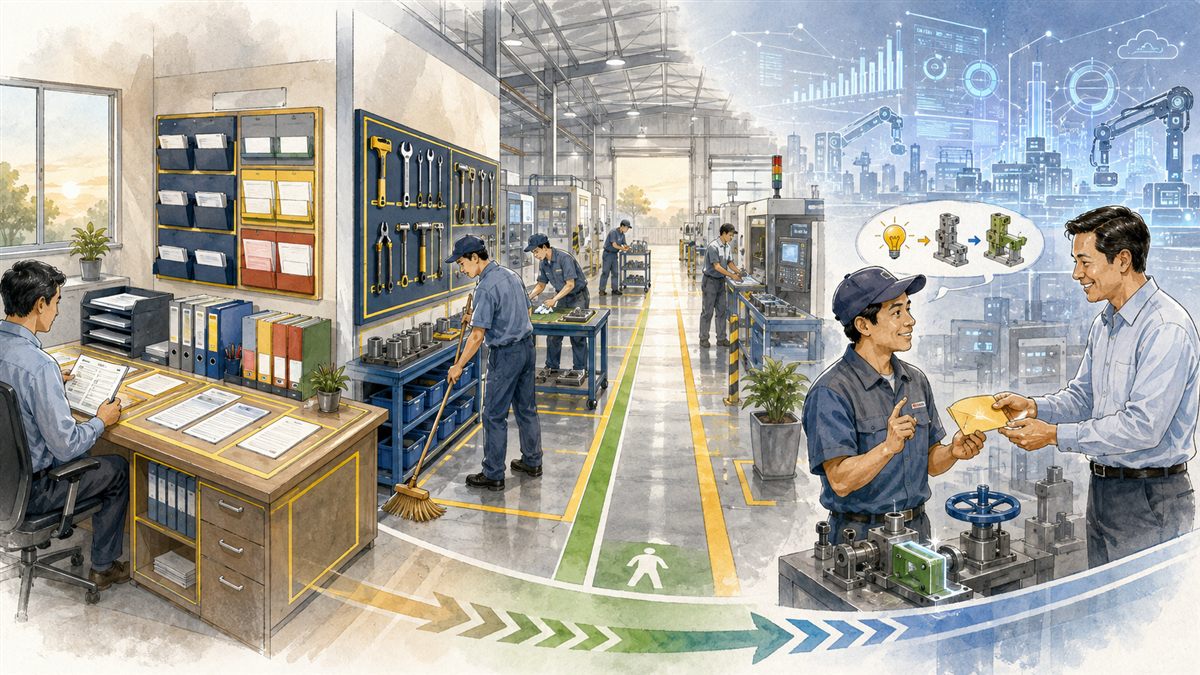
모든 책상 바닥과 캐비닛에 테이프로 구역 선을 그려, [결재 대기] [오늘 처리] [타 부서 협조]처럼 서류의 성격에 따라 자리를 정했습니다.
담당자가 자리를 비워도 새로 들어온 서류는 무조건 지정된 칸에 놓이도록 했습니다. 덕분에 지나가던 상사나 대리인이 책상만 슬쩍 봐도 업무의 우선순위와 병목 지점을 곧바로 파악할 수 있게 되었습니다.
서류를 찾는 시간이 눈에 띄게 줄었고, 지연되던 작업 지시가 제때 내려가면서 현장 불량률도 함께 낮아졌습니다.
장면 2. "새벽잠을 설치며 배우러 옵니다" — 동양강업(가칭)의 아침 3정5S
철강재를 깎고 자르는 현장은 흔히 쇳가루와 기름 찌꺼기, 낡은 공구들로 어수선하기 쉬운 곳입니다. 환경이 거칠면 작업자의 집중력이 떨어지고, 미세한 치수 오차로 인한 불량과 안전사고도 늘어납니다.
동양강업(가칭) 같은 곳들이 택한 돌파구는 '아침 3정5S 활동'이었습니다.
조업이 시작되기 전, 전 직원이 모여 단순히 청소만 하는 게 아니라 공구함 벽면에 각 공구의 모양(실루엣)을 그려 넣고, 사용한 공구는 반드시 제자리로 돌아가도록 정위치 습관을 훈련했습니다.
이동 통로와 위험 구역을 밝은 색으로 구분해 칠해, 지나가는 사람도 자재 배치가 잘못됐는지 한눈에 알아볼 수 있게 시각화했습니다.
먼지 없는 현장에서 공구 찾는 시간이 줄어들자 생산성도 함께 올라갔습니다. 이런 변화를 눈으로 확인하려는 동종 업계 관계자들의 견학 발길이 이어졌다는 이야기도 전해집니다.
장면 3. "아이디어가 나오는 즉시 지갑을 열어라" — 유니켐(가칭)의 즉시 포상제
많은 중소기업에 사내 제안 제도가 있지만, 대부분은 복잡한 양식을 갖춰 기획서를 써내고 수차례 결재를 거쳐야 겨우 연말에 소소한 상품권을 받는 방식으로 운영됩니다. 서류 작업에 지친 현장 근로자들은 점차 입을 닫게 됩니다.
유니켐(가칭) 같은 회사들이 택한 방식은 훨씬 단순했습니다.
작업자가 현장에서 "이 밸브 위치를 옮기면 더 안전하고 빠를 것 같다"는 의견을 조장이나 공장장에게 그 자리에서 던집니다.
복잡한 기획서 없이, 관리자가 타당성만 즉석에서 확인한 뒤 사내 즉시 포상 봉투에서 소액의 현금이나 상품권을 그날 바로 건넵니다.
"내 아이디어가 즉시 인정받는다"는 경험이 쌓이면서, 작은 개선 제안이 밑바닥에서부터 꾸준히 올라오는 문화가 자리 잡았다고 합니다.
세 장면이 공통으로 말해주는 것
세 이야기의 공통점은 명확합니다. 돈을 많이 들이지 않고도, 자리를 정하고, 습관을 들이고, 즉각적으로 인정해주는 것만으로 현장은 충분히 바뀔 수 있다는 것입니다.
첨단 스마트공장으로 도약할 수 있었던 기업들의 배경에도, 수십 년간 현장에서 바닥을 쓸고 서류 칸을 나누며 작은 아이디어에 귀 기울이던 아날로그 시간이 뼈대처럼 자리 잡고 있었을 가능성이 큽니다. 첨단 시스템이라는 지붕은, 그 아래 아날로그 기본기라는 튼튼한 뼈대 없이는 오래 버티지 못합니다.
혁신을 준비하고 있다면, 비싼 소프트웨어 카탈로그를 뒤적이기 전에 먼저 우리 현장 바닥의 선이 삐뚤어져 있지는 않은지, 직원들 책상 위 서류가 쌓여 있지는 않은지부터 점검해보는 것이 순서일지 모릅니다. 위대한 변화는 언제나 가장 낮은 곳, 가장 아날로그적인 기본기에서 시작됩니다.
Why Companies Spend Hundreds of Millions and Still Fail
Many small and mid-sized manufacturers today dream of building a "smart factory" — one equipped with AI, robotics, and automated systems running in seamless coordination at the push of a button.
But a phrase you hear just as often on the plant floor is: "A significant share of companies that invest heavily in enterprise systems never achieve the results they expected." The reason is straightforward: putting computers into a chaotic factory coated in grease and buried in tangled tools and paperwork does not, by itself, create efficiency.
Watching manufacturing operations over time, real innovation frequently starts not with expensive equipment but with low-cost analog fundamentals — the 3-Fix 5S discipline (right item, right quantity, right location + sort, set in order, shine, standardize, sustain). The three cases below reconstruct patterns that appear repeatedly across manufacturing plants.
Company names are fictional. These are not verified accounts of specific real firms — they are composite examples drawn from common patterns observed across manufacturing improvement initiatives.
Scene 1. A Line of Tape on a Desk — Dong-A Precision (fictional) and Office Visual Management
3-Fix 5S is typically thought of as something for production workers on the shop floor. But Dong-A Precision (fictional), a mold manufacturer, started in the office building where the management staff worked.
Before the change, the office looked like most small manufacturers': unidentifiable stacks of paper accumulating on absent employees' desks, important drawings and approval documents requiring a full search through drawers to locate, and delayed paperwork that threw off production schedules on the floor.
The approach they chose was office visual management:
Tape lines were drawn on every desk surface and cabinet to define zones labeled by document type — [Awaiting Approval], [Handle Today], [Needs Another Department] — and each zone was fixed.
Even when the responsible person was away, any newly arrived document had to go into its designated slot. A passing supervisor or stand-in could read the desk at a glance and immediately see priorities and bottlenecks.
Time spent searching for documents dropped noticeably. Work orders that had been routinely late started reaching the floor on time — and defect rates on the floor fell with them.
Scene 2. "People Drive Hours in the Early Morning to Come and See" — Dong-Yang Steel (fictional) and the Morning 5S Routine
Steel cutting and grinding operations tend toward disorder: metal shavings, oil residue, worn tools scattered across surfaces. When the physical environment is rough, worker concentration drops, dimensional tolerances drift, and both defects and safety incidents increase.
Companies like Dong-Yang Steel (fictional) addressed this through a daily morning 3-Fix 5S routine:
Before operations began, every employee gathered — not just to clean, but to trace each tool's silhouette onto the tool cabinet wall, so that any tool out of place was immediately visible. Returning tools to their exact spot became a trained habit, not an afterthought.
Walkways and hazard zones were painted in distinct colors so that anyone passing could tell at a glance whether materials were positioned correctly.
In a clean environment where no one wasted time hunting for tools, productivity rose as a direct consequence. The story goes that word spread among industry peers, and visitors began arriving from comparable companies specifically to see the transformation.
Scene 3. "Open Your Wallet the Moment the Idea Appears" — Unichem (fictional) and the Instant Reward System
Most small manufacturers have an internal suggestion program. Most of those programs require filling out forms, writing up a proposal, clearing multiple rounds of approval, and waiting until year-end for a modest gift certificate. Workers exhausted by paperwork eventually stop suggesting anything at all.
Companies like Unichem (fictional) took a much simpler approach:
A worker on the floor says, "Moving this valve a meter to the left would be safer and faster." They say it then and there to their team leader or plant manager.
No proposal document. The manager checks feasibility on the spot. If it holds up, a small amount of cash or a gift card comes out of a pre-loaded instant-reward envelope that same day.
Once workers experience "my idea was recognized immediately," small improvement suggestions begin flowing steadily upward from the floor — and a continuous improvement culture builds from the bottom rather than being mandated from the top.
What All Three Scenes Say Together
The common thread across all three is clear: without spending much money — simply by designating places, building habits, and offering immediate recognition — the shop floor can change substantially.
Behind every company that has made the leap to an advanced smart factory, there were almost certainly years of sweeping floors, drawing tape lines around document trays, and listening to small ideas from workers. The roof of an advanced system cannot stand for long without the skeleton of solid analog fundamentals beneath it.
If you are preparing for innovation, the right first step before browsing expensive software catalogs may be to check whether the lines on your shop floor are straight, and whether papers are stacking up on employees' desks. Great change has always started at the lowest level, in the most analog of fundamentals.
댓글Comments