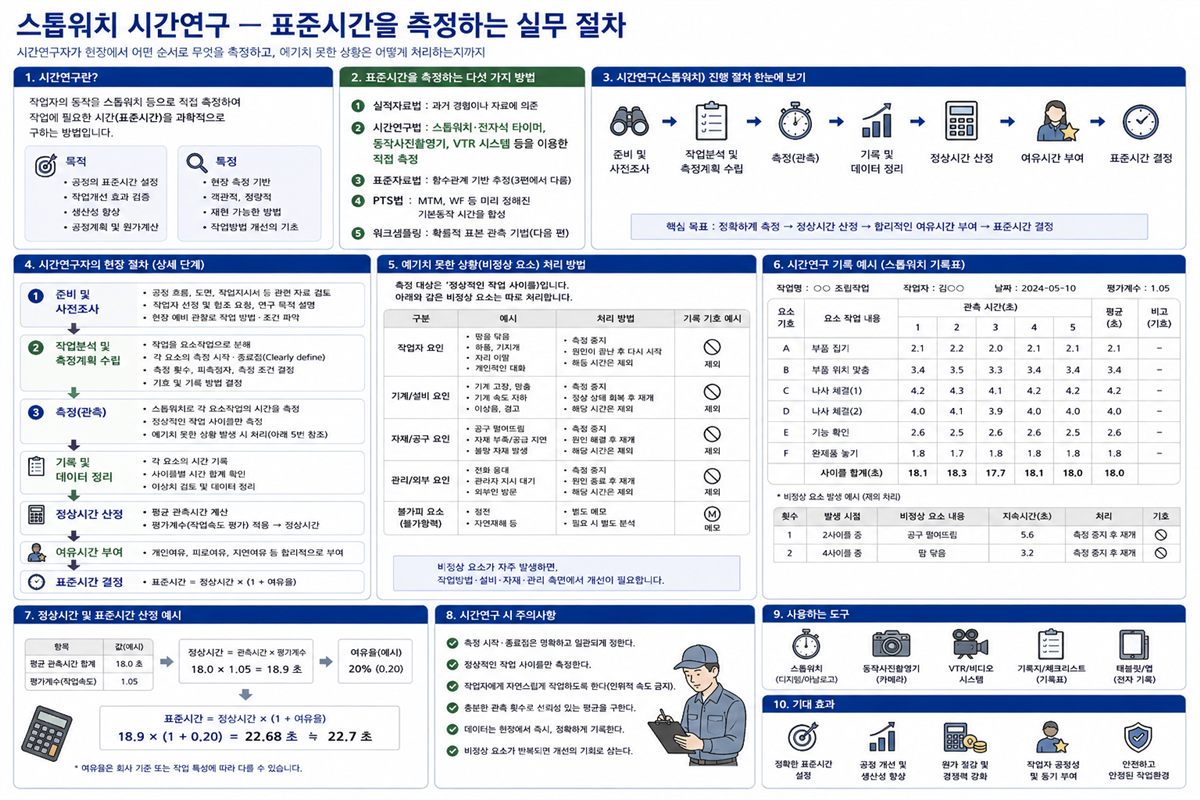
4편에서는 손동작 하나하나를 서블릭 단위로 쪼개는 동작연구를 다뤘습니다. 이번 편은 다시 스케일을 조금 넓혀서, 앞서 여러 번 언급했던 스톱워치 시간연구를 실무 절차 수준까지 파고듭니다. 시간연구자가 현장에서 어떤 순서로 무엇을 측정하고, 예기치 못한 상황(작업자가 땀을 닦거나 공구를 떨어뜨리는 등)을 어떻게 처리하는지까지 다룹니다.
표준시간을 측정하는 다섯 가지 방법
표준시간을 산정하는 방법을 개관하면 이렇게 정리됩니다.
실적자료법: 과거 경험이나 자료에 의존
시간연구법: 스톱워치·전자식 타이머, 동작사진촬영기, VTR 시스템 등을 이용한 직접 측정
표준자료법: 3편에서 다룬 함수관계 기반 추정
PTS법: MTM, WF 등 미리 정해진 기본동작 시간을 합성
워크샘플링: 다음 편에서 다룰, 확률적 표본 관측 기법
이번 편은 이 중 실적자료법과 시간연구법(스톱워치)을 집중적으로 다룹니다.
실적자료법: 과거 데이터로 표준시간 구하기
가장 단순한 접근은 과거 실적 데이터를 그대로 쓰는 것입니다. 세 가지 방식이 있습니다.
과거 자료를 그대로 사용
작업조건·방법·수행도를 고려해서 과거 자료를 수정해서 사용
전문가의 경험으로 산정
예를 들어 어느 제품의 과거 자료가 이렇다고 해봅시다.
날짜
완성품 개수
소요시간
4월 8일
60개
8.8시간
5월 3일
100개
15.4시간
7월 9일
90개
14.8시간
첫 번째 방식은 이 자료를 그대로 합쳐서 "39시간 ÷ 250개 = 0.16시간/개"로 표준시간을 구하는 식입니다. 하지만 이건 "과거에 그렇게 해왔다"는 사실을 보여줄 뿐이라, 평가 목적에 쓰기엔 곤란합니다. 특히 이걸 성과급 제도에 쓰면 회사의 임금 지출이 과다해질 수 있습니다.
두 번째 방식은 자료 수집 이후 작업방법·조건이 바뀌었을 가능성을 감안하고, 정상작업수행도 개념을 반영해서 수정하는 것으로, 첫 번째보다는 낫습니다. 세 번째는 전문가가 경험이나 유사 작업의 표준시간을 원용해서 추산하는 방식인데, 생각보다 결과가 나쁘지 않다고 합니다.
장점은 시간과 비용이 절약된다는 것이고, 결점은 두 가지입니다. 작업자가 표준시간을 부분적·전반적으로 조절할 가능성이 있다는 것, 그리고 자료 수집 이후 발생한 작업방법·조건·기계·공구 변화를 측정자가 인식하지 못해서 현재 상태를 반영하지 못하는 표준시간이 나올 수 있다는 것입니다.
시간연구 준비: 장비와 절차
필요 장비
시간측정장치: 스톱워치, 전자식 타이머(가장 보편적), 동작사진촬영기(스프링/배터리 방식은 분당 960프레임, 전기모터 방식은 분당 1000프레임), VTR 시스템, 마이크로크로노미터, 전자식 자료집적기(Datamyte 등)
관측용지: 작업자·관측자 인적사항, 측정시간·장소, 작업대와 부품 스케치, 동작요소 내용, 표준시간 결정 과정을 기록하도록 미리 디자인해두는 게 좋음
기타 도구: 연필, 계산기, 지우개, 자, 필요시 타코메타(기계 회전속도 측정)
시간연구법으로 표준시간을 정하는 8단계
직장의 이해·협조를 구하고 대상 작업자를 선정해서 시간연구 내용을 설명한다
대상 작업을 관찰해서 작업개선을 추구한다
작업을 요소작업으로 분할해서 기록한다
작업을 실제 관측해서 시간치를 관측지에 기록한다
관측 횟수가 충분한지 검사한다
작업수행도를 평가(레이팅)한다
요소작업별 평균시간치를 구하고 평가계수를 적용해 정미시간을 구한다
여유율을 결정해서 표준시간을 결정한다
시간연구자에게 필요한 자질
표준시간 설정은 일종의 "art and science(기술이자 과학)"이기 때문에, 시간연구자는 원만한 인간관계로 주위의 신뢰를 받아야 하고, 정확한 판단력·자신감·창의적인 성품을 갖춰야 합니다. 작업자 선정, 요소작업 분할, 시간치 기록, 작업수행도 평가, 여유율 산정 — 이 모든 단계가 표준시간치와 밀접하게 연결되기 때문에, 전문 지식과 풍부한 현장 경험이 필요합니다.
시간연구 준비 단계
시간연구를 의뢰받으면 먼저 확인할 것들이 있습니다: 처음 설정하는 작업인지 재측정인지, 표준시간이 어떤 용도로 쓰이는지, 표준시간을 설정할 여건이 갖춰졌는지. 작업방법 변경, 투입 자재 품질 불량, 기계 성능 변화, 작업조건 변화가 생기면 새 표준시간이 필요해지기 때문에, 이런 변화가 단기간에 발생하지 않도록 작업의 비능률성을 먼저 제거·개선하는 게 우선입니다.
이게 바로 "방법연구(2편) 다음에 작업측정(이번 편)을 소개하는" 이유입니다 — 표준시간 측정 전에 개선안을 추구하는 과정을 통해 시간연구자가 작업을 완전히 이해하게 되기 때문입니다.
관측지에 기재할 사항
작업장 스케치와 동작거리
요소작업 설명과 시작점·끝점
대상 작업 부품의 설명·스케치
투입되는 자재
사용 기계 번호·유형·치공구
작업자 인적사항, 관측 일시
이 자료들은 나중에 작업자·노동조합·타 부서에서 표준시간의 타당성을 문의할 때 그 근거를 밝히는 중요한 역할을 합니다.
대상 작업자의 선정
표준시간은 연구 대상 작업자뿐 아니라 동종 작업을 하는 모든 사람에게 적용되기 때문에, 선정에 신경 써야 합니다. 숙련도가 극히 우수하거나 열등한 작업자는 피하고, 평균 혹은 이를 다소 상회하는 작업자를 택하는 게 원칙입니다 — 이런 작업자가 견실하게 작업하고, 작업 수준이 정상 수준에 가까워 작업수행도 평가가 더 정확해지기 때문입니다. 시간연구에 협조적이고, 작업관리 개선에 흥미를 가진 작업자를 선정하는 것도 중요합니다.
참고로 4편에서 다룬 미세동작연구는 이와 정반대로 최고 숙련자를 선정한다는 점이 흥미로운 대비입니다 — 목적이 "일반적인 표준시간"인가 "이상적인 동작 패턴 추출"인가에 따라 접근이 달라집니다.
요소작업으로 분할하는 이유와 원칙
작업 사이클 전체를 하나의 요소작업으로 간주해서 측정하는 건 옳지 않고, 보통 여러 개로 나눠 측정합니다. 이유는 이렇습니다.
요소작업을 명확히 기술하면 작업 내용을 더 정확히 파악할 수 있다
같은 유형의 요소작업 자료로부터 표준자료를 개발할 수 있다
작업방법이 일부 변경돼도 변경된 부분만 다시 측정해서 표준시간을 쉽게 조정할 수 있다
작업자가 사이클마다 완전히 같은 속도로 작업하지 않으므로, 요소작업별로 작업수행도 평가를 다르게 적용할 수 있다
요소작업별로 타당한 여유율을 따로 산정해서 여유시간을 더 정확히 구할 수 있다
관측지의 관측항목란에는 규칙적으로 발생하는 요소작업을 먼저 적고, 불규칙적인 것은 뒤에 추가합니다.
요소작업 분할의 6가지 원칙
측정 범위 내에서 가능하면 잘게 분할한다. 서블릭은 스톱워치로 측정하기엔 너무 세분화된 동작이므로, 몇 개의 서블릭을 그룹으로 묶어 요소작업을 형성한다. 숙련된 시간연구 전문가는 0.02분 정도의 짧은 요소작업까지도 처리할 수 있다.
규칙적 요소작업과 불규칙적 요소작업을 구분한다. 불규칙적 요소작업(예: 기계에 가끔 기름을 주입하는 작업)도 작업 내용의 일부이므로 레이팅과 여유율을 산정해서 표준시간에 포함시켜야 한다.
작업자 요소작업과 기계요소작업을 분할한다. 작업자 요소작업은 작업자가 의도대로 시간을 조절할 수 있는 요소이고, 기계요소작업은 기계 동작시간과 별도로 수행되는지(외적요소작업) 아니면 기계 동작 중에 수행되는지(내적요소작업)에 따라 다시 나뉜다. 예를 들어 전 사이클에서 생산된 제품을 다음 사이클의 기계 가동 중에 검사한다면, 이건 작업자 요소작업이면서 동시에 내적 요소작업이다.
상수요소작업과 변수요소작업으로 구분한다. 상수요소작업은 부품의 크기·길이·무게·형태와 무관하게 시간이 동일한 요소(예: 프레스 시동버튼 누르기)이고, 변수요소작업은 부품 특성에 영향받는 요소(예: 프레스 가공시간 자체)다.
시점과 종점을 명확히 밝힌다. 한 요소작업의 종점은 다음 요소작업의 시점이 되는데, 이를 측정포인트(breaking point)라 부른다. 측정포인트는 눈보다 청각으로 감지하는 게 더 정확하다.
작업 진행 순서에 따라 분할한다.
관측 위치와 방법
시간연구자는 작업자 뒤편 1.5~2m 비껴선 위치에서 관측합니다. 작업자를 신경 쓰이게 하거나 방해하지 않으면서, 시계·관측용지·작업자 동작을 한꺼번에 볼 수 있는 위치입니다. 관측 중 작업자와 대화하지 않는 게 원칙입니다.
시간 기록 방법은 시계 사용법에 따라 네 가지로 나뉩니다.
① 계속법 (Continuous Method)
첫 사이클의 첫 요소작업이 시작되는 순간 시계를 작동시켜 관측이 끝날 때까지 멈추지 않습니다. 요소작업 종점마다 시계 바늘을 재빨리 읽어 적산시간을 기록하고, 나중에 뺄셈으로 각 요소작업의 실제 소요시간을 구합니다.
장점: 바늘을 멈추고 되돌릴 때 생기는 측정오차가 없다. 짧은 요소작업도 정확히 측정할 수 있다. 관측 시간 중 발생하는 모든 상황이 기록되므로 표준시간 설정 과정을 설명하기 쉽고, 나중에 문제가 생겼을 때 근거로 삼기 좋다. 이 때문에 작업자나 노동조합 측에서는 계속법을 선호한다.
단점: 요소작업 시간을 구하려면 뺄셈을 많이 해야 한다.
② 반복법 (Snapback Method)
각 요소작업 종점에서 시계 바늘을 멈춰 시간을 읽은 뒤, 원점으로 되돌리고 다시 작동시켜 다음 요소작업 시간을 잽니다.
장점: 연구가 끝난 후 뺄셈이 필요 없다. 요소작업 순서가 바뀌어도 쉽게 처리할 수 있고, 비교적 긴 요소작업 측정에 적합하다. 정체나 외래요소 처리도 간편하다.
단점: 0.06분 이하의 짧은 요소작업 측정에는 부적당하다. 바늘을 되돌리는 시간(약 0.0038분)만큼 작업자에게 불리하게 작용한다. 몇 사이클 측정 후에는 시간연구자가 시간을 예측할 수 있게 되어 부주의해지기 쉽다. 지체나 외래요소를 보통 기록하지 않기 때문에, 표준시간에 대한 의문점 해결 근거가 부족하다.
③ 순환법 (Cycle Timing)
요소작업이 너무 짧아 측정하기 힘들 때 씁니다. A, B, C, D 네 요소작업이 있다면, (A,B,C)를 한 그룹으로 시간을 재고, 이어서 (B,C,D), (C,D,A), (D,A,B) 순으로 그룹을 바꿔가며 측정해서, 연립 1차방정식으로 각 요소의 시간치를 역산하는 방식입니다. 일반적으로는 잘 쓰이지 않습니다.
④ 누적법 (Accumulative Timing)
측정 방법이라기보다는 도구적 보완에 가깝습니다. 스톱워치 두세 개를 레버에 연결해서 관측판에 부착한 뒤, 요소작업이 끝날 때마다 레버를 당겨 시간을 읽습니다. 계속법이나 반복법을 더 쉽고 정확하게 읽기 위한 수단인데, 관측판 앞이 무겁다는 게 단점으로 지적됩니다.
시간자료 기록 실례
계속법 기록을 예로 들어보겠습니다. 어느 작업이 Loading(요소작업1) → 기계가공(2) → Unloading(3) → 부품검사(4)로 구성됩니다.
관측지에는 R란(적산시간, Reading)에 시계 바늘이 가리키는 숫자를 그대로 적고, 나중에 T란(개별시간, Time)에 뺄셈한 값을 채웁니다. 이때 앞 요소작업의 측정 포인트 시간과 분 단위 숫자가 같으면 분 단위는 생략합니다 — 생략된 시간만큼 시간연구자가 여유를 갖고 레이팅을 할 수 있기 때문입니다.
측정 도중 예기치 못한 상황이 생길 수 있습니다. 처리 방법은 이렇습니다.
측정 포인트를 놓쳐 시간을 못 읽은 경우: R란에 M(Miss)을 기입. 이 경우 전후 요소의 개별시간도 산출할 수 없음
작업자가 요소작업을 생략한 경우: 해당 R란에 "–"를 기입. 이땐 생략된 요소작업만 영향을 받음 (이런 일이 자주 생기면 시간연구를 중단하고 그 요소작업의 필요성을 직장과 상의)
작업 순서가 바뀐 경우: 순서가 바뀐 요소작업의 R란 중간에 선을 긋고, 분모에 시작시간·분자에 종료시간을 기록. 정상 순서로 돌아온 뒤 다시 원래 방식으로 기입
외래요소(공구 파손, 직장과의 대화, 물 마시기 등 불가피한 지연)가 발생한 경우: 발생 직후 요소작업의 T란에 알파벳으로 표기하고, 외래요소표에 내용과 시간을 별도 기록. 만약 이 외래요소가 작업의 일부로 판단되면 불규칙적 요소작업으로 취급해서 레이팅·여유율을 산정해 표준시간에 반영
0.06분 이하의 아주 짧은 외래요소(공구를 떨어뜨렸다가 바로 집는다든지, 코를 풀거나 땀을 닦는 등): 그 시간을 원(circle)으로 둘러싸서 표시하고, 나중에 개별시간 계산 시 해당 요소 시간에서 제외
5사이클을 측정한 예를 정리하면 이렇습니다.
사이클
요소작업
R란 (적산시간)
비고
1
1→2→3→4
10, 35, 41, 55
—
2
1→2→3→4
65, M, 96, –
요소2: 측정포인트 놓침 / 요소4: 작업자가 생략
3
1→2→3→4
106, 131, 145, 151
요소3에서 작업순서 변경 발생
4
1→2→3→4
161, 186, 221, 235
요소3에서 외래요소(직장과 대화, 213에서 시작 221에서 재개)
5
1→…
247, …
요소1 후 땀을 닦음 (0.06분 이하면 circle 처리)
R란 값을 뺄셈해서 T란을 채우면, M·생략·외래요소가 있었던 사이클의 해당 요소는 계산에서 제외되고, 각 요소작업의 정상적인 사이클 시간이 드러납니다.
관측 횟수의 결정
개별 요소작업의 소요시간은 사이클마다 다소 달라집니다. 작업자의 동작이 완벽히 일관될 수 없고, 공구·재료 위치가 사이클마다 조금씩 다르며, 관측자가 시계를 읽는 데 따른 오차도 섞이기 때문입니다. 요소작업의 개별 시간치가 서로 독립이고 동일한 정규분포를 따른다고 가정하면, 통계학의 기본 이론(표준편차와 신뢰수준 기반 표본크기 산출)을 응용해서 필요한 관측 횟수를 결정할 수 있습니다. 구체적인 횟수 기준은 3편에서 소개한 Westinghouse Electric사 기준표를 참고하면 됩니다.
개별 시간 계산과 이상시간치 처리
필요한 횟수만큼 측정한 후, 사무실로 돌아와 레이팅 계수를 관측지에 기입하고 요소작업의 개별 시간을 계산해서 T란에 채웁니다. T란 기입이 끝나면, 개별시간 중 이상 시간치가 있는지 점검해서 제거한 뒤 요소작업의 평균 관측시간을 구합니다.
여기서 까다로운 질문이 생깁니다 — 변동이 얼마나 커야 "이상 시간치"로 볼 것인가? 명확한 정답은 없지만, 변동이 크더라도 작업의 본질에서 나온 것이라면 이상치로 보지 않아야 하고, 시간연구자의 오독이나 외부 요인에서 온 것이라면 제거해야 합니다.
M.E. Mundel이 제시한 기준은 이렇습니다.
작업자의 불필요하거나 잘못된 동작, 정해진 작업방법을 따르지 않은 경우 → 그 시간치를 제거한다
부품이 어질러진 상태에서 잘못 잡은 경우 → 작업의 본질에 기인한 것이므로 그대로 사용한다
처음엔 외래요소로 취급했지만 조사 결과 작업의 일부로 판정된 경우(불량 재료, 기계 조정 등) → 별도로 평가해서 발생 비율에 따라 표준시간에 반영한다
변동이 크더라도 특별한 이유를 찾을 수 없으면 → 평균시간 계산에 그대로 포함시킨다
이상 시간치로 확정된 경우 → 그 값을 원(circle)으로 둘러싼 뒤 제거하고, 관측 횟수를 하나 줄인다
이번 편에서 확인했듯, 스톱워치 시간연구는 "그냥 시간을 잰다"는 단순한 작업이 아니라, 예기치 못한 모든 상황을 어떻게 기록하고 처리할지에 대한 세밀한 규칙 체계를 갖추고 있습니다. 이게 바로 표준시간이 "누가 언제 재도 신뢰할 수 있는 숫자"가 되는 이유입니다.
다음 편(6편, 시리즈 마지막)에서는 여유시간(Allowance Time)의 상세한 산정 기준, 피로 측정, 그리고 워크샘플링을 다루며 IE 시리즈를 마무리할 예정입니다.
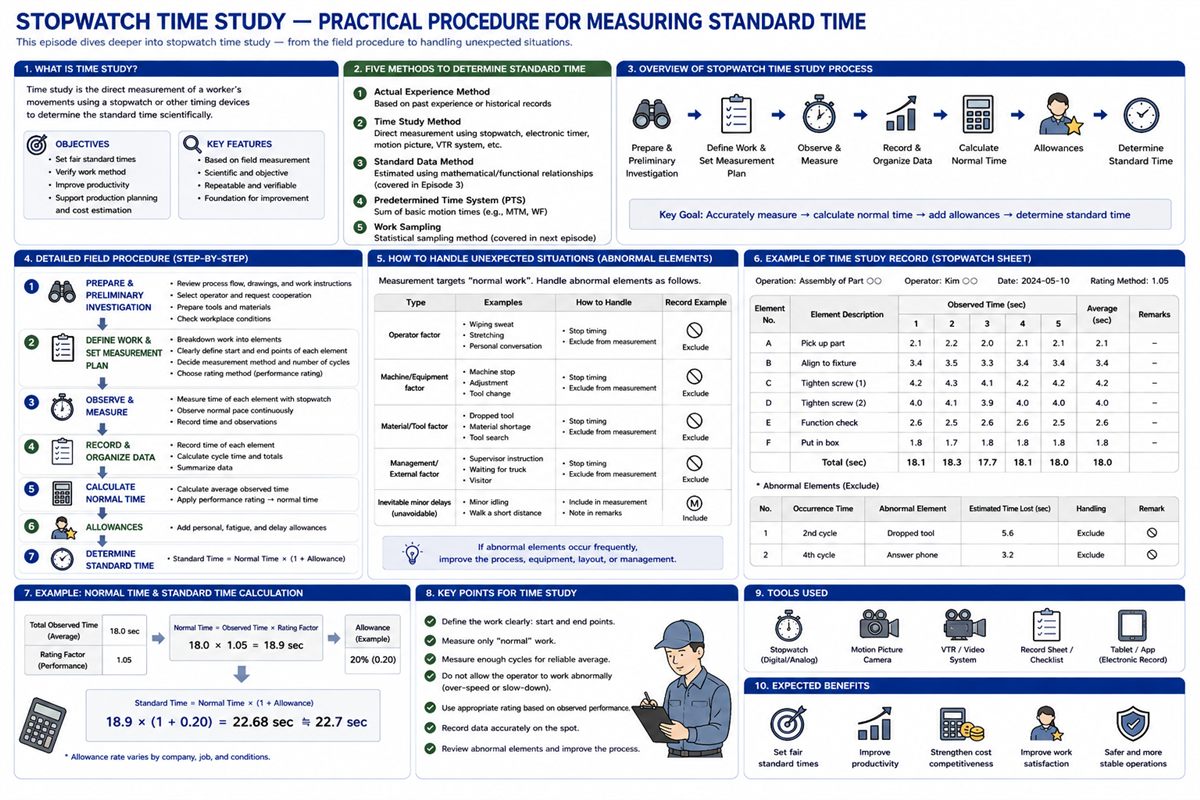
Part 4 zoomed into individual hand movements at the therblig level. This part widens the lens again to cover stopwatch time study at the level of practical procedure — what the time study analyst actually does on the floor, step by step, and how unexpected events (a worker wiping sweat, dropping a tool) are handled and recorded.
Five Methods for Setting Standard Time
Standard time can be established by five broad methods:
Historical data method: relying on past records or experience
Time study method: direct measurement using stopwatches, electronic timers, film cameras, or VTR systems
Standard data method: function-based estimation covered in Part 3
PTS method: synthesizing pre-determined time values (MTM, WF, etc.)
Work sampling: probability-based observation covered in the next part
This part focuses on the historical data method and the stopwatch time study method.
Historical Data Method: Setting Standard Time from Past Records
The simplest approach is to use existing production records directly. Three variants exist:
Use past data as-is
Adjust past data to account for changes in work method, conditions, or performance level
Estimate based on expert experience
Consider this sample production record for a product:
Date
Units completed
Time taken
April 8
60 units
8.8 hours
May 3
100 units
15.4 hours
July 9
90 units
14.8 hours
Variant 1 combines the totals: 39 hours ÷ 250 units = 0.16 hours/unit. This shows what was done in the past, but not what should be done — it is unsuitable for performance evaluation. Applied to incentive pay systems, it can result in excessive labor costs.
Variant 2 is better: it adjusts for changes in work method and conditions since the data was collected, and incorporates the concept of normal performance. Variant 3 — expert estimation by analogy from similar operations — produces surprisingly acceptable results in practice.
The advantage of historical data methods is that they save time and cost. The weaknesses are two: workers may have consciously or unconsciously paced themselves to influence the data; and the analyst may be unaware of changes in method, conditions, machinery, or tooling that occurred after the data was collected, producing a standard that no longer reflects current reality.
Preparing for Time Study: Equipment and Procedure
Required Equipment
Timing device: stopwatch, electronic timer (most common), motion picture camera (spring/battery type: 960 frames/min; electric motor type: 1,000 frames/min), VTR system, microchronometer, electronic data collector (Datamyte, etc.)
Observation sheet: pre-designed to capture analyst and worker details, time and location, workplace sketch, element descriptions, and the standard-time derivation process
Other tools: pencil, calculator, eraser, ruler, tachometer (for machine speed measurement where needed)
Eight Steps for Setting Standard Time by Time Study
Secure the understanding and cooperation of the supervisor; select the worker; explain the time study
Observe the operation and pursue improvements to the work method
Break the operation into work elements and document them
Observe and record time values on the observation sheet
Verify that the number of observations is sufficient
Rate the worker's performance
Calculate the average observed time per element and apply the rating factor to get normal time
Determine allowances and calculate standard time
Qualities a Time Study Analyst Needs
Setting standard time is both an art and a science. The analyst must earn the trust of those around them through good interpersonal skills, and bring accurate judgment, confidence, and creative thinking to the work. Every stage — worker selection, element breakdown, time recording, performance rating, allowance determination — is directly tied to the resulting standard time. Deep technical knowledge and extensive floor experience are both required.
The Preparation Phase
When assigned a time study, the analyst should first clarify: is this a first-time study or a re-study? What will the standard time be used for? Are conditions stable enough to conduct the study? Changes in work method, incoming material quality, machine performance, or working conditions all trigger the need for a new standard time — so the first priority is eliminating inefficiencies before measurement begins, to prevent those changes from occurring during or shortly after the study.
This is precisely why methods research (Part 2) comes before work measurement (this part): pursuing improvement first ensures that the time study analyst fully understands the operation before timing it.
What to Record on the Observation Sheet
Workplace sketch and motion distances
Element descriptions with start and end points
Description and sketch of the part being worked on
Materials used
Machine number, type, and tooling
Worker details and observation date/time
This documentation serves as the evidentiary basis when workers, unions, or other departments later question the validity of the standard time.
Selecting the Right Worker
Because the standard time will apply to every worker doing that job — not just the one being studied — selection matters. The principle is to avoid workers at either extreme of skill and choose one who is average or slightly above. Such workers perform steadily, work close to normal pace, and make performance rating more accurate. It also helps to choose a worker who is cooperative and interested in work improvement.
Micro motion study (Part 4) takes exactly the opposite approach and selects the most highly skilled workers available — a telling contrast. The difference is in the goal: general standard time vs. extraction of the ideal motion pattern.
Why and How to Break Work into Elements
Timing an entire operation as one unit is not appropriate; it is normally divided into several work elements. The reasons:
Clear element descriptions give a more precise picture of what the work actually involves
Data from similar elements across operations can be compiled into standard data
When the work method changes partially, only the changed elements need to be re-timed
Workers do not work at exactly the same pace throughout a cycle; element-level timing allows element-specific performance ratings
Allowances can be determined separately for each element, giving more accurate allowance times
On the observation sheet, regularly occurring elements are listed first; irregular ones are added at the end.
Six Principles for Breaking Work into Elements
Divide as finely as measurement allows. Therbligs are too small to time with a stopwatch, so several therbligs are grouped into one element. An experienced analyst can handle elements as short as 0.02 minutes.
Separate regular elements from irregular elements. Irregular elements (e.g., occasionally oiling a machine) are still part of the work and must be rated and given allowances so they are included in the standard time.
Separate worker elements from machine elements. Worker elements are those the worker controls; machine elements are further divided into external elements (performed separately from machine running time) and internal elements (performed while the machine runs). Inspecting the previous cycle's output while the machine runs the current cycle, for example, is both a worker element and an internal element.
Separate constant elements from variable elements. Constant elements take the same time regardless of the part's size, weight, or shape (e.g., pressing the start button). Variable elements are affected by part characteristics (e.g., the machining time itself).
Define start and end points clearly. The end of one element is the start of the next; this is called the breakpoint. Breakpoints are more reliably detected by sound than by sight.
Divide in the order work is actually performed.
Observer Position and Timing Methods
The analyst stands 1.5–2 m behind and to the side of the worker — close enough to see the stopwatch, observation sheet, and worker's motions simultaneously, without causing distraction. No conversation with the worker during observation.
There are four timing methods, classified by how the stopwatch is used.
① Continuous Method
The watch is started at the beginning of the first element and runs uninterrupted until the study ends. At each element's breakpoint, the analyst reads the accumulated time and records it in the R (Reading) column. Individual element times are later computed by subtraction.
Advantages: No measurement error from stopping and resetting. Short elements can be timed accurately. Every event during the study is on record, making the standard time easy to explain and defend — which is why workers and unions generally prefer the continuous method.
Disadvantage: Subtraction is required for every element time after the study.
② Snapback Method
At each element's breakpoint, the watch is stopped, read, snapped back to zero, and immediately restarted for the next element.
Advantages: No post-study subtraction required. Easy to handle elements that occur out of sequence. Well suited to longer elements. Foreign elements and delays are easy to deal with.
Disadvantages: Unsuitable for elements shorter than 0.06 minutes. The snapback itself takes roughly 0.0038 minutes, which systematically disadvantages the worker. After a few cycles, the analyst may begin anticipating readings, leading to carelessness. Foreign elements are typically not recorded, leaving less evidence to resolve later disputes.
③ Cycle Timing
Used when elements are too short to time individually. For four elements A, B, C, D, the analyst times (A,B,C), then (B,C,D), then (C,D,A), then (D,A,B), and solves a system of linear equations to recover individual times. Not commonly used in practice.
④ Accumulative Timing
More of a tool assist than a method. Two or three stopwatches are linked by a lever on the observation board; the analyst throws the lever at each breakpoint to advance to the next watch. It makes continuous or snapback timing easier and more accurate but adds weight to the board.
Recording in Practice
Consider an operation with four elements: Loading (1) → Machining (2) → Unloading (3) → Inspection (4), timed over five cycles using the continuous method.
The analyst records accumulated times in the R column as the study proceeds, then fills in the T (Time) column by subtraction afterward. When the minute-unit digit is the same as the previous breakpoint, the minute is omitted — the time saved is available for rating the current element.
Handling unexpected events:
Missed reading (breakpoint not caught): write M in the R column. Both this element and the adjacent one lose their individual times.
Worker omits an element: write "–" in that element's R column. Only that element's time is lost. If this recurs, stop the study and discuss whether the element is really necessary.
Elements performed out of sequence: draw a line through the R column entry; record start time in the denominator and end time in the numerator. Resume normal recording once the sequence returns to normal.
Foreign element (tool breakage, conversation with supervisor, water break, etc.): note with a letter in the T column and record details and duration in a separate foreign-element table. If the event turns out to be part of the job, reclassify it as an irregular element and include it in the standard time with its own rating and allowance.
Very short foreign element under 0.06 min (momentary tool drop, nose wipe, wiping sweat): circle the time value; subtract it when computing individual element times.
A five-cycle example summarized:
Cycle
Elements
R column (accumulated)
Notes
1
1→2→3→4
10, 35, 41, 55
—
2
1→2→3→4
65, M, 96, –
Element 2: missed / Element 4: omitted by worker
3
1→2→3→4
106, 131, 145, 151
Sequence change in element 3
4
1→2→3→4
161, 186, 221, 235
Foreign element in element 3 (conversation: starts at 213, resumes at 221)
5
1→…
247, …
Worker wipes sweat after element 1 (circle if under 0.06 min)
Subtracting R values to fill the T column reveals each element's normal cycle times; cycles with M, omissions, or foreign elements are excluded for the affected elements only.
Determining How Many Observations Are Needed
Element times vary slightly from cycle to cycle — worker motion is never perfectly consistent, material and tool positions shift, and the analyst's reading introduces small errors. Assuming element times are independent and normally distributed, standard statistical theory (sample size from standard deviation and confidence level) can be used to determine the required number of observations. The Westinghouse Electric reference table introduced in Part 3 provides practical benchmarks.
Computing Times and Handling Outliers
After collecting sufficient observations, the analyst returns to the office, enters rating factors on the sheet, computes individual element times in the T column, and calculates averages. Elements marked M lose both their own and the adjacent element's time; elements marked "–" lose only their own. Foreign element duration is subtracted before computing.
Once the T column is complete, the analyst scans for outliers — abnormally high or low values — before computing averages. The key judgment: large variation that originates in the nature of the work itself is not an outlier; variation traceable to analyst error or external interruption should be removed.
Mundel's guidelines:
Unnecessary or incorrect worker motions, or deviation from the specified method → remove the time value
Picking up a part from a disorganized pile incorrectly → inherent to the job; keep the value
Initially classified as foreign but later judged part of the job (defective material, machine adjustment) → evaluate separately and include in the standard time weighted by frequency of occurrence
Large variation with no identifiable cause → include in the average as-is
Confirmed outlier → circle the value, exclude it, and reduce the observation count by one
Stopwatch time study is not simply "timing work." It is a structured system for recording and handling every unexpected event that can arise on the floor — which is precisely what makes the resulting standard time credible regardless of who conducts the study or when.
Part 6, the final installment, will cover allowance time in detail — fatigue measurement, personal time, unavoidable delay — and work sampling, completing the IE series.
댓글Comments