포지셔닝전략의 핵심은 제품의 수명주기 단계와 공정의 단계가 서로 적합해야 한다는 것입니다. 이 원리를 극한까지 밀어붙여 좁은 공간, 적은 재고, 적은 인원으로 대량생산 수준의 성과를 실현하려는 접근이 바로 린생산방식(Lean Production)입니다.
중소기업이 생산관리에서 겪는 어려움
중소기업 현장에서 생산관리 대안을 수립할 때 흔히 부딪히는 어려움은 다음과 같습니다.
생산관리와 원가절감을 추진할 전문 인력의 부재
회사의 현 상황과 특징에 맞는 효과적인 생산관리 방법을 고르기 어려움
국내 상황에 맞지 않는 솔루션과 교육이 난립
단기 성과에만 치중하고 전반적인 계획 수립이 부재
생산관리를 전사적 시스템이 아니라 부문별 단속 관리로 인식
흥미로운 점은 이런 어려움이 다음과 같은 패턴으로 반복된다는 것입니다. "무언가 하자!" → "요즘 다른 회사는 뭘 하지?" → "무조건 하자!" — 즉, 회사의 현 상태에 대한 사전조사 없이 유행하는 솔루션을 무조건 도입하는 흐름입니다. 협력 모회사의 원가인하 압력, 급한 납기, 지속적인 품질개량 요구, 재무·인력 구조의 취약성, 생산품 라이프사이클 단축, 다품종소량생산 체제 전환, 저가 경쟁업체의 등장 등이 겹치면서 "무엇이든 하자, 살아남자"는 절박함이 생산관리의 중요성을 부각시킵니다.
생산관리의 정의와 역사
생산관리(Production Management)는 제조업체의 생산관리를 말하며, 서비스업까지 포괄하는 개념은 운영관리(Operations Management)라고 부릅니다.
미국 기업의 경영관리 흐름을 시대별로 보면 흥미로운 변화가 보입니다.
1기(1865~1950년): 생산관리 위주의 경영. 불황과 조직적 태업으로 인해 합리적인 원가절감이 필요했던 시기입니다. 과학적 관리법, 이동 컨베이어 시스템이 등장했습니다.
2기(1960년대): 마케팅 중심적 경영. TV 등 매스미디어가 확산되며 "Marketing is everything"이라는 말이 통용되던 시기입니다.
3기(1970년대): 재무 중심적 경영. 기업 인수합병이 활발해진 시기입니다.
이후 70년대 후반부터 미국 경기침체가 이어지고 80년대 들어 많은 기업이 도산했는데, 그 원인으로 환율·경제정책·금리·임금 문제와 더불어 전문경영인의 짧은 재임기간, 생산성 향상을 위한 장기 투자 감소가 지목되었고, 이것이 일본 기업에 뒤처지게 된 배경으로 분석됩니다.
생산관리시스템의 4요소
생산은 투입물을 경제재로 변환시키는 기능으로, 재무·영업과 함께 기업의 3대 기능 중 하나입니다. 생산시스템은 투입물(인력·자재·장비·자금·정보), 변환기능, 산출물(제품·서비스), 정보 피드백이라는 네 요소로 구성되며, 이를 통해 가치창출(팔릴 수 있는 것)과 경제적 생산(싸게 만드는 것)을 동시에 달성하는 것이 목표입니다.
변환기능은 형태변환(가공·조립), 시간변환(창고·은행), 장소변환(항공사·운수업), 소유변환(소매·도매·리스), 행위변환(인증·보증·검사) 등 다양한 형태로 나타납니다.
경쟁력을 결정하는 4가지 요소: 가격·품질·시간·유연성
경쟁력이 강한 기업이란 기업 내외의 이해관계자들을 만족시키는, 즉 가격과 품질 경쟁력이 높은 기업입니다. 이를 구성하는 네 가지 요소는 앞서 다룬 생산전략의 기본요소와 그대로 겹칩니다.
가격: 조직의 효율적 운영, 낭비 제거, 생산성 향상, 불량 감소, 원자재 구입비용 감소, 공정 표준화, 지속적인 공정개선
시간: 경쟁사보다 빠른 개발속도, 설계부터 시장 출하까지의 소요시간 단축, 납기 준수, 정보의 신속함. 시간 경쟁력을 강화하려면 조직의 수평화, 분권화, 신속한 피드백 체계가 뒷받침되어야 합니다.
제조와 서비스, 무엇이 다른가
제조는 제품 지향적이고 서비스는 행위 지향적이라는 점에서 근본적으로 다릅니다.
제품(제조)
서비스
물리적·내구성 있음
무형적
재고 가능
재고 불가능 (생산과 소비가 동시에 일어남)
고객접촉 제한적
고객접촉도 높음
대형설비·자동화, 자본집약적
진입·퇴거장벽 낮음
품질측정 용이
주관적 품질
생산관리의 뿌리: 테일러의 과학적 관리법과 포드의 이동 컨베이어
생산관리의 역사를 이야기할 때 빠지지 않는 두 인물이 있습니다.
테일러(F.W. Taylor)는 남북전쟁 이후 생산성 저하와 조직적 태업이 만연하던 시기, 방임적 관리 대신 작업자의 과업을 과학적으로 관리해 고임금과 저노무비용을 동시에 실현하고자 했습니다. 작업의 표준화, 작업조건의 표준화, 차별적 성과급제를 제시했지만, "인간은 금전적 유인에 의해서만 행동한다"는 배금주의적 전제가 한계로 지적되기도 합니다.
헨리 포드(Henry Ford)는 이동 컨베이어 시스템을 도입해 컨베이어와 작업자의 동시 작업을 구현했습니다. 장비의 전문화, 작업의 단순화, 부품의 표준화라는 대량생산의 3대 원칙을 확립했으며, "기업 이윤은 봉사의 결과"라는 경영이념 아래 노동자에게는 높은 임금을, 소비자에게는 양질의 물건을 싼 값에 공급하고자 했습니다.
다음 편: [생산관리 시리즈 ③] 생산형태의 분류 — 주문생산부터 장치산업까지
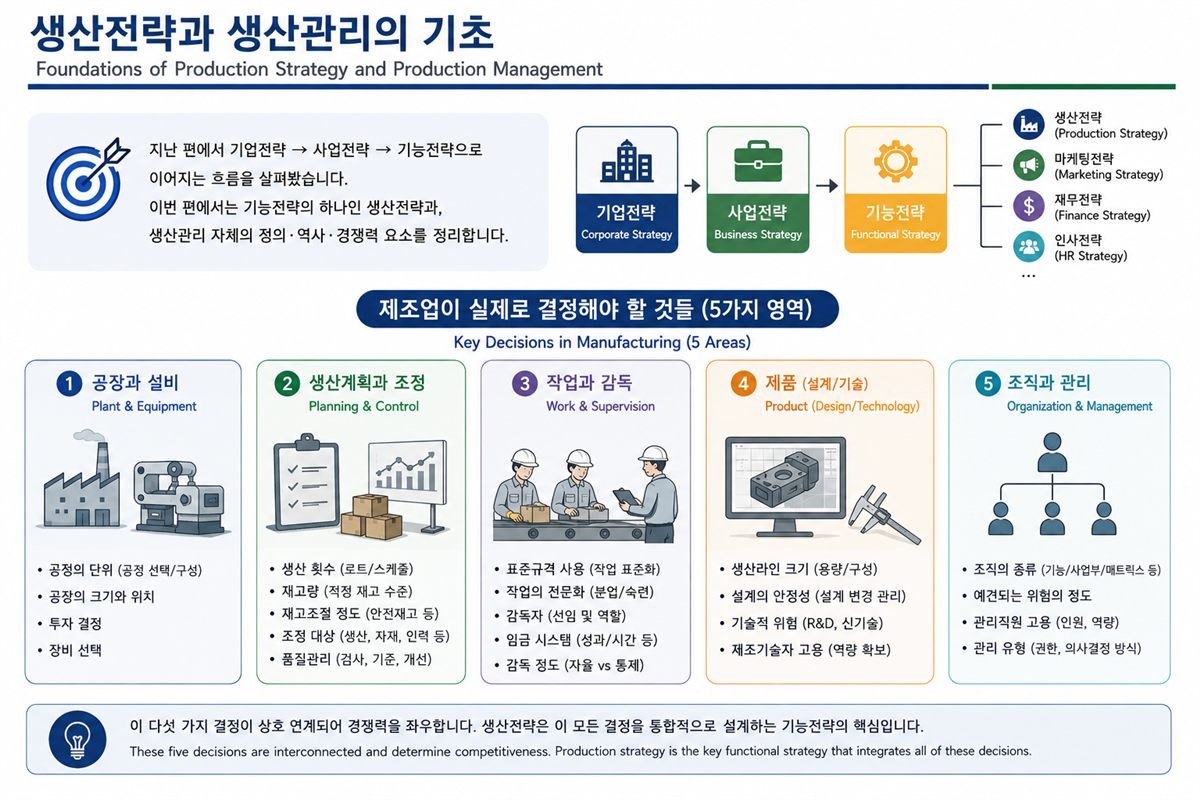
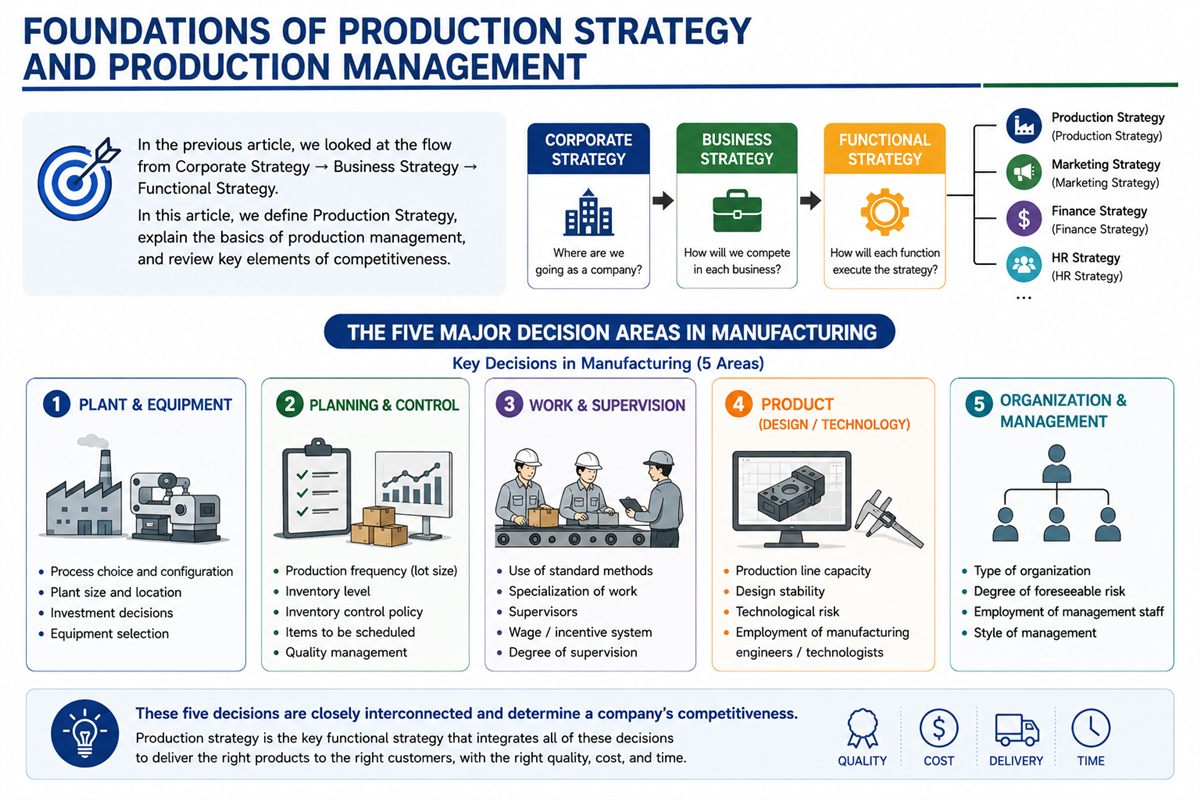
The previous article traced the flow from corporate strategy to business strategy to functional strategy. This article covers production strategy — one of those functional strategies — along with the definition, history, and competitive elements of production management itself.
How corporate, business, and production strategy connect
The three strategy tiers are hierarchically linked.
Corporate strategy focuses on survival.
Business strategy focuses on core competencies, expressed through cost leadership, differentiation, and focus.
Production strategy focuses on competitive advantage, expressed through four elements: cost, quality, time, and flexibility.
These three tiers interact with other functional strategies — marketing, finance, HR, engineering — to address resources, processes, products, infrastructure, and policies, ultimately delivering customer satisfaction through products and services.
The four elements of production strategy
1) Cost
Reducing labor costs, material costs, and manufacturing overhead to enable lower prices is the core concern.
2) Quality
High-performance design: superior performance, tight tolerances, high durability
Consistent quality: how closely products and services conform to design specifications
3) Time
Fast delivery lead times, on-time delivery, and development speed are the time-related competitive factors.
4) Flexibility
Customization: the ability to accommodate customer-specific product design requirements
Volume flexibility: the ability to adjust output in response to demand changes
Building a production strategy
A production strategy is developed in three steps.
Set objectives for the production system
Prioritize competitive elements (which of cost, quality, time, and flexibility comes first)
Allocate production resources rationally
The basic structure of production policy to consider in this process includes: the production technology suited to the company, the current production system, the degree of protection from competition (patents and institutional barriers), supplier reliability, and the relationship between the chosen products and labor costs — especially as labor costs rise in developed economies.
The focused factory strategy
First proposed by Skinner in 1974, the focused factory strategy concentrates production capacity so that each plant performs only one mission. The logic is straightforward.
When a single plant produces too many product types, management becomes difficult and internal misalignment generates inefficiency.
Complex plants — where equipment, personnel, processes, technology, and support services are all entangled — tend to slide into unmanageable states.
Concentrating a plant's role in terms of process technology, demand profile, and production volume therefore tends to be the better approach.
Product-process life cycles and positioning
The product life cycle (non-standard low-volume → high-mix low-volume → low-mix low-volume → standard high-volume) and the process life cycle (jumbled flow / job shop → disconnected line / batch → connected line / assembly → continuous flow) are paired.
The central insight of positioning strategy is that the product life cycle stage and the process stage must match. Taking this principle to its extreme — achieving mass-production-scale output with minimal space, inventory, and headcount — is what Lean Production is about.
Challenges small manufacturers face
Small manufacturers commonly run into these obstacles when trying to develop production management alternatives.
No specialist staff to drive production management and cost-reduction initiatives
Difficulty choosing methods that actually fit the company's specific situation
A crowded market of solutions and training programs mismatched to local conditions
Focus on short-term results with no overall plan
Treating production management as piecemeal departmental control rather than a company-wide system
What's striking is how these difficulties repeat in a recognizable pattern: "We have to do something!" → "What are other companies doing?" → "Let's just do that!" — implementing whatever solution is trending without any prior assessment of the company's actual state. Pressure from large client companies on cost, rushed delivery schedules, continuous quality demands, financial and staffing fragility, shrinking product life cycles, the shift to high-mix low-volume production, and the emergence of low-cost competitors all converge to create the desperation of "do anything, just survive" — and that desperation is what makes production management feel urgent.
Definition and history of production management
Production Management refers to managing production in manufacturing companies. The broader concept that extends to service industries is Operations Management.
Looking at how management emphasis in American companies shifted by era reveals an interesting pattern.
Phase 1 (1865–1950): Production-led management. Recessions and organized work slowdowns created pressure for rational cost reduction. Scientific management and the moving assembly line emerged in this period.
Phase 2 (1960s): Marketing-led management. Mass media — especially television — spread rapidly, and "Marketing is everything" became the dominant mindset.
Phase 3 (1970s): Finance-led management. Corporate mergers and acquisitions became widespread.
From the late 1970s, the US economy entered a prolonged slump, and many companies failed in the 1980s. The causes identified included exchange rate and monetary policy issues, but also short CEO tenures and declining long-term investment in productivity — factors that allowed Japanese manufacturers to pull ahead.
The four components of a production system
Production is the function of transforming inputs into economic goods — one of a company's three core functions alongside finance and sales. A production system consists of four elements: inputs (labor, materials, equipment, capital, information), the transformation function, outputs (products and services), and information feedback. The goal is to simultaneously achieve value creation (making something worth buying) and economical production (making it cheaply).
The transformation function takes many forms: form transformation (machining, assembly), time transformation (warehousing, banking), place transformation (airlines, logistics), ownership transformation (retail, wholesale, leasing), and state transformation (certification, warranty, inspection).
The four drivers of competitiveness: price, quality, time, flexibility
A competitive company is one that satisfies its internal and external stakeholders — in other words, one with strong price and quality competitiveness. The four components map directly onto the production strategy elements covered earlier.
Price: efficient organization, waste elimination, productivity improvement, defect reduction, lower raw material costs, process standardization, continuous process improvement
Quality: TQM and Six Sigma adoption, quality consideration from the design stage, quality assurance systems
Flexibility: human resource and equipment flexibility. High changeover costs cause longer production runs, higher inventory, and larger plants and warehouses.
Time: faster development than competitors, shorter time from design to market launch, on-time delivery, rapid information flow. Strengthening time competitiveness requires a flatter organization, decentralization, and fast feedback loops.
Manufacturing vs. services
Manufacturing is product-oriented; services are act-oriented. The differences are fundamental.
Products (Manufacturing)
Services
Physical, durable
Intangible
Can be inventoried
Cannot be inventoried (production and consumption simultaneous)
Limited customer contact
High customer contact
Large equipment, automation, capital-intensive
Low entry and exit barriers
Quality easy to measure
Quality subjective
Roots: Taylor's scientific management and Ford's assembly line
Two figures are inseparable from any history of production management.
F.W. Taylor worked in the era after the American Civil War, when productivity had fallen and organized work slowdowns were rampant. Rather than permissive management, he proposed scientifically managing workers' tasks to achieve high wages and low labor costs simultaneously. He introduced work standardization, standardization of working conditions, and differential piece-rate pay — though his assumption that "workers are motivated only by financial incentives" has been widely criticized as reductive.
Henry Ford introduced the moving assembly line, enabling conveyor and worker to operate simultaneously. He established the three principles of mass production — specialization of equipment, simplification of work, and standardization of parts — and operated under the conviction that "business profit is the result of service." His aim was to pay workers well and supply consumers with quality goods at low prices.
Next: [Production Mgmt Series ③] Types of Production — From Make-to-Order to Process Industries
댓글Comments