[생산관리 시리즈 ③] 생산형태의 분류 — 주문생산부터 장치산업까지[Production Mgmt Series ③] Types of Production — From Make-to-Order to Process Industries
FREEWAYFREEWAY·2026년 8월 26일August 26, 2026·10분 읽기10 min read
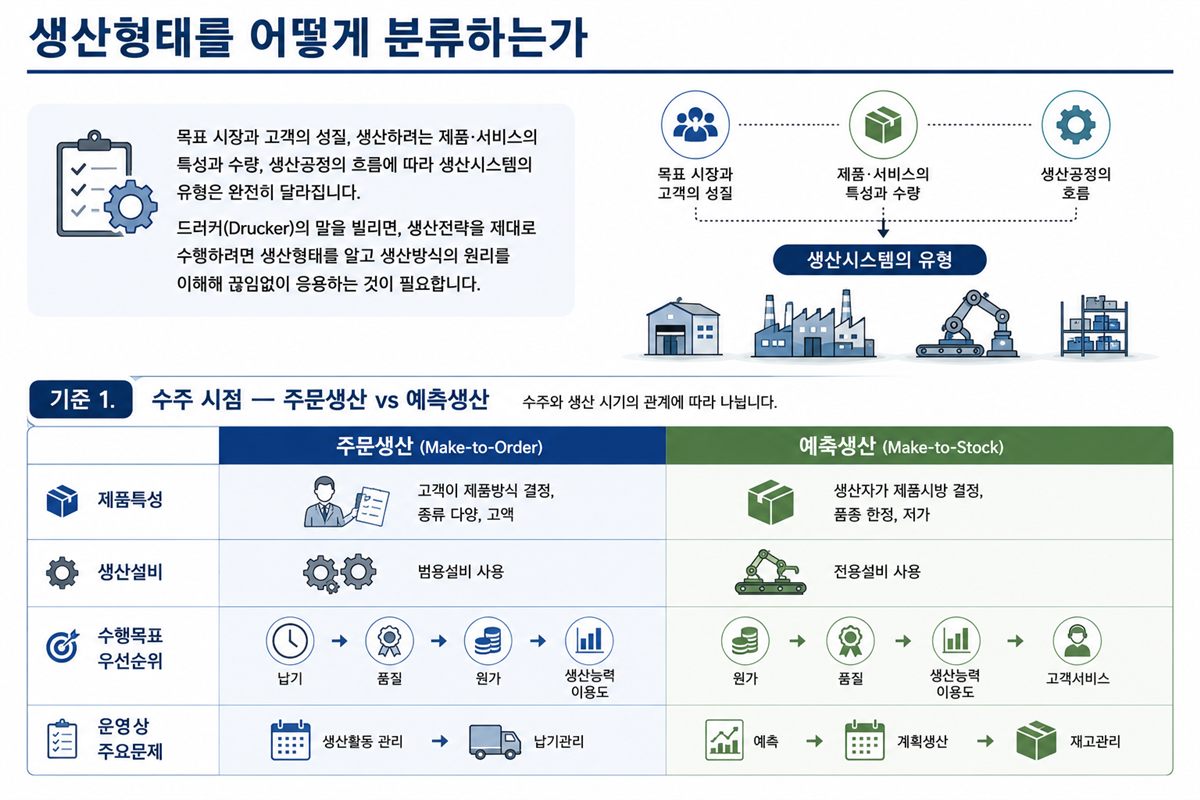
앞선 두 편에서 기업전략과 생산전략을 다뤘다면, 이번 편은 조금 더 실무에 가까운 주제입니다. 바로 생산형태를 어떻게 분류하는가입니다. 목표 시장과 고객의 성질, 생산하려는 제품·서비스의 특성과 수량, 생산공정의 흐름에 따라 생산시스템의 유형은 완전히 달라집니다. 드러커(Drucker)의 말을 빌리면, 생산전략을 제대로 수행하려면 생산형태를 알고 생산방식의 원리를 이해해 끊임없이 응용하는 것이 필요합니다.
제품의 종류(P)와 생산량(Q)의 관계에 따라 소품종다량생산, 중품종중량생산, 다품종소량생산으로 나뉩니다. 품종이 적을수록·생산량이 많을수록 소품종다량생산에 가까워지고, 반대로 품종이 많을수록·생산량이 적을수록 다품종소량생산에 가까워집니다.
기준 3. 생산흐름의 연속 여부 — 단속생산 vs 연속생산
단속생산: 개별생산, 소로트 단속생산, 중·대로트 단속생산
연속생산: 장치산업형 연속생산, 기계공업형 연속생산
기준 4. 생산의 반복성 — 개별·뱃치·연속
개별생산: 주문 하나하나를 개별적으로 생산
뱃치생산(로트생산): 일정량씩 반복 생산
연속생산: 대량의 동일 제품을 반복 생산
기준 5. 생산량과 기간
프로젝트 생산: 생산 규모는 거대하지만 수량은 극소, 기간은 장기간. 예) 교량, 댐, 고속도로 건설
개별생산: 생산 기간이 단기적이고 소량. 예) 의류, 주택, 특수공작기계
대량생산: 단위당 생산기간은 짧고, 1회 생산량은 대량
단속생산 vs 연속생산 — 특성 총정리
특성
단속생산
연속생산
생산시기
주문생산
예측생산
품종/생산량
다품종소량생산
소품종다량생산
생산속도
느리다
빠르다
단위당 생산원가
높다
낮다
운반설비
자유경로형(범용설비)
고정경로형(전용설비)
설비투자액
적다
많다
마케팅활동
주문 위주의 단기·불규칙적 판매
수요예측 기반의 장기적 마케팅
개별생산(다품종소량생산)시스템 — 특징과 함정
개별생산은 고객의 주문에 따라 전개되며, 양산에 의한 규모의 경제를 기대하기 어렵기 때문에 오히려 양산이 힘든 제품 — 생산수량이 적고 크기가 크며 고가인 제품에 유리합니다. 항공기, 조선, 건축, 토목, 공작기계 및 특수산업기계 제조업, 기계수리업, 맞춤 의류제조업이 대표적입니다.
특징을 정리하면 다음과 같습니다.
제품 사양은 고객(주문자)이 정합니다.
다양한 제품을 만들 수 있는 범용설비가 유리합니다.
작업자는 여러 제품 생산에 대한 풍부한 경험과 지식이 있어야 합니다.
운반물품의 크기·중량이 제각각이라 자유경로형 운반설비가 사용됩니다.
주문마다 가공시간이 달라 생산 흐름이 원활하지 못합니다.
주문 전에는 정확한 생산 예측이 어려워 원자재 계획구매가 곤란합니다.
정확한 일정계획보다는 납기 준수를 위한 생산공수·진도관리가 중요합니다.
주문이 바뀔 때마다 자재 준비, 치공구 설계, 작업할당, 생산계획 절차가 전부 달라집니다.
이런 이유로 생산활동 관리에 많은 시간이 들고, 비정형적 의사결정이 많이 필요합니다.
연속생산(소품종다량생산)시스템
정해진 생산공정을 일정한 속도로 대량 생산한다는 점이 공통점입니다. 각 공정의 가공능력이 균형을 이루고 있다면 공정품 재고는 거의 필요하지 않으며, 대신 생산공정의 높은 신뢰성이 요구됩니다. 전용설비로 일정 품목만 대량생산해 규모의 경제를 실현하며, 제품 단위당 생산원가가 낮다는 이점이 있는 반면 유연성이 적다는 단점이 있습니다.
기계공업형 연속생산
제품 중심으로 기계를 배치하는 생산시스템
전용설비를 사용하며, 설비투자액이 거액이라 신중한 투자결정이 필요
전용기계 고장 시 유휴손실이 크기 때문에 예방보전이 중요
원자재재고는 일정량 유지하지만, 공정품재고는 거의 없음(생산이 연속적이기 때문)
작업이 분업화되어 있어 반숙련·미숙련자도 투입 가능
이점으로는 낮은 단위당 생산원가, 거의 없는 유휴시간, 미숙련공도 투입 가능한 점, 운반비용 절감 등이 있습니다. 반면 전용설비이기 때문에 제품 다양화나 짧은 수명주기 제품에는 부적합하고, 생산율 조정폭이 크지 않으며, 작업자의 결근이나 설비 고장이 전 공정을 멈추는 위험이 있습니다.
장치산업형 연속생산
석유정제, 유리, 시멘트, 비료, 비누 등 화학제품 제조업이 대표적입니다. 거액의 설비투자가 필요하고 생산시스템 변경이 어렵습니다. 투입된 원료가 이동하면서 가공되기 때문에 물자의 공간이동율이 높은데, 이는 곧 고장으로 인해 공정이 멈출 경우 손실이 매우 크다는 뜻이기도 합니다. 그래서 장치·시설 전체의 신뢰성이 무엇보다 중요합니다.
장치산업 vs 가공·조립산업 비교
구분
장치산업
가공·조립산업
고객 수
소수
다수
자본/노동 구성
자본집약적
노동집약적
자동화 수준
높다
낮다
생산 유연성
적다
많다
설비의 신뢰성
높다
낮다
제품 관리 방식
집단관리 용이
개체관리 곤란
학자별 생산시스템 분류
생산시스템을 바라보는 관점은 학자마다 조금씩 다릅니다.
Locker: 개별생산방식, lot(batch)생산방식, line(흐름)생산방식
Buffa: 단속생산방식, 연속생산방식 (수요의 형태 기준)
Dilworth: 프로젝트생산, 단위(batch)생산, 대량생산, 장치생산
Chase & Aquilano: 맞춤서비스 생산방식, 표준화된 서비스 생산방식
넓은 의미의 생산활동을 종합하면 프로젝트생산, 개별생산(Job Shop), 롯트(뱃치)생산, 라인(흐름)생산으로 정리할 수 있습니다.
다음 편: [생산관리 시리즈 ④] MRP에서 ERP까지 — 생산관리 시스템의 발전사
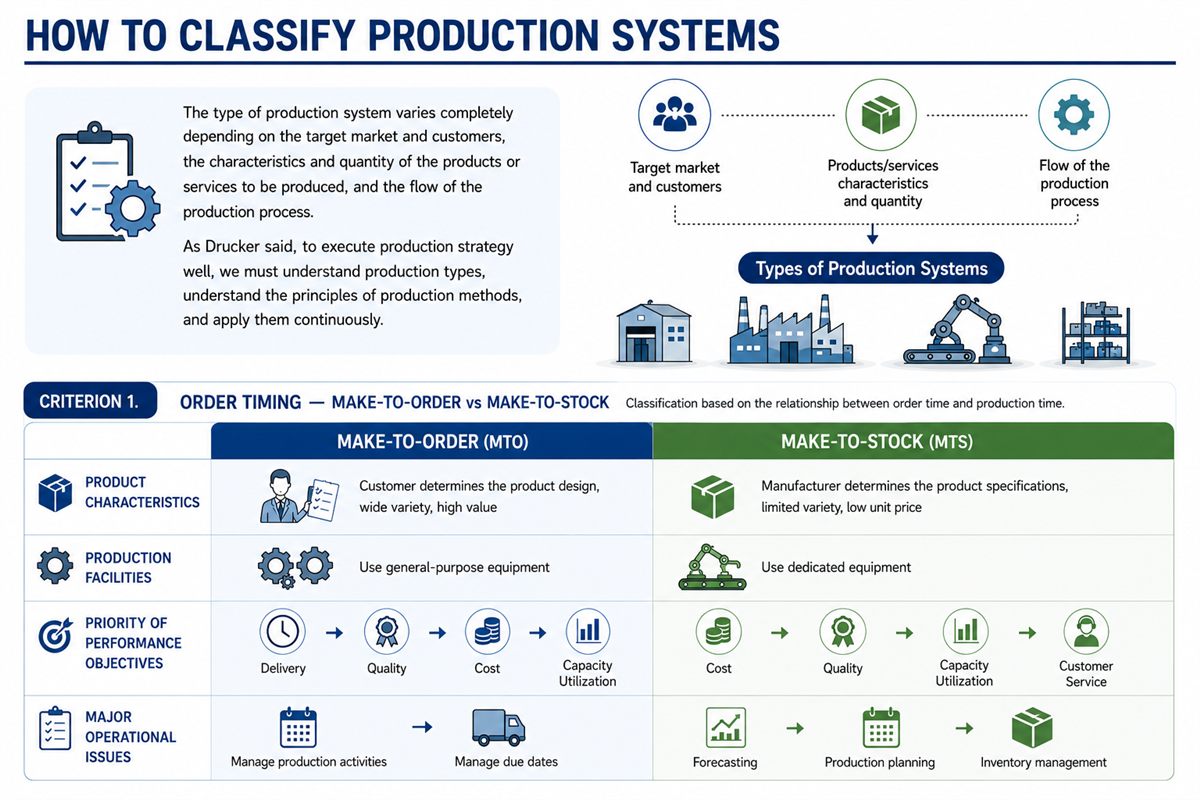
The previous two articles covered corporate strategy and production strategy. This article moves closer to the shop floor: how production types are classified. The type of production system that works best depends entirely on the target market, the nature of products or services, the volumes involved, and how production flows. As Drucker observed, properly executing a production strategy requires understanding how production types work and applying those principles continuously.
Production type is also classified by the relationship between the number of product types (P) and the quantity produced (Q): low-mix high-volume, medium-mix medium-volume, and high-mix low-volume. The fewer product types and the higher the volume, the closer a system is to mass production; the more types and the lower the volume, the closer to job-shop production.
Criterion 3: Flow continuity — intermittent vs. continuous
Job production: each order is produced individually
Batch production (lot production): a fixed quantity is produced repeatedly
Continuous production: large volumes of identical products produced repeatedly
Criterion 5: Volume and time horizon
Project production: enormous scope but extremely low quantity, long duration — e.g., bridges, dams, highways
Job production: short production runs, low volume — e.g., clothing, houses, special-purpose machine tools
Mass production: short cycle time per unit, very high output per run
Intermittent vs. continuous — full comparison
Characteristic
Intermittent
Continuous
Production trigger
Make-to-order
Make-to-forecast
Mix / volume
High-mix low-volume
Low-mix high-volume
Production speed
Slow
Fast
Unit production cost
High
Low
Material handling
Variable-path (general-purpose)
Fixed-path (dedicated)
Capital investment
Low
High
Marketing
Order-driven, short-term, irregular
Demand-forecast-driven, long-term
Job shop (high-mix-low-volume) production — characteristics and pitfalls
Job-shop production is driven by individual customer orders. Because economies of scale through mass production are difficult to achieve, it actually excels for products that are hard to mass-produce — low-quantity, large, high-value items. Typical industries include aerospace, shipbuilding, construction, civil engineering, machine tools and special industrial machinery, machinery repair, and bespoke garment manufacturing.
Key characteristics:
Product specifications are set by the customer (the ordering party).
General-purpose equipment that can handle a variety of products is preferred.
Workers need broad experience and knowledge across multiple product types.
Variable-path material handling equipment is used because load sizes and weights differ for every job.
Processing times differ by order, so production flow is uneven.
Accurate production forecasting before an order arrives is difficult, making planned raw material purchasing challenging.
Rather than precise scheduling, production-hour tracking and progress control to meet delivery dates are more important.
Each new order requires a completely different set of material preparation, tooling design, work assignment, and production planning.
As a result, production activity control consumes significant time and requires substantial unstructured decision-making.
Continuous (low-mix-high-volume) production
The defining feature is producing large volumes of standardised products through a fixed process at a constant rate. When process capacities are balanced, work-in-process inventory is almost unnecessary — but high process reliability becomes essential. Dedicated equipment enables economies of scale on a limited product range, yielding low unit costs, while flexibility is the trade-off.
Mechanical-industry continuous production
Product-centred machine layout
Uses dedicated equipment; large capital investment demands careful decision-making
Breakdowns cause major idle-time losses, so preventive maintenance is critical
Raw material inventory is kept at a set level; work-in-process inventory is minimal because production is continuous
Specialised tasks allow semi-skilled or unskilled workers to be used
Advantages include low unit cost, minimal idle time, the ability to deploy unskilled labour, and reduced handling costs. Disadvantages: dedicated equipment is unsuitable for product diversification or short product life cycles, output rate adjustment is limited, and a single worker absence or equipment failure can halt the entire line.
Process industry continuous production
Petroleum refining, glass, cement, fertiliser, and soap manufacturing are the classic examples. Very large capital investment is required and changing the production system is difficult. Because raw materials are continuously transformed as they move through the process, spatial throughput rates are high — meaning that a process stoppage caused by a breakdown results in very large losses. System-wide reliability of plant and equipment is therefore paramount.
Process industries vs. discrete manufacturing
Dimension
Process Industries
Discrete (Machining & Assembly)
Number of customers
Few
Many
Capital / labour intensity
Capital-intensive
Labour-intensive
Automation level
High
Low
Production flexibility
Low
High
Equipment reliability requirement
High
Lower
Product control method
Batch/group control (easy)
Individual unit tracking (difficult)
How scholars classify production systems
Academics approach the classification of production systems from slightly different angles.
Locker: job production, lot (batch) production, line (flow) production
Buffa: intermittent production, continuous production (based on demand pattern)
Dilworth: project production, unit (batch) production, mass production, process production
Chase & Aquilano: customised-service production, standardised-service production
Taking the broadest view of production activity, the field generally resolves into four types: project production, job shop production, lot (batch) production, and line (flow) production.
Next: [Production Mgmt Series ④] From MRP to ERP — The History of Production Management Systems
댓글Comments