[생산관리] 물류의 정의와 6대 기능, 다시 제대로 정리하기[Production Management] Logistics Redefined: Definitions, Six Functions, and Core Systems
FREEWAYFREEWAY·2026년 8월 14일August 14, 2026·9분 읽기9 min read
앞선 물류관리 큰 그림 글이 개론 강의 목차 수준이었다면, 이번 자료는 물류의 정의·기능·영역을 훨씬 더 촘촘하게 정리한 요약본입니다. 여러 기관의 정의를 비교해보고, 조달·생산·판매물류의 구분, 물류의 6대 사회경제적 기능, 로지스틱스와의 차이, 운송·보관·하역·포장까지 다뤄보겠습니다.
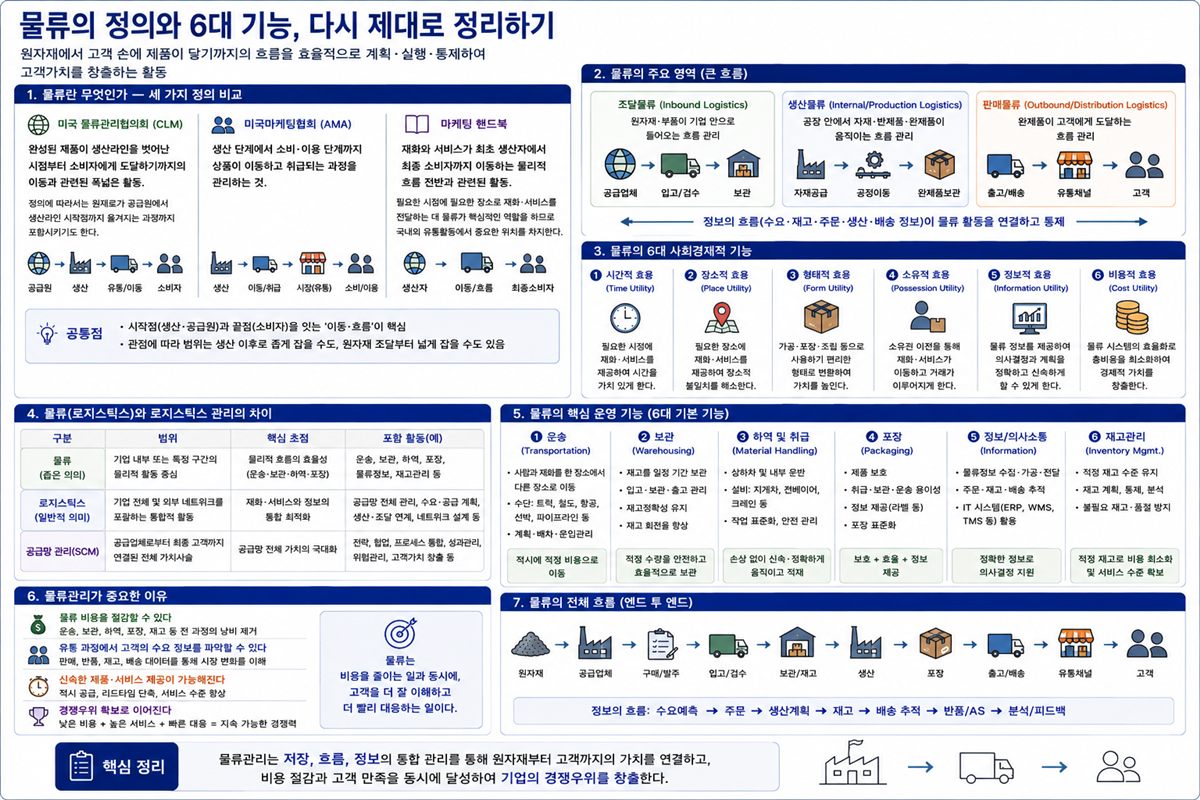
물류란 무엇인가 — 세 가지 정의 비교
물류를 정의하는 방식은 기관마다 조금씩 결이 다릅니다.
미국 물류관리협의회는 물류를, 완성된 제품이 생산라인을 벗어난 시점부터 소비자에게 도달하기까지의 이동과 관련된 폭넓은 활동으로 정의합니다. 정의에 따라서는 원재료가 공급원에서 생산라인 시작점까지 옮겨지는 과정까지 포함시키기도 합니다.
미국마케팅협회(AMA)는 조금 더 간결하게, 생산 단계에서 소비·이용 단계까지 상품이 이동하고 취급되는 과정을 관리하는 것으로 물류를 정의합니다.
마케팅 핸드북은 범위를 더 넓게 잡습니다. 재화와 서비스가 최초 생산자에서 최종 소비자까지 이동하는 물리적 흐름 전반과 관련된 활동으로 보면서, 필요한 시점에 필요한 장소로 재화·서비스를 전달하는 데 물류가 핵심적인 역할을 하기 때문에 국내외 유통활동에서 중요한 위치를 차지하게 됐다고 설명합니다.
세 정의를 나란히 놓고 보면 공통점이 보입니다 — 시작점(생산·공급원)과 끝점(소비자)을 잇는 "이동·흐름"이 핵심이고, 관점에 따라 그 범위를 생산 이후로 좁게 잡을 수도, 원자재 조달부터 넓게 잡을 수도 있다는 것입니다.
물류의 개념: 계획·실시·통제의 시스템
물적유통(물류)을 조금 더 실무적으로 풀면 이렇습니다.
원자재·재공품·완제품 및 관련 정보를 생산지점에서 소비지점까지 효율적이고 효과적으로 이동되도록 계획·실시·통제하는 과정으로, 기업 내 모든 물자의 계획·생산·통제에 대한 시스템적 접근.
이를 통해 얻는 결과가 물류관리의 존재 이유입니다. 효율적인 물류관리는 가장 낮은 비용으로, 소비자가 원하는 시간에, 적절한 장소에서 물자를 획득할 수 있게 해서 소비자를 만족시키고, 동시에 기업의 경쟁력을 높이는 가치창출 활동입니다. 비용 절감과 고객 만족이 서로 배치되는 게 아니라, 물류 시스템을 잘 설계하면 둘 다 잡을 수 있다는 관점입니다.
물류시스템의 4가지 영역
물류를 기업 내부의 흐름 순서로 나누면 네 단계가 됩니다.
① 조달물류
물류관리의 시발점입니다. 공급요청을 받은 외주공장에서 원자재·부품을 어떻게 포장·단위화(unit)해서 모기업의 자재창고까지 수송·배송할 것인가를 다룹니다. 원부자재의 조달부터 자재창고에서의 보관, 자재관리의 효율성 제고에 중점을 둡니다.
② 생산물류
자재창고의 출고작업부터 생산공정으로의 운반·하역, 다시 창고로의 입고작업까지를 말합니다. 핵심 과제는 이 과정을 얼마나 단축시키는가이고, 그래서 운반·하역·창고의 자동화에 특히 무게를 둡니다.
③ 판매물류
물류의 최종 단계로, 제품을 소비자에게 전달하는 모든 수·배송 활동을 가리킵니다. 제품창고 출고 → 중간 물류거점인 배송센터까지의 수송 → 배송센터 내 유통가공·제품분류 → 각 대리점·고객에게 배송하는 작업까지 전부 포함됩니다.
④ 사내물류
제품이 회사 내부에서 이동하고 포장되는 것부터 출고 이전까지의 작업을 가리키며, 보통 생산물류에 포함되는 개념으로 다룹니다.
이 네 단계를 순서대로 이으면 원자재가 공장에 들어와서(조달물류) → 생산 과정을 거치고(생산물류·사내물류) → 최종적으로 고객에게 도달하는(판매물류) 전체 흐름이 완성됩니다.
물류의 6가지 사회경제적 기능
물류가 경제 전체에서 어떤 역할을 하는지를 "거리 조정"이라는 관점으로 정리하면 여섯 가지가 나옵니다. 생산자와 소비자 사이에는 여러 종류의 "거리"가 있고, 물류는 이 거리들을 좁혀주는 역할을 합니다.
조정 기능
설명
필요한 물류 요소
장소적 거리
생산 장소와 소비 장소가 다름. 경제가 발전할수록 이 거리는 오히려 확대되는 경향
수송기능
시간적 거리
재화의 생산 시기와 소비 시기가 일치하지 않음
보관기능
수량적 거리
생산자의 생산단위 수량과 소비자의 소비단위 수량이 다름
집하·중계·배송기능
품질적 거리
생산자가 제공하는 재화와 소비자가 기대하는 재화의 품질이 다름
가공·조립·포장기능
가격적 거리
생산자와 소비자 사이 가격 조정이 필요함
수송~정보활동 전반
인적 거리
생산자와 소비자가 인격적으로 다르고, 분업이 진행되면서 유통경제조직이 복잡해짐
수송·상거래기능
이 여섯 가지 거리는 결국 물류의 다섯 가지 실행 요소 — 수송, 보관, 하역, 포장, 정보활동 — 가 서로 결합되면서 조정됩니다.
물류시스템의 기능과 역할
물류를 이루는 개별 기능은 구매·포장·수송·하역·보관·정보 등으로 나눌 수 있습니다. 여기서 중요한 지적은, 개별 기능 하나하나를 잘하는 것만으로는 부족하고, 이를 통합적·시스템적으로 관리하는 체계가 필요하다는 것입니다. 각 기능을 따로 개선해봐야, 서로 맞물리지 않으면 전체 흐름은 오히려 비효율적일 수 있습니다.
물류시스템의 역할을 한 줄로 요약하면, 생산과 소비를 연결하는 기능을 보다 합리적으로 수행하는 것입니다.
물류(Physical Distribution)와 로지스틱스(Logistics)의 차이
두 용어가 비슷하게 쓰이지만 사실 범위가 다릅니다. 로지스틱스라는 개념은 1960년 미국 워싱턴대학의 브류워 교수와 존슨 교수가 "물적유통관리의 과학적 접근법"이라는 제목으로 처음 발표했는데, 어원이 흥미롭습니다 — Rho(흐름), Chrema(자재 또는 물자), Ics(학술 또는 과학)를 뜻하는 그리스어에서 나왔다고 합니다.
물류(Physical Distribution): 공급자인 생산자가 소비자에게 재화를 공급하는 과정만 다룸
로지스틱스(자재관리 + 물류관리): 원재료·부품 공급자 단계부터 생산 단계를 거쳐 최종 소비자에게 전달되는 전 과정을 총체적으로 다룸
즉 물류가 "생산 이후"에 초점을 맞춘 개념이라면, 로지스틱스는 "원자재부터 소비자까지" 전체를 아우르는 더 넓은 개념입니다. 앞선 물류관리 글에서 자재관리와 유통관리를 물류의 두 축으로 소개했었는데, 그 둘을 합친 게 정확히 로지스틱스에 해당합니다.
운송 물류
운송이란 제품이 생산되는 장소와 소비되는 장소 사이의 거리(공간)를 조정하는 활동입니다. 여기서 흔히 헷갈리는 두 용어를 구분할 필요가 있습니다.
수송: 제품을 공장이나 창고로부터 물류센터까지 운송하는 것
배송: 제품을 물류센터로부터 각 대리점이나 고객에게 운송하는 것
"수송"은 물류센터까지 오는 큰 흐름, "배송"은 물류센터에서 최종 목적지까지 가는 마지막 구간입니다.
운송수단의 선택
운송수단은 육운(철도·도로), 해운, 항공, 파이프라인 등으로 나뉘고, 실제 선택할 때는 운송물량, 운임, 기후, 안전성, 일관수송·복합운송 여부, 중량, 신속성, 물류비, 배차, 화물의 수취 방식 등 여러 요소를 종합적으로 고려합니다. 어느 하나만 최적화해서 결정할 수 있는 문제가 아닙니다.
보관 및 창고 시스템
보관시스템
보관이란 원자재·재공품·제품을 보관·저장하는 활동이면서, 동시에 필요할 때 즉시 출하할 수 있도록 하는 물류창고 시스템 전체를 가리킵니다. 다품종 소량생산, 다빈도 소량배송이 요구되는 오늘날에는, 보관 활동이 단순히 창고에 쌓아두는 기능에서 벗어나 고객 요구에 신속히 대응하기 위한 시스템으로서의 역할을 하게 됐습니다.
창고시스템
창고의 주된 역할은 보관이지만, 실제 기능은 그보다 훨씬 다양합니다.
저장 기능
수급조정 기능
가격조정 기능
물류의 각 기능을 연결해주는 기능
매매기관적 기능
신용기관적 기능
판매전진기지적 기능
창고의 종류도 용도에 따라 상품창고, 벌크화물창고, 저온창고, 가정용품창고, 일반잡화창고 등으로 세분화됩니다.
창고업무의 자동화
자재조달·생산·판매관리의 중간과정에서 나타나는 보관관리를, CIM(컴퓨터통합생산)이나 자동제어기술과 결합해서 만든 게 인공두뇌창고입니다. 이건 MRP나 POS 같은 컴퓨터 기반 관리시스템과 결합해서, 관리와 생산을 하나로 묶는 공장자동화로 이어집니다. 앞서 다룬 생산계획 글에서 소개한 CIM·MRP 개념이 여기서 창고 자동화라는 형태로 다시 등장하는 셈입니다.
하역 및 포장 시스템
하역시스템
하역이란 수·배송 및 보관 활동을 위해 이뤄지는 물건의 상하차와, 일정 장소로의 단거리 이동 작업을 말합니다. 하역을 합리화하는 원칙은 이렇게 정리됩니다.
하역·운반의 경제성
이동거리 및 시간의 최소화
활성화지수 최대화 (물건이 다음 작업으로 얼마나 쉽게 넘어갈 수 있는가)
유닛화 (개별 물건을 단위 묶음으로 처리)
기계화
중력이용
시스템화
정보화
IE 시리즈의 동작경제원칙에서 다뤘던 "중력이송 원리"나 "낙하식 운반" 개념이, 여기서는 창고·하역 스케일로 확장되어 똑같이 적용되고 있는 걸 볼 수 있습니다.
포장시스템
포장이란 물품의 유통 과정에서 가치와 상태를 보호·유지하기 위해 적합한 재료나 용기 등을 사용하는 기술 및 그 상태를 말합니다.
포장의 종류는 세 단계로 나뉩니다.
단위포장(개장): 개별 상품 단위의 포장
내부포장(내장): 개별 포장품을 묶는 중간 단계 포장
외부포장(외장): 운송·보관을 위한 최종 외부 포장
포장의 기능은 크게 세 가지입니다: 내용물을 보호하고, 취급을 편리하게 하며, 판매를 촉진하는 것.
포장을 설계할 때 고려해야 할 요소: 보호성, 하역성, 작업성, 편리성, 표시성, 운송성, 경제성. 포장 하나에도 "안전하게 보호하면서, 다루기 쉽고, 운송에도 유리하고, 비용도 합리적이어야 한다"는 여러 요구가 동시에 걸려 있습니다.
물류의 원칙: 7R과 3S1L
앞선 물류관리 글에서 다룬 두 원칙이 이 요약본에도 다시 등장합니다.
7R의 원칙: 적절한 상품을, 적절한 품질로, 적절한 양만큼, 적절한 시간에, 적절한 장소에, 적절한 인상으로, 적절한 가격에 전달
이 두 원칙이 물류의 거의 모든 세부 시스템(운송·보관·하역·포장) 설계에서 공통적으로 적용되는 판단 기준입니다.
정리하면, 물류는 "생산과 소비 사이의 여섯 가지 거리(장소·시간·수량·품질·가격·인적)를 조정하는 활동"이라는 관점으로 보면 훨씬 명확해집니다. 그리고 이 조정은 조달물류·생산물류·판매물류라는 순차적 흐름 속에서, 수송·보관·하역·포장·정보라는 다섯 가지 실행 요소가 유기적으로 결합되면서 이뤄집니다. 앞서 다룬 물류관리 개론이 "무엇을 하는가"에 가까웠다면, 이번 내용은 "왜 그렇게 하는가"에 조금 더 가까운 내용이었습니다.
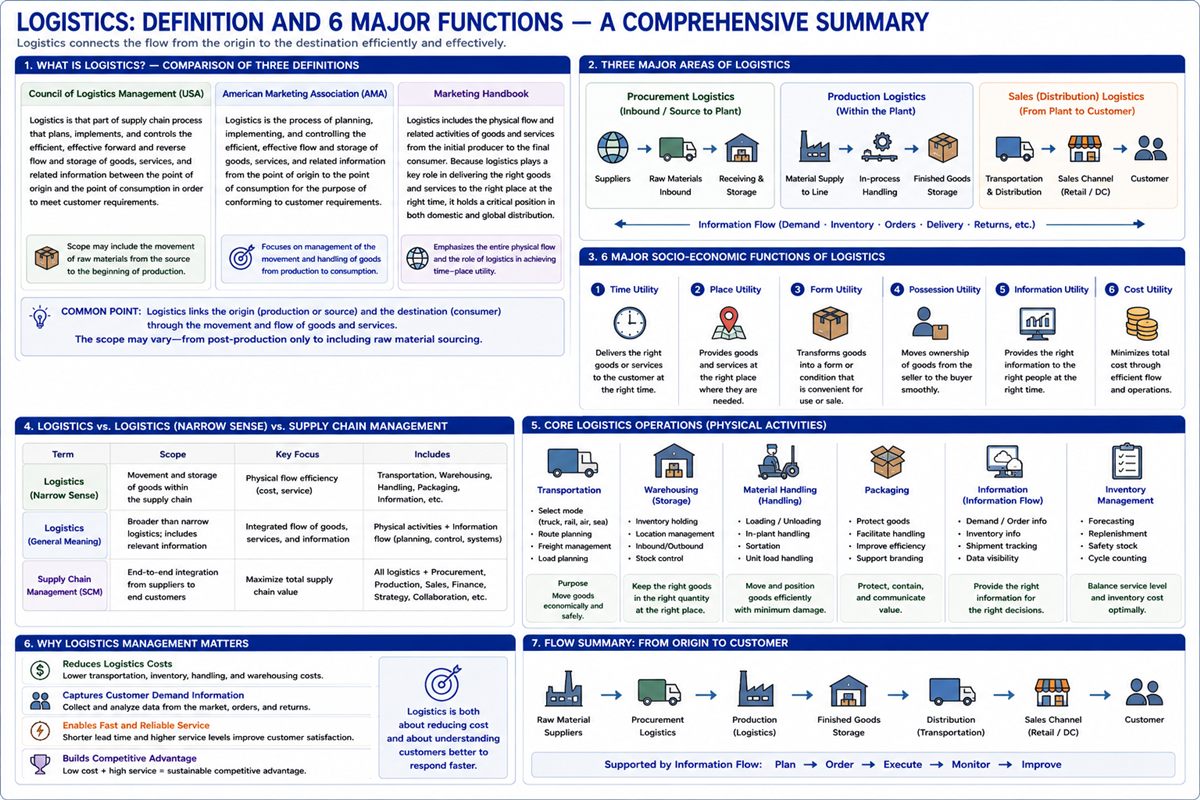
The previous logistics article offered a broad, introductory overview. This one goes much deeper: comparing three formal definitions of logistics side by side, clarifying the four logistics stages (procurement, production, sales, in-house), mapping the six socioeconomic functions, distinguishing physical distribution from logistics, and detailing the transportation, storage, cargo handling, and packaging systems.
Logistics Defined — Three Perspectives
How logistics is defined depends on who is defining it.
The National Council of Physical Distribution Management (USA) defines logistics as a broad range of activities associated with the movement of finished products from the end of the production line to the consumer. Depending on the interpretation, it may extend upstream to include the movement of raw materials from their source to the start of the production line.
The American Marketing Association (AMA) takes a more concise view: managing the movement and handling of goods from the stage of production to the stage of consumption or use.
The Marketing Handbook casts the widest net, defining logistics as all activities related to the physical flow of goods and services from the original producer to the final consumer. It emphasizes that logistics plays a central role in both domestic and international distribution because it is ultimately responsible for delivering goods and services to the right place at the right time.
Placing the three definitions side by side reveals a common core: the "movement and flow" connecting a starting point (production or supply) to an endpoint (the consumer). What differs is scope — some definitions begin after production is complete; others reach back all the way to raw material procurement.
The Concept: A System of Planning, Implementation, and Control
In operational terms, physical distribution (logistics) is:
The process of planning, implementing, and controlling the efficient and effective movement of raw materials, work-in-process, finished goods, and related information from the point of production to the point of consumption — a systems approach to planning, producing, and controlling all materials within an enterprise.
The outcome of this work is the reason logistics management exists. Effective logistics enables a company to obtain materials at the lowest cost, at the time the customer needs them, at the right location — satisfying customers while simultaneously strengthening the firm's competitiveness. The design premise is that cost reduction and customer satisfaction are not in tension: a well-designed logistics system can deliver both.
The Four Logistics Stages
Following the flow of materials through a company reveals four distinct logistics stages.
① Procurement Logistics
The starting point of logistics management. This stage covers how raw materials and components are packaged, unitized, transported, and delivered from the subcontractor's facility to the parent company's materials warehouse — along with the storage and management of those materials once they arrive. Efficiency of materials management is the central focus.
② Production Logistics
From the moment materials leave the warehouse through every handling and transport step within the production process, back to the point where finished or semi-finished goods re-enter storage. The central challenge is compressing this cycle time, which is why automation of transport, handling, and warehouse operations within the plant receives particular emphasis.
③ Sales Logistics
The final stage: all distribution activities involved in delivering products to the customer. This runs from product warehouse dispatch → transport to the intermediate distribution center → value-added processing and product sorting at the distribution center → delivery to dealers and end customers. Everything in this chain falls under sales logistics.
④ In-House Logistics
Covers the movement and packaging of products within the company up to the point of dispatch. In practice this is usually treated as part of production logistics rather than a fully separate category.
Connecting the four stages in sequence: raw materials enter the factory (procurement logistics) → pass through the production process (production logistics, including in-house) → reach the customer (sales logistics). This is the end-to-end flow.
Six Socioeconomic Functions of Logistics
Viewed through the lens of "bridging gaps," logistics performs six distinct socioeconomic roles. Between producer and consumer there are multiple types of "distance," and logistics exists to close each of them.
Gap type
Description
Logistics element needed
Place gap
Production location and consumption location differ. As the economy develops this gap tends to widen, not narrow.
Transportation
Time gap
When goods are produced and when they are consumed do not coincide.
Storage
Quantity gap
The production unit (batch, pallet, truckload) differs from the consumption unit (individual item, small case).
Consolidation, relay, delivery
Quality gap
The quality of what the producer supplies differs from what the consumer expects.
Processing, assembly, packaging
Price gap
Price adjustment is required between producer and consumer.
Full range from transport to information activities
Personal gap
Producer and consumer are separate entities; as specialization advances, the distribution network becomes more complex.
Transport and trade functions
All six gaps are resolved through the combination of logistics' five execution elements: transportation, storage, cargo handling, packaging, and information activities. Their integration is what creates the economic value of logistics.
The Role of the Logistics System
The individual functions of logistics — purchasing, packaging, transportation, cargo handling, storage, and information — each matter on their own. But the more important point is that optimizing any one function in isolation is not enough: a system that integrates and manages all of them together is required. Improving functions independently without ensuring they mesh produces a system that is locally efficient but globally wasteful.
The role of the logistics system, in a single sentence: to perform the function of connecting production and consumption more rationally.
Physical Distribution vs. Logistics: The Difference
The two terms are often used interchangeably, but their scope differs. The concept of "logistics" as a management discipline was formally introduced in 1960 by Professors Brewer and Johnson at the University of Washington in a paper titled "A Scientific Approach to Physical Distribution Management." The word itself has an interesting etymology: derived from the Greek Rho (flow), Chrema (materials or goods), and Ics (science or academic discipline).
Physical Distribution: covers only the process by which the producer (supplier) delivers goods to the consumer
Logistics (materials management + physical distribution management): covers the entire flow from raw material and component suppliers, through production, to the final consumer
Physical distribution begins after production is complete. Logistics begins at the raw material source. The earlier overview article introduced materials management and distribution management as the two pillars of logistics — that combination is precisely what the term "logistics" encompasses in its full sense.
Transportation
Transportation is the activity that bridges the spatial gap between where a product is made and where it is consumed. Two terms are worth distinguishing:
Long-haul transport (수송): moving products from factories or warehouses to the distribution center
Last-mile delivery (배송): moving products from the distribution center to individual dealers or customers
Transport is the large-scale inbound flow to the distribution hub; delivery is the final outbound leg from the hub to the destination.
Choosing a Transport Mode
Transport modes include road (truck), rail, sea, air, and pipeline. The choice involves weighing multiple factors simultaneously: volume, freight cost, weather conditions, safety, availability of intermodal options, weight, speed requirements, total logistics cost, scheduling flexibility, and the nature of the receiving arrangement. No single factor dominates — the decision is always a multi-variable optimization.
Storage and Warehouse Systems
Storage
Storage refers both to the act of holding raw materials, work-in-process, and finished goods, and to the overall warehouse system that enables those goods to be dispatched immediately when needed. In an era of high-mix/low-volume production and high-frequency/small-lot delivery, storage has evolved from passive stockpiling into an active system for responding rapidly to customer demand.
Warehouse Functions
A warehouse's primary purpose is storage, but its actual functions are considerably broader:
Storage
Supply-demand balancing
Price stabilization
Connecting logistics functions (hub role)
Trade facilitation
Credit support (goods as collateral)
Sales advance base (forward-positioned stock for rapid fulfillment)
Warehouse types vary by use: general merchandise, bulk cargo, cold storage, household goods, and miscellaneous goods warehouses, among others.
Warehouse Automation
Combining storage management — the intermediate step between materials procurement, production, and sales — with CIM (Computer Integrated Manufacturing) and automated control technology produces what is called an intelligent warehouse (cybernetized warehouse). Integrated with computer-based management systems such as MRP and POS, this extends into factory automation that unites production management with physical production. The CIM and MRP concepts introduced in the production planning articles reappear here in the specific form of warehouse automation.
Cargo Handling and Packaging Systems
Cargo Handling
Cargo handling covers the loading, unloading, and short-distance movement of goods that support transportation and storage activities. The principles for rationalizing cargo handling are:
Economy in handling and transport
Minimize travel distance and time
Maximize the activity index (how readily an item can be moved to the next operation)
Unitization (consolidating individual items into standard load units)
Mechanization
Use of gravity
Systematization
Information integration
The gravity-feed and drop-delivery principles from the motion economy article in the IE series apply here at warehouse and cargo-handling scale — the same logic, expanded in scope.
Packaging
Packaging is the technology and the resulting state of using appropriate materials or containers to protect and preserve the value and condition of goods throughout the distribution process.
Packaging levels:
Unit packaging (consumer unit): packaging at the level of the individual product
Inner packaging: intermediate grouping of individually packaged items
Outer packaging (shipping): final external packaging for transport and storage
Packaging serves three functions: protecting contents, facilitating handling, and promoting sales.
Design considerations: protective performance, handling compatibility, workability, user convenience, labeling clarity, transport suitability, and cost-efficiency. Every packaging decision is a simultaneous constraint satisfaction problem across all seven dimensions.
The Principles: 7R and 3S1L (Revisited)
The two frameworks introduced in the previous article reappear here as the common evaluation criteria across all logistics subsystems:
7R Principle: Right Product, Right Quality, Right Quantity, Right Time, Right Place, Right Impression, Right Price
3S1L Principle: Speedy, Surely, Safely, at Low cost
These two principles apply as the decision standard across every logistics subsystem — transportation, storage, cargo handling, and packaging alike.
Framed as "bridging six types of gaps between production and consumption," logistics becomes considerably clearer. The bridging happens through a sequential flow — procurement, production, and sales logistics — in which five execution elements (transportation, storage, cargo handling, packaging, and information activities) work together organically. If the earlier overview answered "what logistics does," this article addresses "why logistics does it that way."
댓글Comments