이 모든 것이 앞으로 CALS 체제 아래 통합될 것으로 전망되었습니다. CALS는 업무 통합, 데이터 통합, 물리적 통합을 지향하는 구현 도구이며, MRP/ERP는 기업의 경쟁력 제고를 위한 가장 바람직한 대안으로 자리매김하게 됩니다.
시리즈를 마치며
지금까지 4편에 걸쳐 기업전략 → 생산전략 → 생산형태의 분류 → ERP 발전사를 순서대로 살펴봤습니다. 이 흐름을 관통하는 하나의 맥락이 있습니다. 회사 전체의 전략(무엇을 할 것인가)이 생산 현장의 전략(어떻게 경쟁우위를 만들 것인가)으로 이어지고, 이를 실제 현장에 맞는 생산방식(어떤 형태로 만들 것인가)으로 구체화하며, 마지막으로 이 모든 것을 정보시스템(어떻게 관리할 것인가)으로 뒷받침한다는 것입니다.
생산관리를 공부하거나 실무에 적용할 때, 지금 마주한 문제가 이 네 층위 중 어디에 해당하는지 짚어보는 것만으로도 접근 방법이 훨씬 명확해질 수 있습니다.
This is the final article in the series. Having covered corporate strategy, production strategy, and the classification of production types, this article turns to how the information systems that actually manage all of it evolved. ERP is taken for granted today — here we trace the path it took to become what it is now.
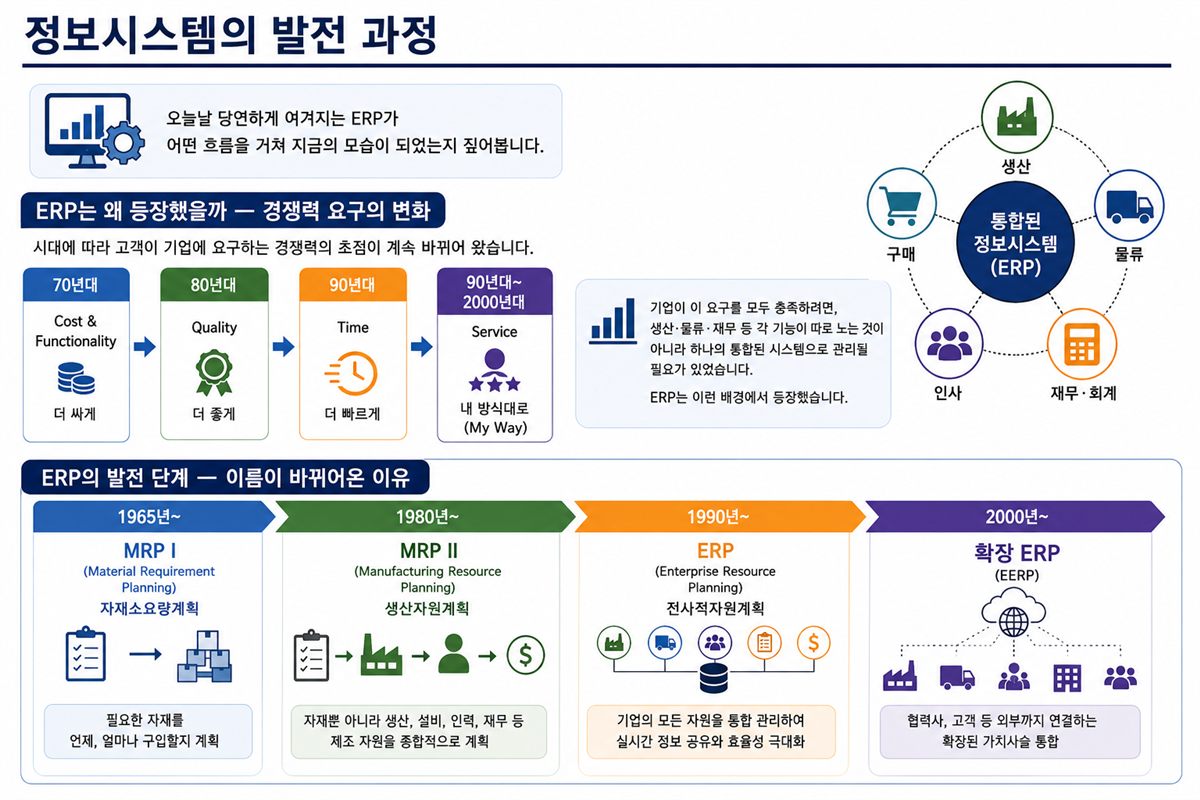
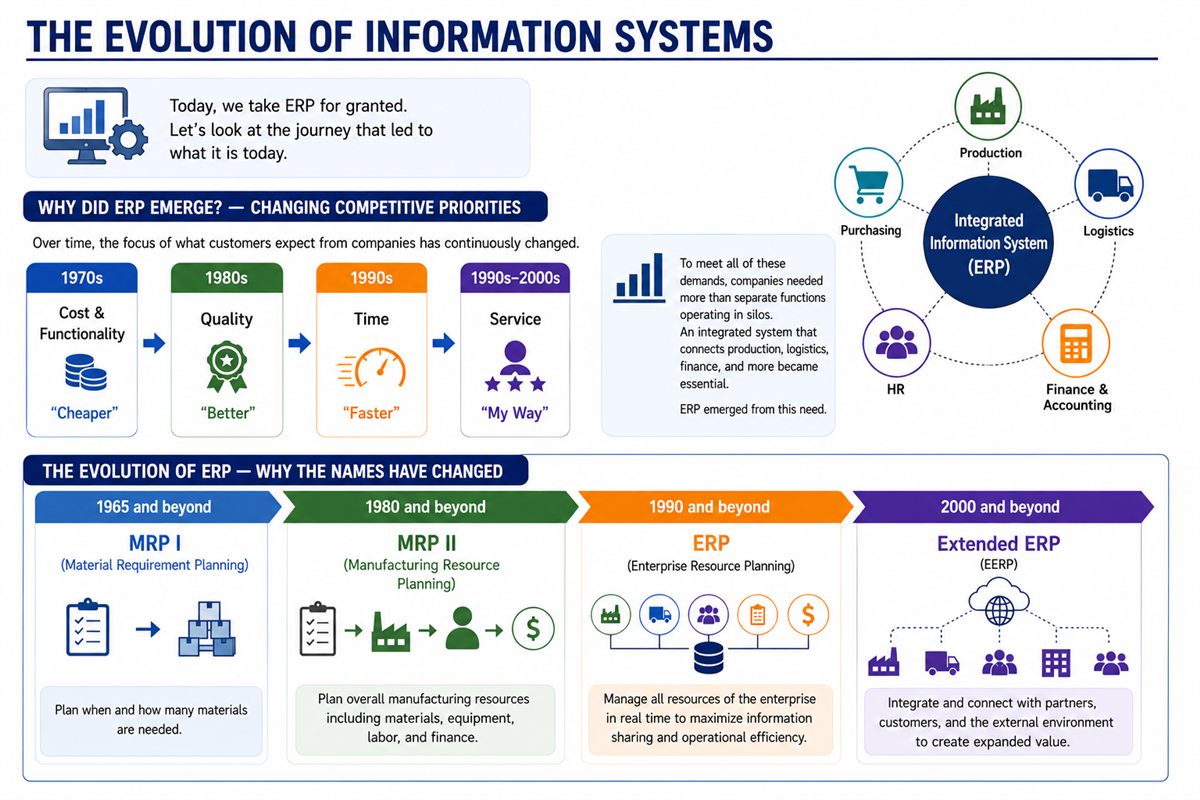
Over the decades, the focus of what customers demanded from companies kept shifting.
1970s: Cost & Functionality — "cheaper"
1980s: Quality — "better"
1990s: Time — "faster"
1990s–2000s: Service — "my way"
To satisfy all of these demands at once, functions such as production, logistics, and finance could no longer operate in silos — they had to be managed as a single integrated system. ERP emerged against this backdrop.
The stages of ERP — why the name kept changing
Laid out chronologically, the evolution of the information system runs as follows.
From 1965: MRP I (Material Requirement Planning)
From 1980: MRP II (Manufacturing Resource Planning)
From 1990: ERP (Enterprise Resource Planning)
From 2000: Extended ERP (EERP)
Alongside this main thread, related concepts developed in parallel — CRP (Capacity Requirement Planning), SCM (Supply Chain Management), CRM (Customer Relationship Management), APS (Advanced Planning & Scheduling), and SEM (Strategic Enterprise Management).
What changed in each era
Era
Stage
Focus
Core content
1970s
MRP
Material management
Bill-of-materials-based requirement calculation, inventory views, manufacturing schedules and procurement plans
1980s
MRP II
Production management
Adds outsourced and in-house capacity, links capacity planning with master production scheduling, ties in manufacturing, equipment purchasing, and sales plans
1990s
ERP
Enterprise-wide resource management
Integrates sales, purchasing, production, and general administration (MRP II + management information systems) across the whole enterprise
2000s
Extended ERP
Extended total supply-chain management
Handles external supply chains in real time (ERP + CALS/EC), extends to strategic alliances between producers and suppliers
1970s: MRP — the start of material management
Calculates material requirements from the part list
Manages inventory information (the inventory view)
Produces concrete manufacturing schedules and procurement plans
1980s: MRP II — factoring in production capacity
Considers both outsourced and in-house production capacity
Links capacity requirement planning with master production scheduling
Extends to manufacturing plans, equipment-purchasing plans, and sales plans
1990s: ERP — enterprise-wide integration
Integrated management of sales, purchasing, production, and general administration (MRP II + management information systems)
Covers the full range of enterprise business activity
2000s: Extended ERP — connecting company to company
Handles not only internal supply but external supply chains in real time (ERP + CALS/EC)
Extends to strategic alliances between producers and suppliers, and between company and company
In a single sentence: a system that once "managed the materials inside my own factory" broadened into one that "manages my whole company," and then into one that "manages my company and all of its trading partners together" — a steady expansion of scope.
The real-world pitfalls of MRP/ERP adoption
For ERP to run successfully, several conditions must be met: the existence and accuracy of data, system response time, ease of use, and flexibility. On the shop floor, however, the following problems frequently get in the way.
Weak production management practices: introducing the system when Production Packets, standard production times, and standard processes are not properly established
Irrational business practices: neglecting the business process reengineering (BPR) that should redesign the processes themselves to fit the system
Legal / institutional issues: practices that clash with system logic, such as off-the-books data and tax conventions
ERP software itself spans a vast footprint.
Production: master production scheduling, capacity planning, material supply-and-demand planning, production data management, quality management
The concepts then expected to shape the optimal manufacturing system were:
CIM, CALS, product data management (PDM)
Finite Capacity Scheduling (FCS)
Manufacturing Execution System (MES)
Cell Control System (CCS)
Continuous shop-floor improvement methods such as TQM, VE, IE, JIT, ZD, and 5S
All of these were expected to be integrated under the CALS framework. CALS is an implementation tool aimed at business integration, data integration, and physical integration — and MRP/ERP came to be positioned as the most desirable option for strengthening a company's competitiveness.
Closing the series
Across four articles we have worked through corporate strategy → production strategy → the classification of production types → the history of ERP, in order. One thread runs through the whole sequence: the company-wide strategy (what to do) leads into the shop-floor strategy (how to build competitive advantage), which is made concrete in a production method suited to the actual site (what form to build it in), and finally underpinned by an information system (how to manage it all).
Whether you are studying production management or applying it in practice, simply asking which of these four layers your current problem belongs to can make the right approach far clearer.
댓글Comments